Last Thursday I headed to Newcastle for ALL Connected, the title of this year’s Language World conference taking place on 20-21st March at Newcastle University. I look forward to LW each year as it’s a conference that offers lots of ideas but also lots to challenge my “little grey cells” and make me think.
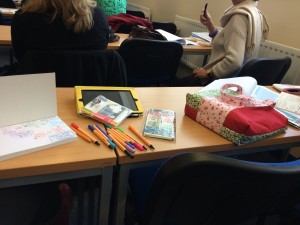
This year I decided to replace my normal note taking with Sketchnoting as started at #ililc5. I’d tried using Paper app on my iPad there and found it quite tricky to use to the extent that it was distracting me from the session content. I’ll persevere and practice further but for Language World I choose a different tool – the notebook and pen! Actually, notebook, pens and pencils! I’m a strong believer in choosing the correct tool for the job, be that an iPad, a pencil and pen or a slate and chalk, and this combination allowed me to write more easily, select colour at will and, most importantly, focus on what was being said rather than worrying about zooming in and out or accidentally drawing whilst trying to make the toolbar reappear!
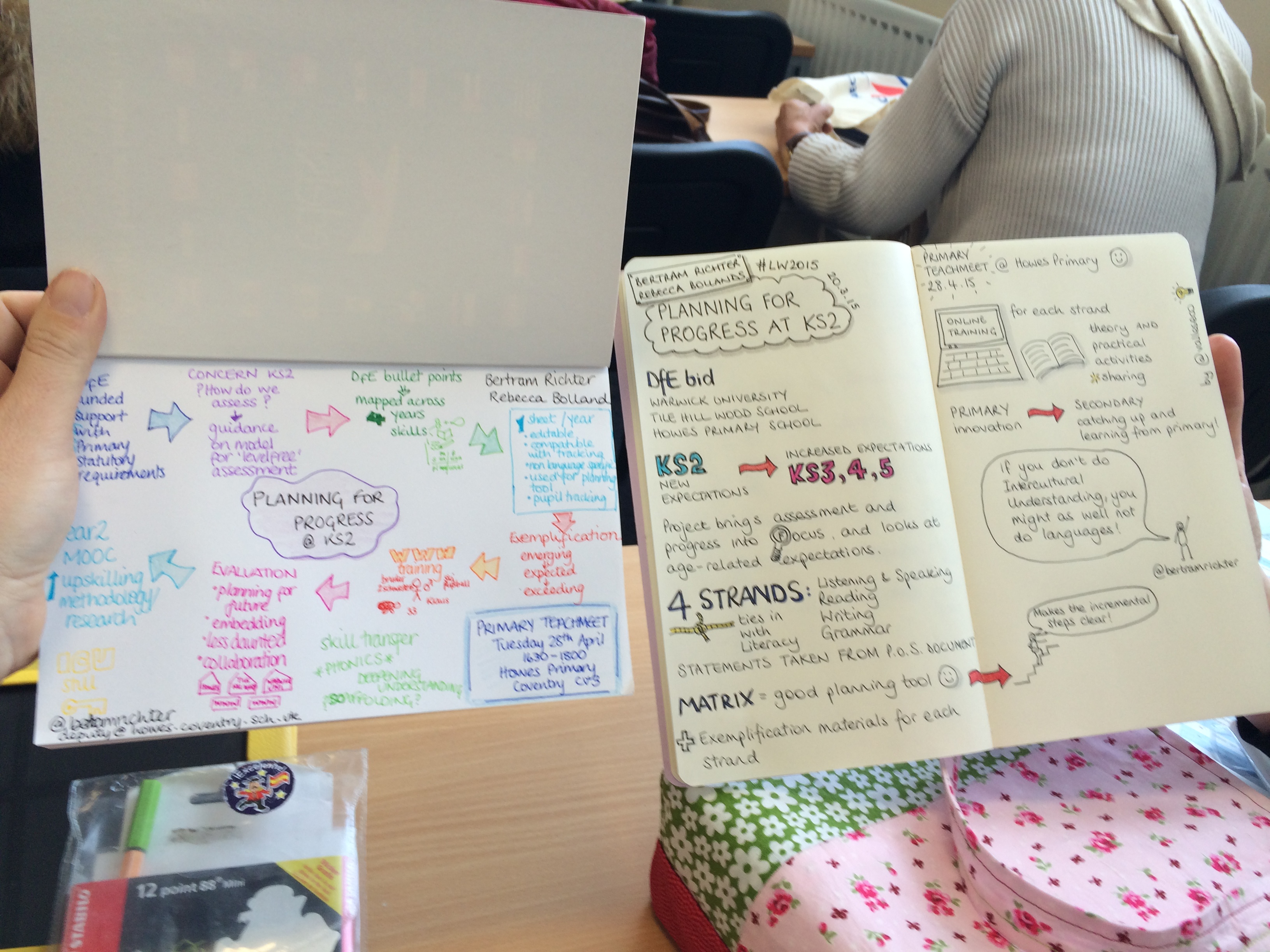
Below are my sketch notes created over the two days. I did them all ‘live’ – no retouching afterwards apart from one on which I’d made a mistake with someone’s name and felt I really should correct it as she’d won an award and deserved it!
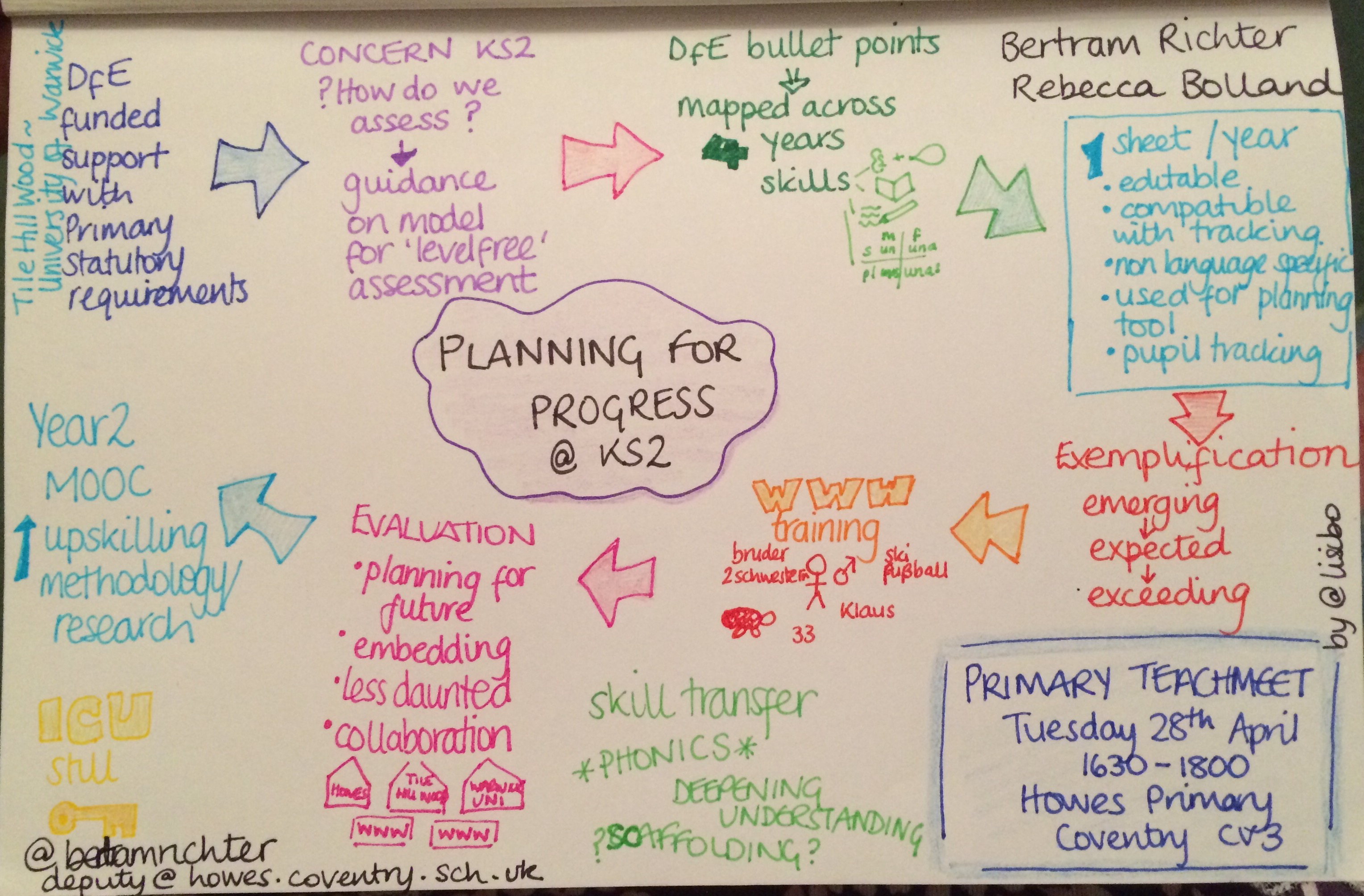
Bertram Richter and Rebecca Bolland – Planning for Progress @KS2
Vicky Cooke – Teaching reading in KS2: leading learners towards independence
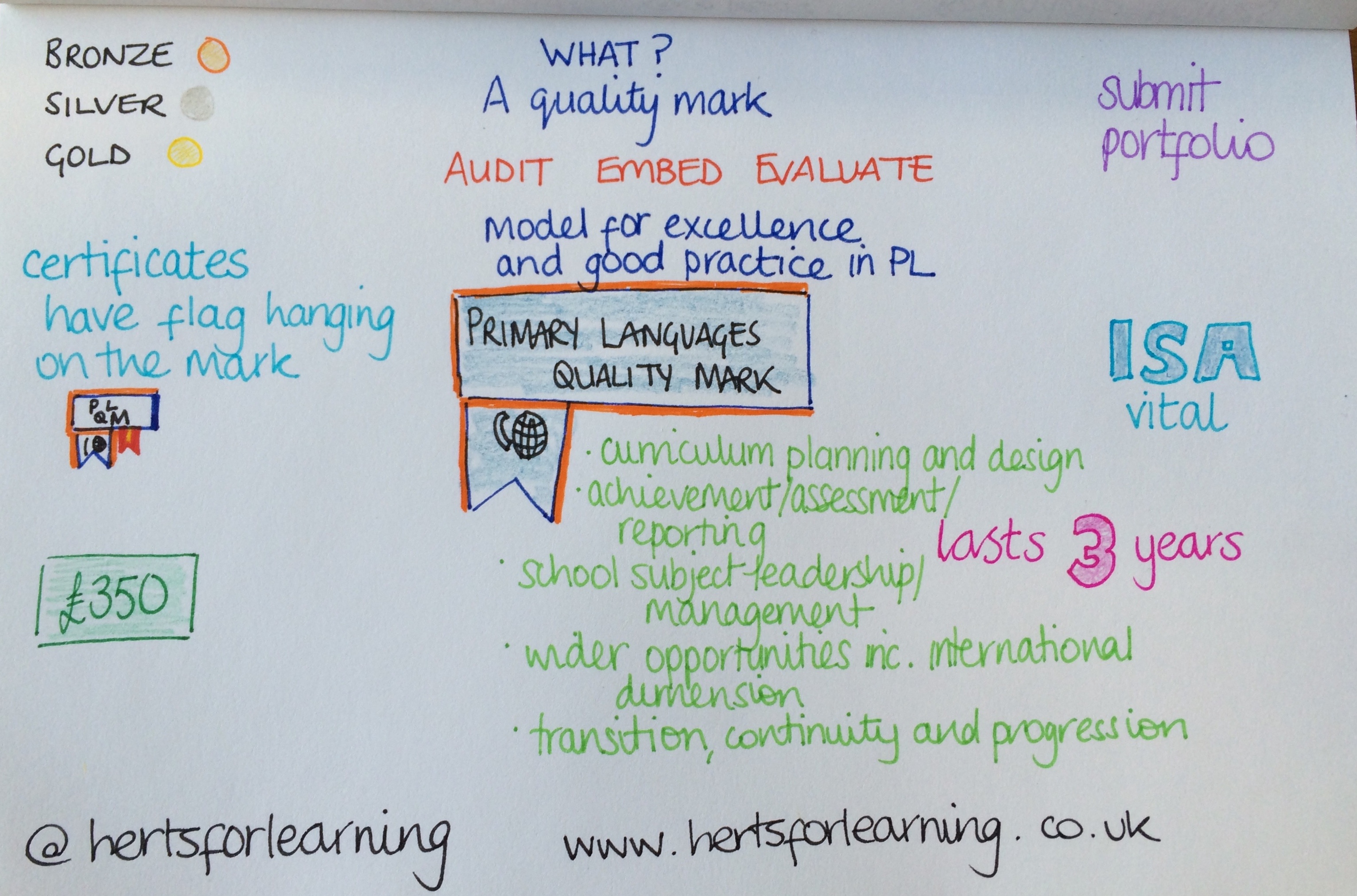
Jackie Rayment – Primary Languages Quality Mark
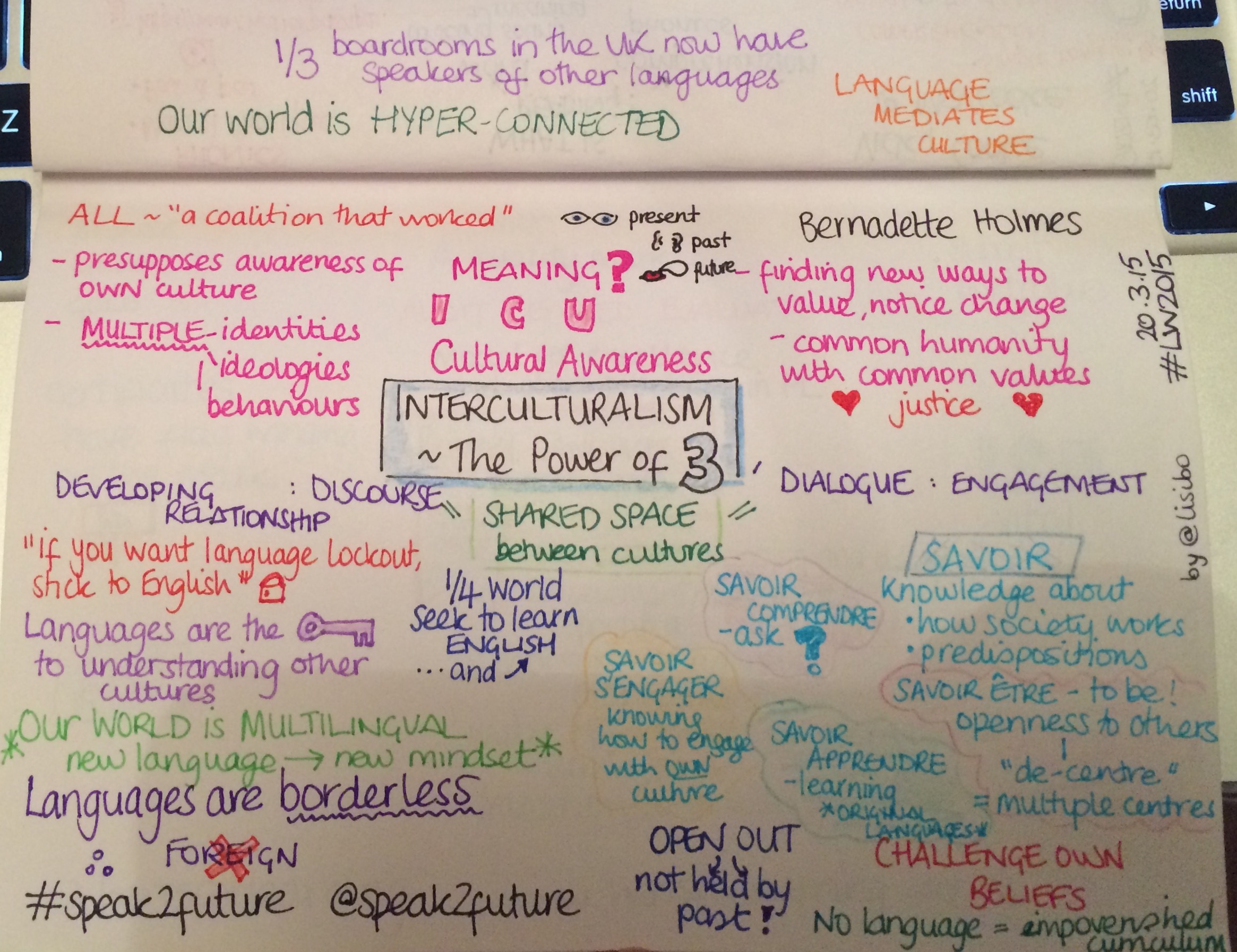
Bernadette Holmes – Interculturalism: The Power of 3
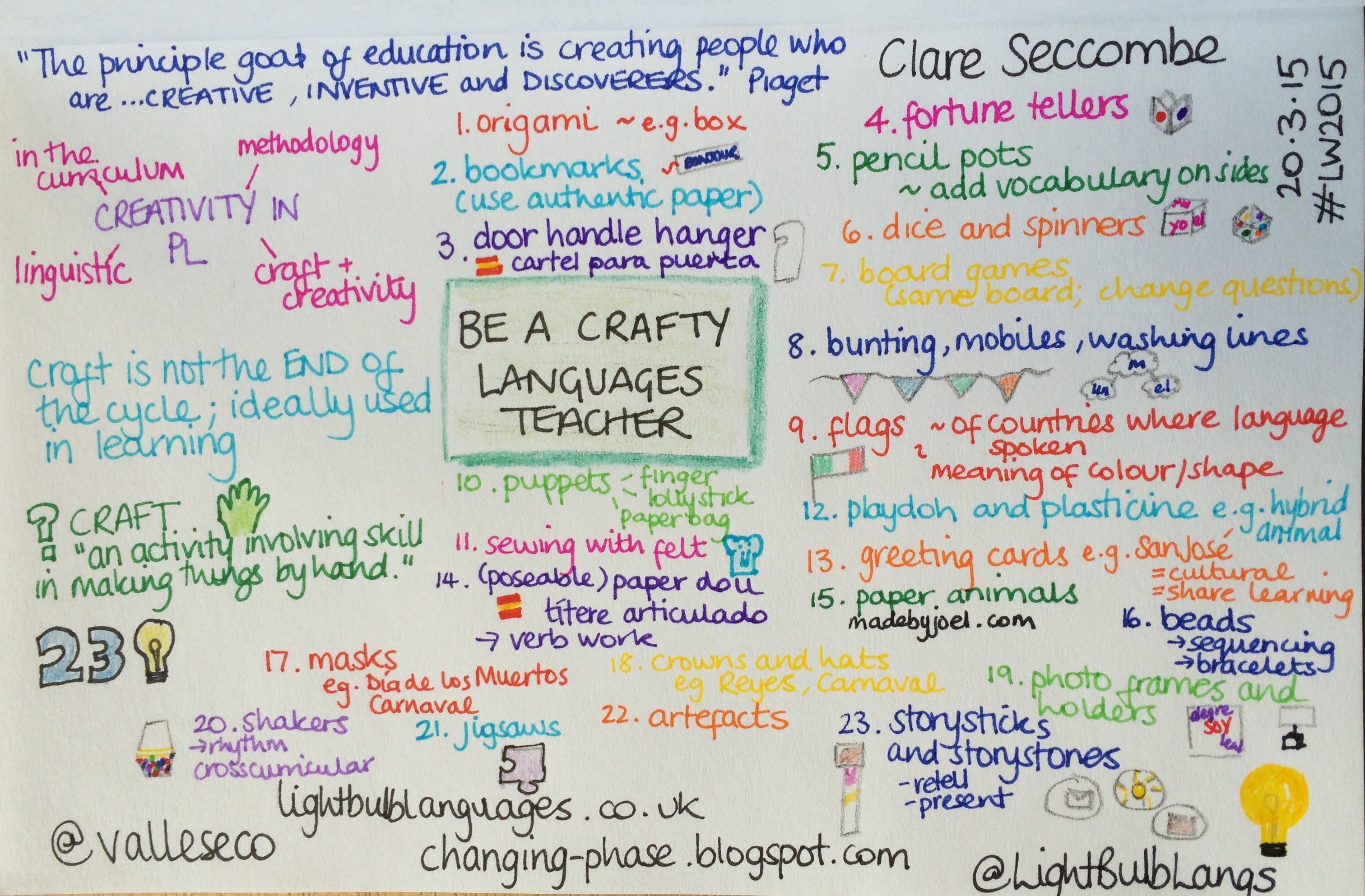
Clare Seccombe – Be a crafty languages teacher
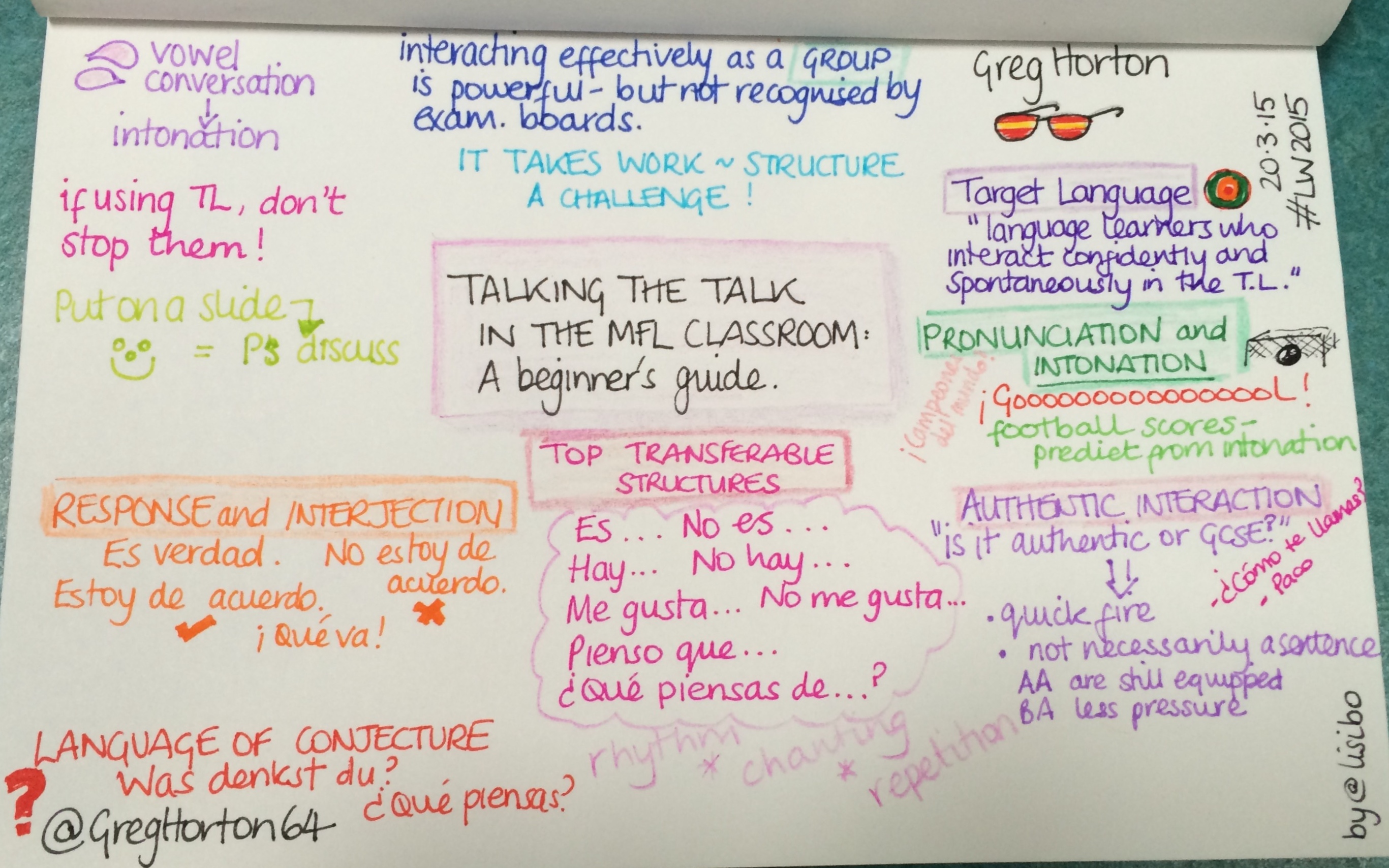
Greg Horton – Talking the talk in the MFL Classroom
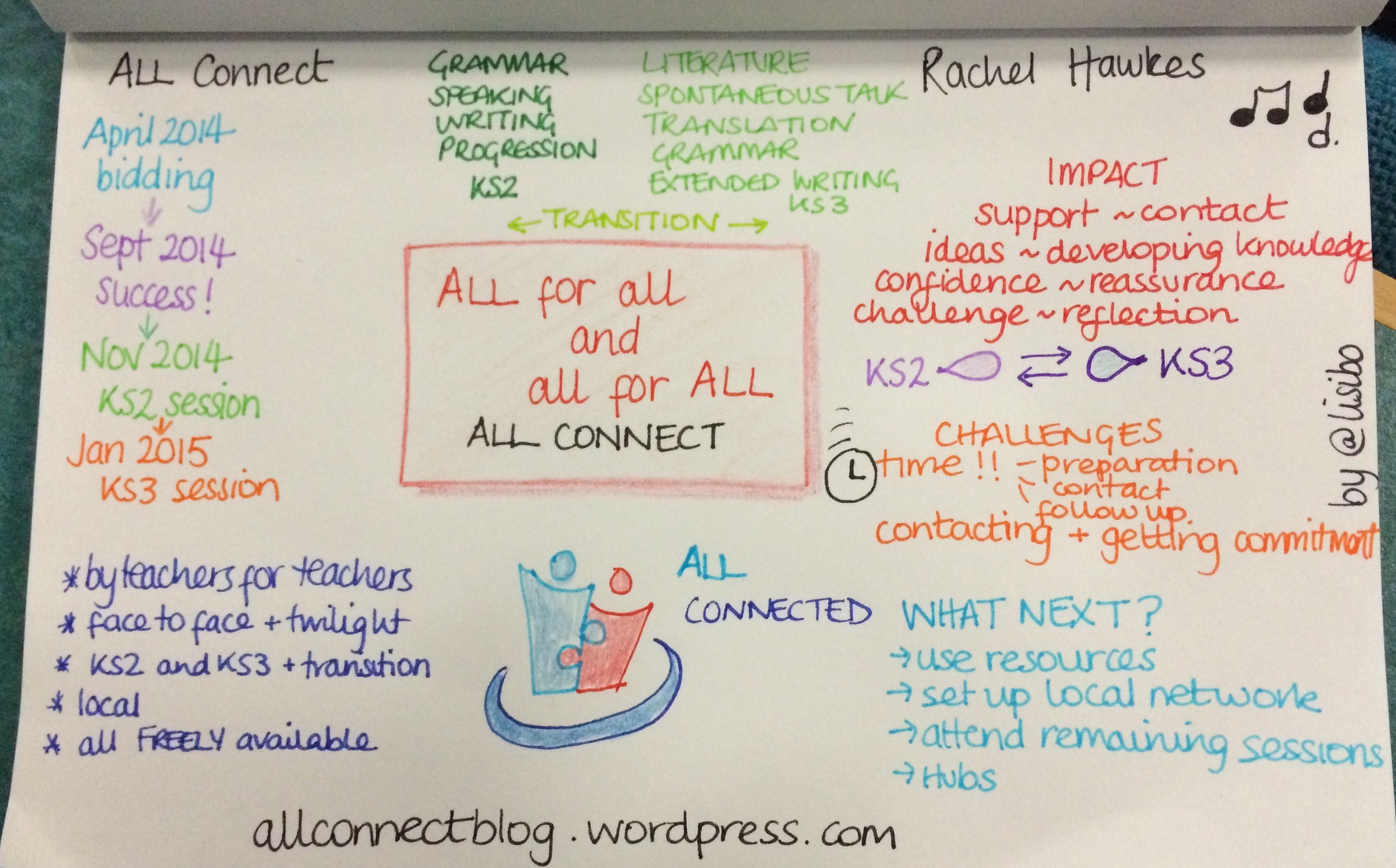
Rachel Hawkes – ALL for all and all for ALL: ALL CONNECT
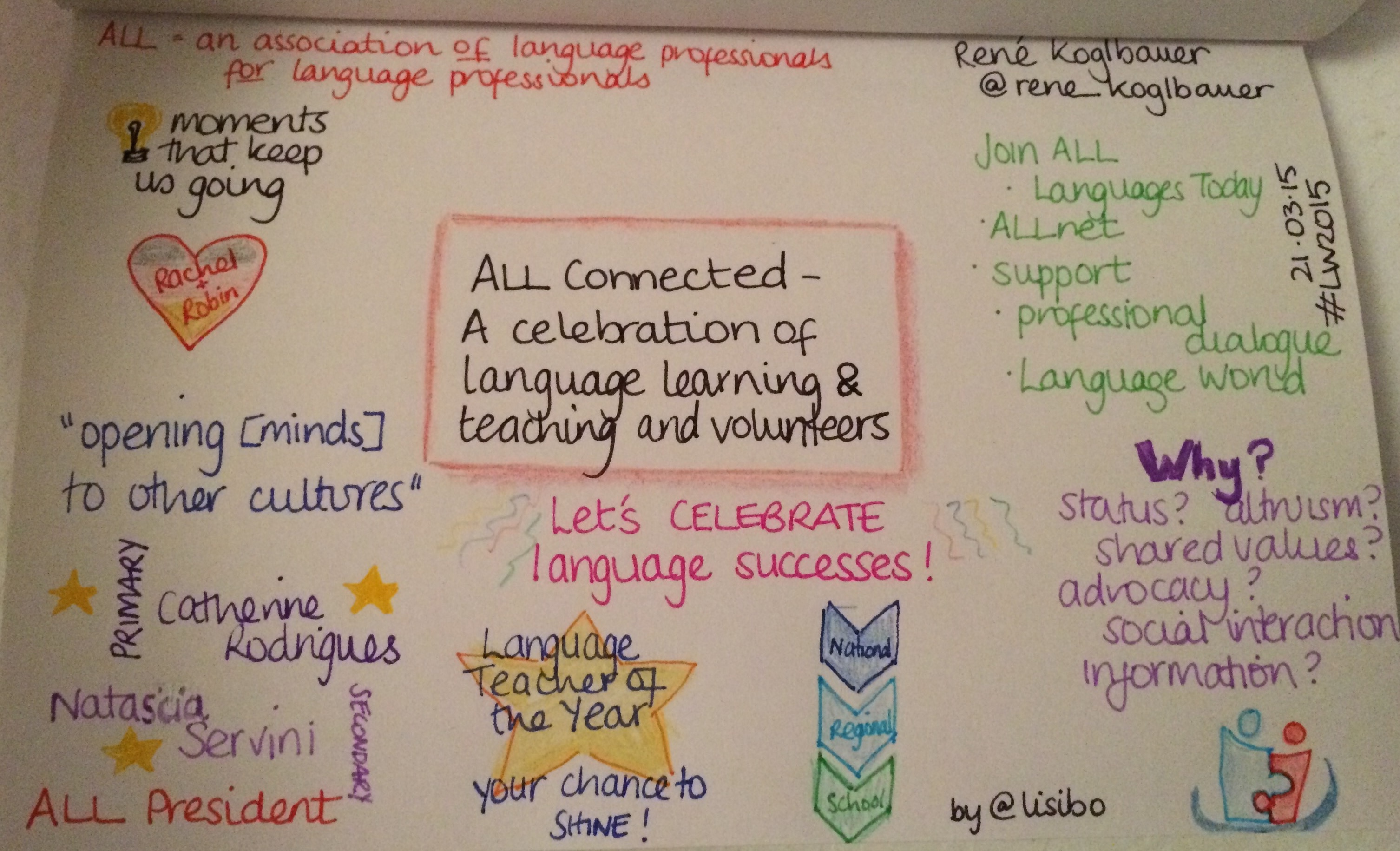
René Koglbauer – ALL Connected: a celebration of language learning & teaching and volunteers.
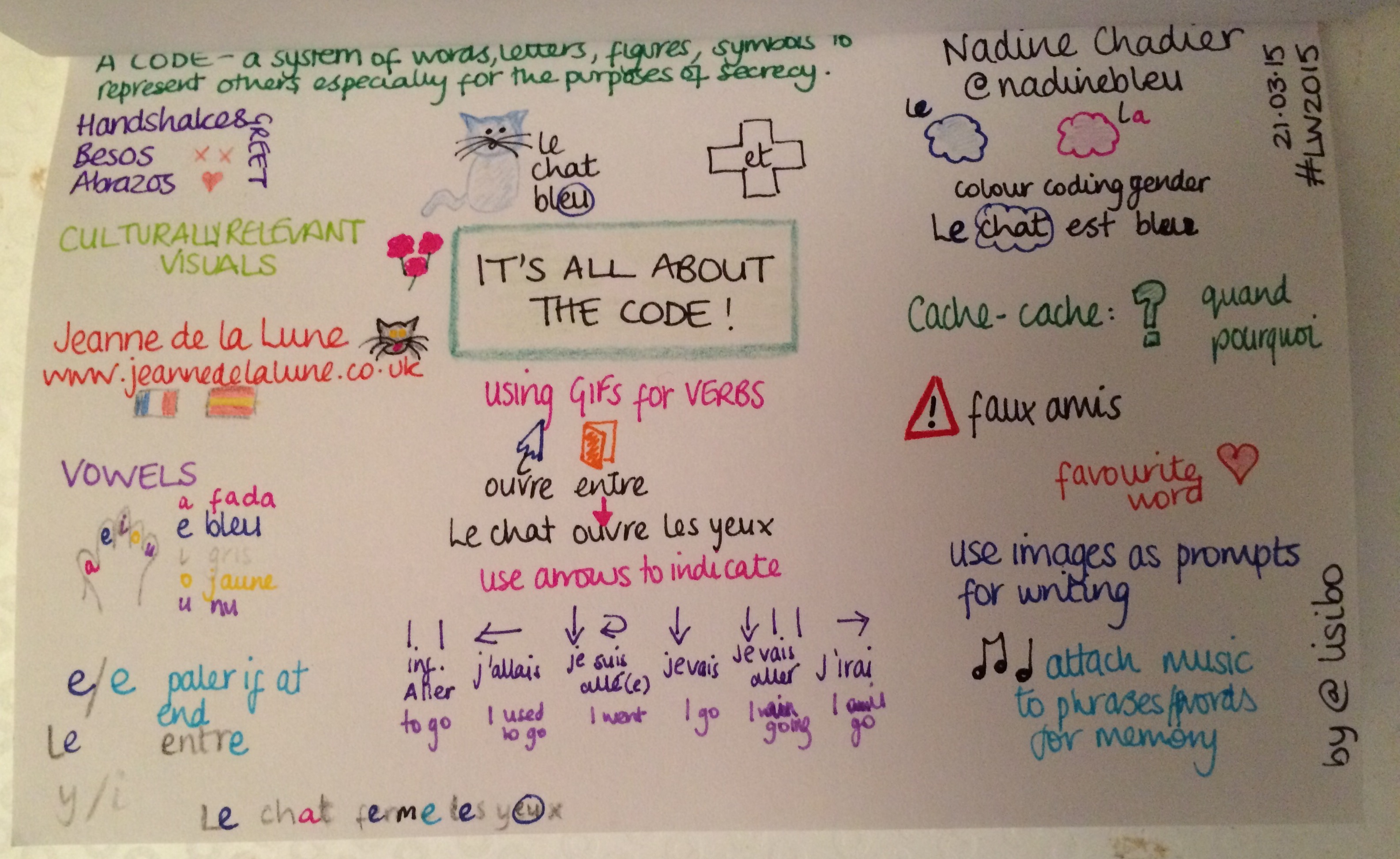
Nadine Chadier – It’s all about the code
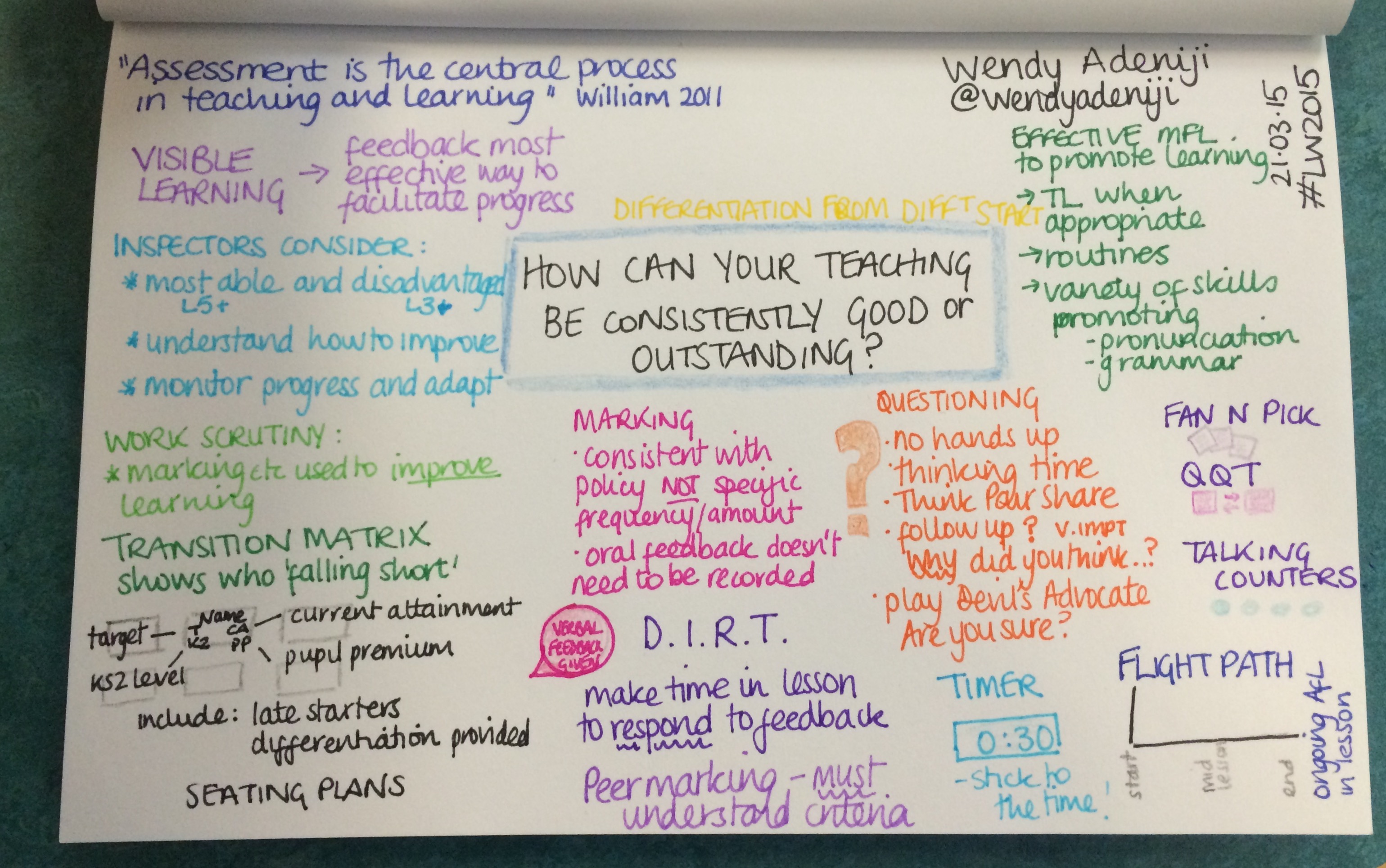
Wendy Adeniji – How can your teaching be consistently good or outstanding?
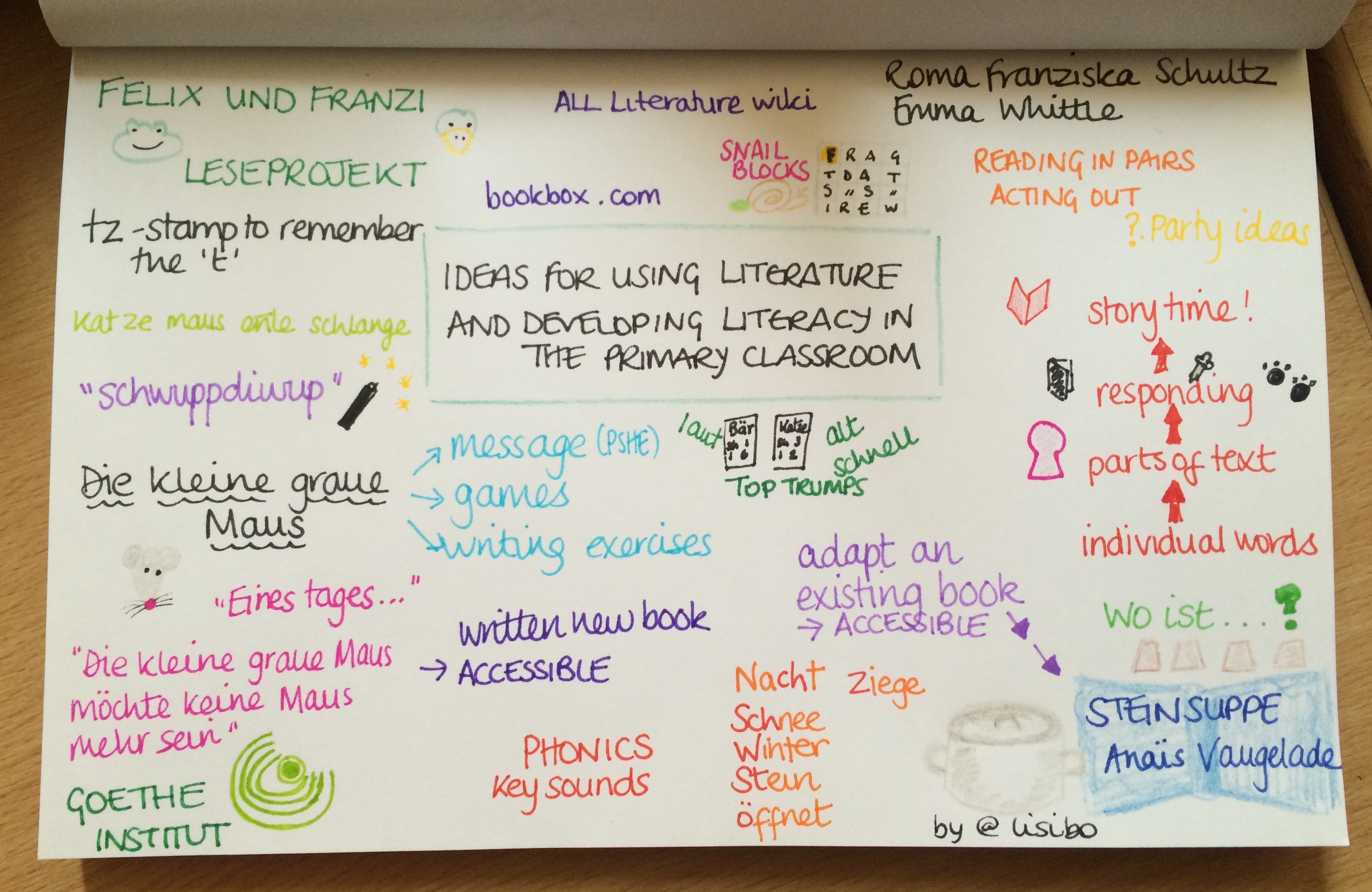
Roma Franziska Schultz and Emma Whittle – Ideas for using literature and developing literacy in the Primary Classroom
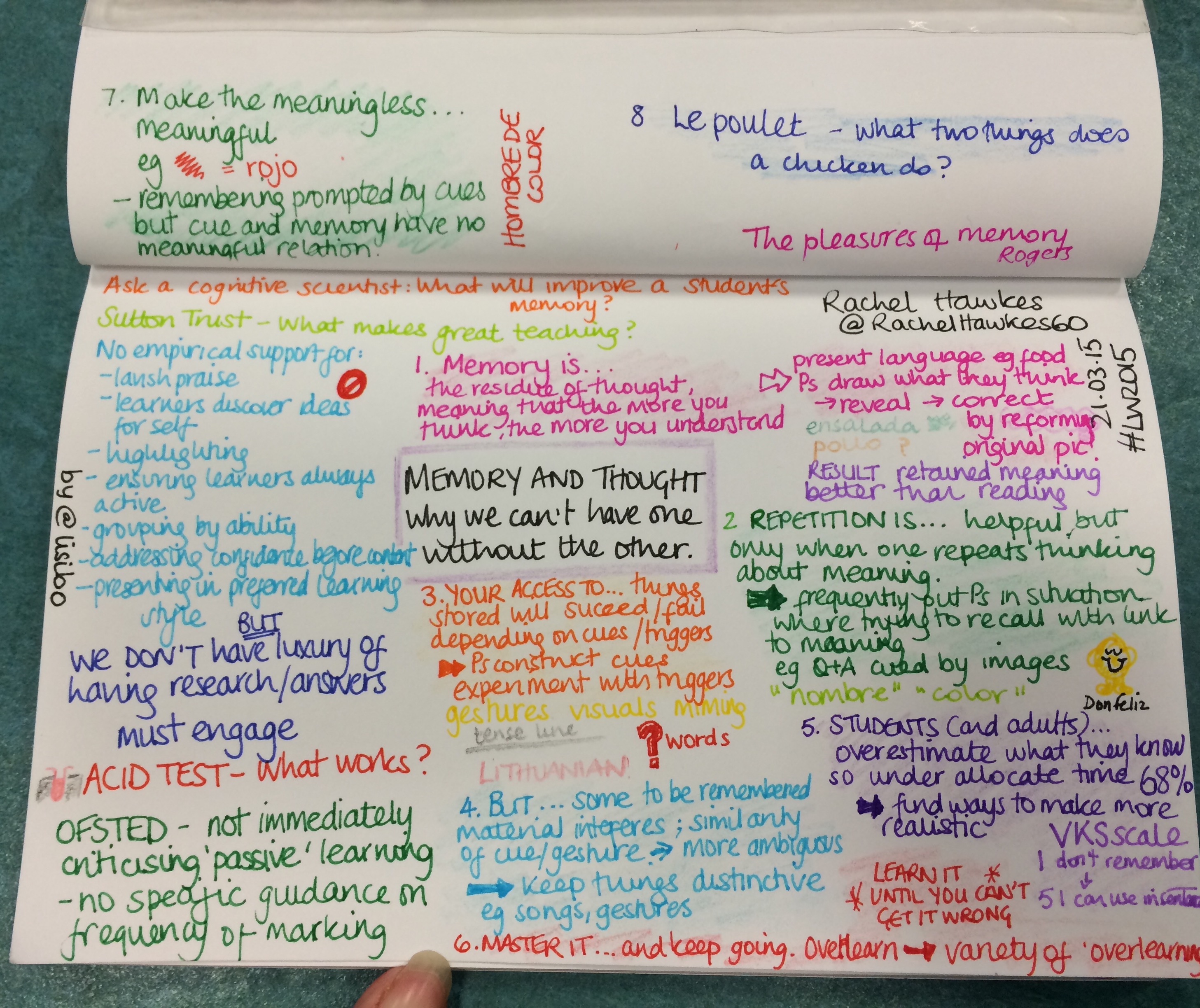
Rachel Hawkes – Memory and thought: why we can’t have one without the other.
Steven Fawkes – Now we are 25
Looking back on them, it’s amazing how much more I can recall about the sessions than I would following my more traditional note taking; my page was smaller than A5 so I had to carefully consider each word/phrase I wrote or picture I drew. I successfully kept to one page per session (45-50minutes) apart from two sessions where there was just too much to fit onto one page.
I’m still learning and developing my own style and I certainly need to work on my drawings (there’s a tortoise on one that looks like a sheep!) but I’m pleased with the way it’s going. I intend to keep working on it, and I’ll persevere with my iPad but I’ll save that for times when there’s no ‘time pressure.’
If you want to see someone else’s take on many of the same sessions as sketch notes, have a look at Clare Seccombe’s post that includes hers. And you can see many of the actual presentations by clicking on Friday programme or Saturday programme.
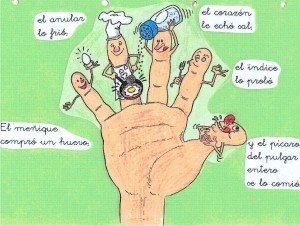
Ever since #ililc5 when Janet Lloyd introduced us to this French song for gaining attention and restoring quiet in the classroom, I’ve been searching for a Spanish equivalent. So far I’ve not found one but it got me thinking about using songs and rhymes to create calm.
I have to admit that I tend to use them to either create excitement and action – see posts about La Vaca Lola and Choco Choco la la, two of my favourite songs, or to teach vocabulary – for example, see these posts on Yo quiero ser by Nubeluz or La finca del Tío Ramón and Hojas Hojas that I subtitled using Amara. However, I began to use this song to start all my lessons in KS1 at the start of the year and noted that as well as signalling the start of the Spanish lesson, it focused us all and calmed everyone down.
Part of the appeal is the routine, but I also think that the actions help. And as I was searching, lots of the songs and rhymes I found were either about or used your hands so I thought that warranted a post!
SONGS
I came across some lovely songs that I think would certainly work for restoring calm, focusing attention and creating a ‘brain break’ during class:
1. El pourri de las manos
I love this collection of songs which could be used separately or as a whole! Each is only about 40 seconds long and all can be sung/acted on the carpet as well as in seats. Some helpful (opposites) vocabulary too – content/triste, arriba/abajo, abre/cierra, allí/allá.
I also like the way that it starts very calm and then gets a little more animated but not too much!
This is one of the songs included in the above video – I think the ‘band’ will be very popular, and it’s still very chilled with the saxophone and calm actions!
Saco una manito. La hago bailar, / I take out one hand. I make it dance. La cierro, la abro y la vuelvo a guardar. / I close it, I open it, and I put it away again. Saco la otra manito. La hago bailar, / I take out the other hand. I make it dance. La cierro, la abro y la vuelvo a guardar. / I close it, I open it, and I put it away again. Saco las dos manitos. Las hago bailar, / I take out two hands. I make them dance. Las cierro, las abro y las vuelvo a guardar. / I close them, I open them, and I put them away again.
3. Dedos
A very very simple song in which you touch each finger together one after the other then all together.
Palmas con un dedo, palmas con el otro, doy con el más largo, luego con el otro,
viene el más pequeño…
¡Y luego con todos!
Éste dedo es la mama,éste otro es el papa,el más grande es el hermanocon la niña de la mano,
el chiquito va detrás.
Todos salen a pasear
4. El zapatero
This song about a shoemaker is the Spanish equivalent of Wind the bobbin up with arm rolling forward and back, pull, pull and then ‘pan pan pan’ as you gently hammer the shoe.
Envolviendo, desenvolviendo,
estira, estira y pan – pan – pan
envolviendo, desenvolviendo,
estira, estira y pan – pan – pan
zapatero a remendar los zapatos sin parar
5. Arramsamsam
I’ve seen this rhyme before but had forgotten about it. A nonsense rhyme, but with hand actions that require some concentration.
Continuing on the original thought of bringing the class together, this might work as I’ve yet to find a class that don’t want to wiggle their bottoms given half a chance!
Mis manos hacen clap clap clap
Mis pies hacen stamp stamp stamp
Mi boca hace la la la
Cintura hace cha cha cha
Other rhymes using your hands include Los dedos de las manos and there are several more here including Dedo pulgar (the Spanish version of Tommy Thumb) and Cinco ratoncitos in which one less finger or ‘ratoncitos’ comes out each time to play! And the ever helpful Spanish Playground has some other suggestions too.
I was going to talk about clapping rhymes but I think I’ll save that for another post as they aren’t really very calming 😉
I’ll try some of these out in class and let you know what happens.
PS Over the last two weeks Y2 and I have been exploring world dance and this week we did some ‘flamenco’ arm work. There was utter concentration so perhaps that’s another avenue to explore!
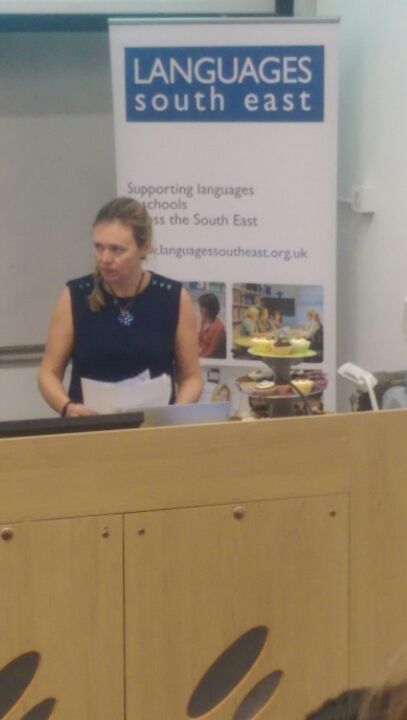
I was rather gobsmacked when Zena asked me to do the closing keynote at #ililc5. An offer I couldn’t refuse but daunting nonetheless. Especially as there was no ‘theme’ this year so I could talk about ‘anything’ according to my instructions!
As Christmas came and passed and I still hadn’t really been inspired, I grew more concerned. It wasn’t until mid January that a seed of an idea formed in my head. I’d been prepared to talk about Cupcakes and Smiles at TeachMeet BETT, a short presentation on education being about ‘feeding’ minds but also celebrating and rewarding learning, and that we did it for those ‘smiles’ that happen when the lightbulb goes on, when the unexpected happens, when you’re speechless at something a child has said and so on. There was no time for my presentation then – although I still shared my cakes. I was a bit annoyed as lugging a few dozen cupcakes from Birmingham and around London on the train and Tube is no fun and nor is being told off for daring to ice them in the presence of Sir Ken Robinson but that’s the way it works. Still, I liked the idea of cupcakes and when there were queries as to why I made cupcakes for TeachMeetBETT but not ILILC, the idea began to germinate.
Over the next few weeks I still wasn’t entirely sure what I’d say but a thought here and there occurred to me. Stupidly I didn’t write them down and I’m sure some ‘got away’. However, with help from my husband John (who must be fed up of my food/language analogies!) who told me to get a grip (and a notepad), Cooking on gas (other fuels are available) grew.
Ready to start?
On the day, armed with new shoes and an assortment of cupcakes, I shared my thoughts about language teaching and learning with the remnant that had managed to survive to the (not so bitter) end. And it was recorded! (I’d forgotten about that part until I was standing there.) You can watch it here.
As my presentation was in Keynote and delivered from my own MBP, the slides don’t show up in the recording but are all synced and appear alongside (thank you to the lovely Matt for doing that!) I’ve added the videos that you can’t see but can hear at the bottom of this post; I know that the Intermarché one about Les fruits et légumes moches has already proved helpful to more than one person!
I summarised some of the main messages right at the end (go to 45 minutes) if you don’t have time for the whole thing, and I’ve also added a Storify of the tweeting that was going on during the presentation; I certainly found it interesting to see what people had taken from my words and thoughts. And I was gobsmacked by the sketch notes too. Thank you Clare, Simone, Jane, Rachel and Catrin, and Alex, Jonathan and Ceri who had a cupcake in their ILILC5 summary sketch notes too. (If I’ve missed any, apologies and please tell me; I’ve been in a bit of stupor all week!)
It’s very different when you’re sharing your personal thoughts, reflections and passions; it made me feel very vulnerable so I’m really glad that people picked up on and identified with the key messages I wanted to share.
Start at 1.10 until 1.30 for the key bit:
PS At 23 minutes, I start talking about my language hero, and whilst I think I communicated that she was special, I didn’t share all that I might have done as time was pressing and I was getting choked up. So in my next post, I’ll tell you all about Luz Sánchez-Richardson, my language hero!
Here is the presentation and notes for my introduction to Twitter session at #ililc5.
I’d delivered a similar presentation before at the National eTwinning Conference in July but since then, new possibilities have arisen and these have been added. For example, you can now send video directly from the Twitter app (record it and send) rather than going via another app, and there is also the possibility of group DMs. Additionally, I’ve added a page of links to other useful material as well as making the ideas more language centred.
I hope those that attended found it useful – I know at least one started tweeting so that’s success in my book!
The picture I shared is on that post (in two parts) and below I’ve uploaded it as one image. I’ve also shared another couple that don’t have questions.
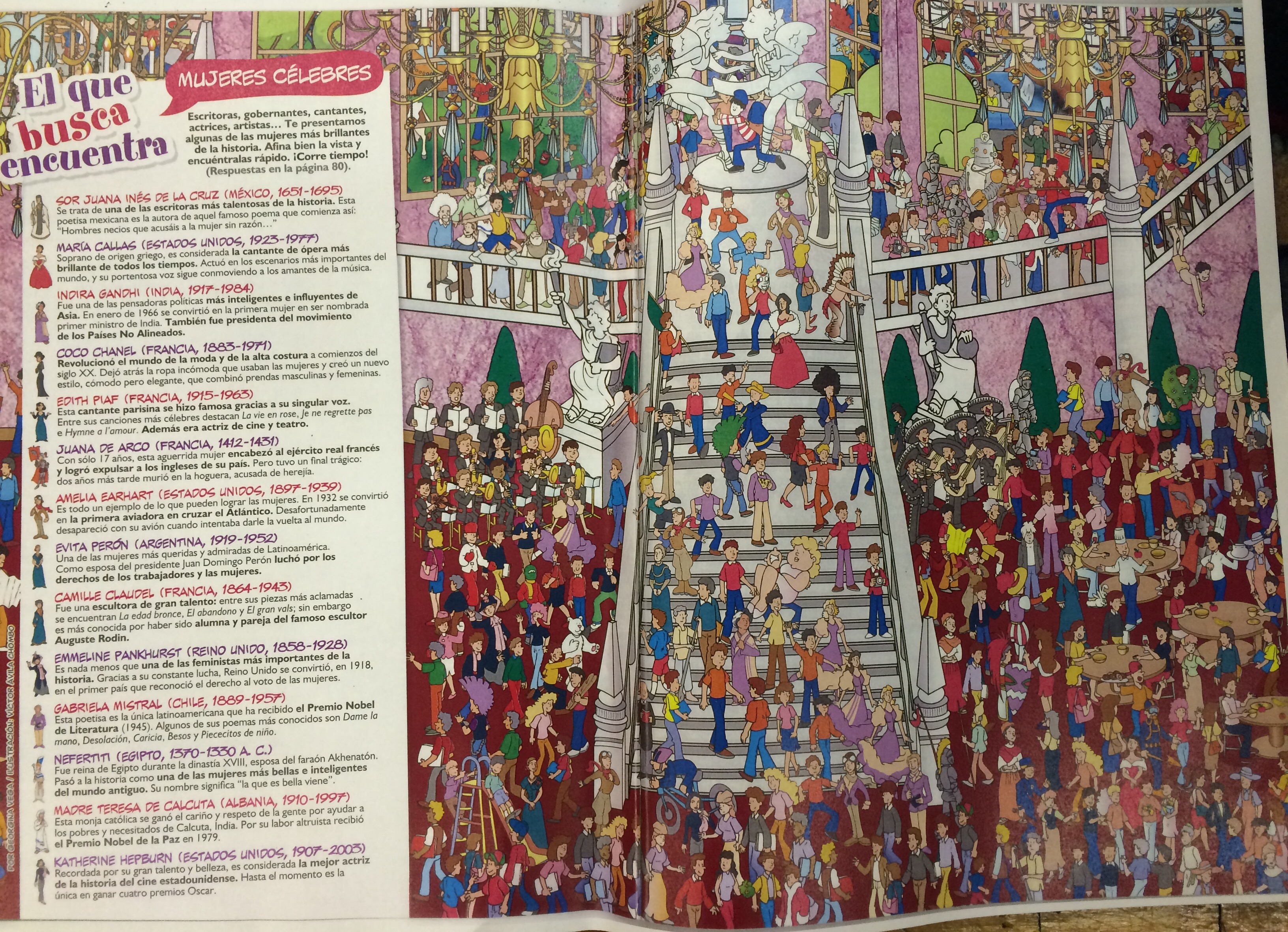
Mujeres célebres
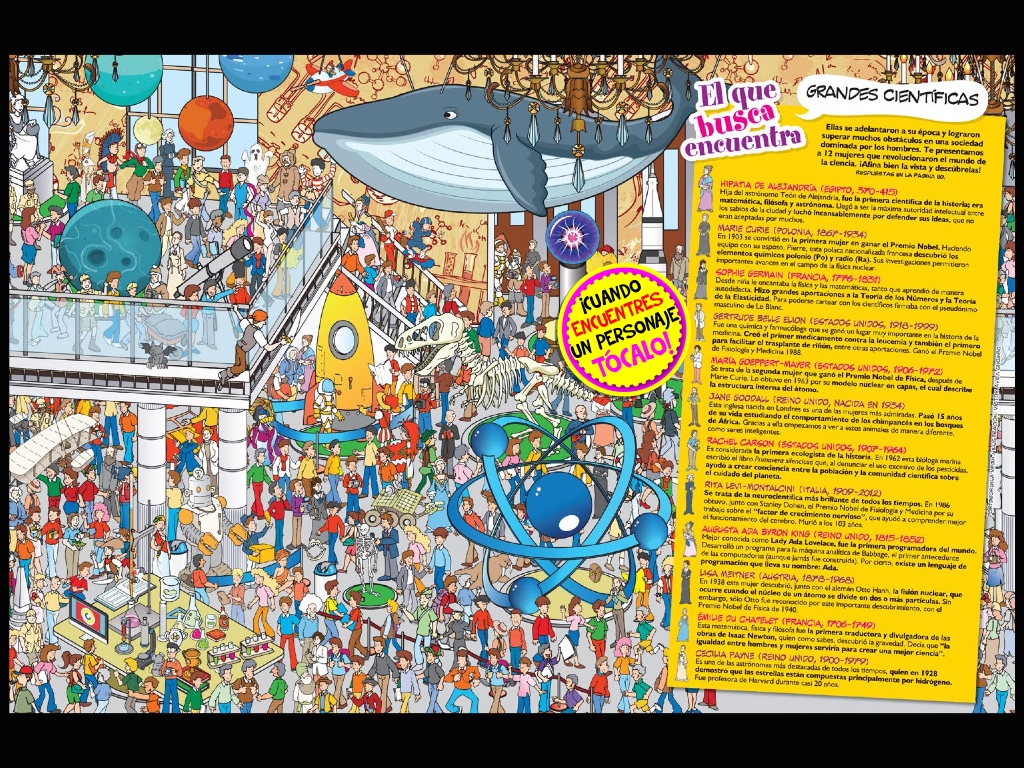
Grandes científicas
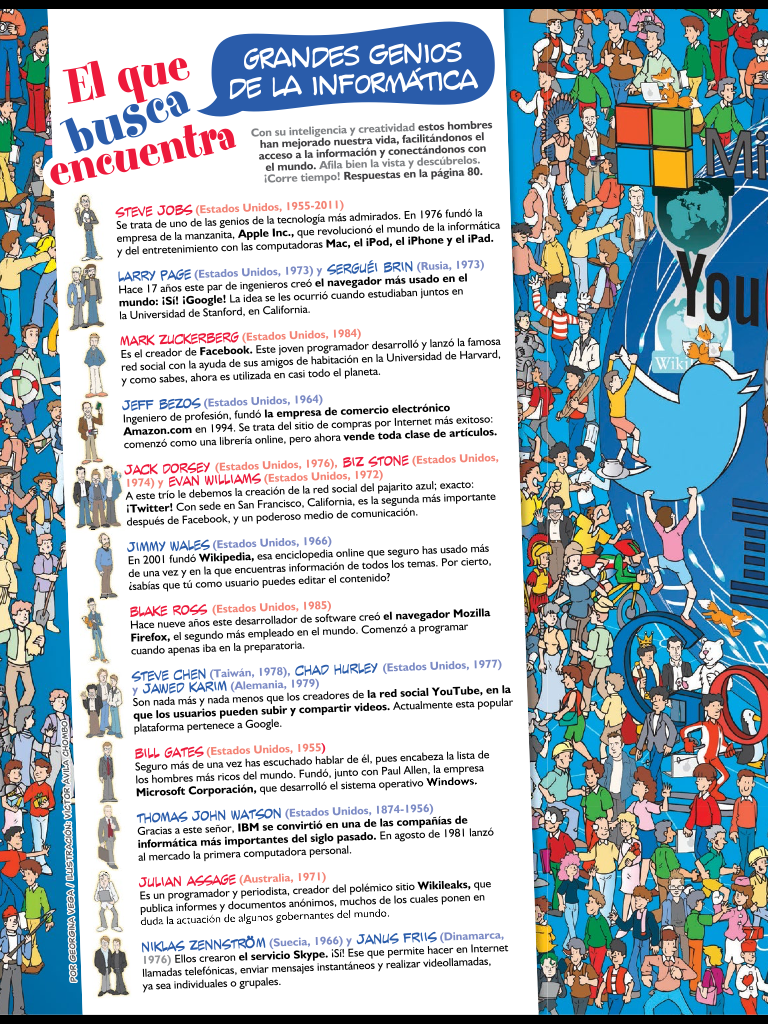
Grandes genios de la informática (arriba)
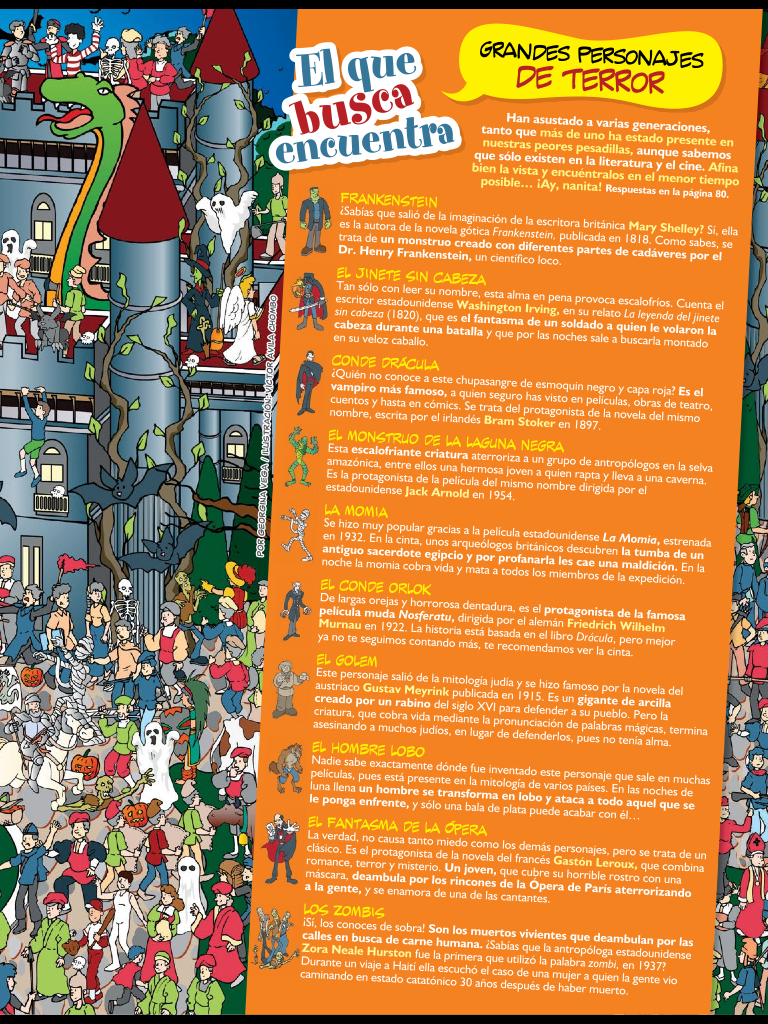
Grandes personajes de terror (abajo) – perhaps for next Halloween?
Apart from the ideas in the previous blogpost, I was going to suggest that any Where’s Wally?/Où est Charlie?/Wo ist Walter?/¿Dónde está Wally? could be used in a similar way:
1. explain where Wally is using prepositions/positional language.
2. provide descriptions of other characters to be found: could be done as a reading or a listening activity .
3. learners could do the above with a partner, or in small groups
4. learners imagine the life of one of the characters and provide a biography, or put themselves into their shoes and introduce themselves (a little like Janet Lloyd’s ‘In the picture’ activity)
and so on!
(Apologies for taking so long to upload – I’ve suffered severe post -#ililc5 exhaustion this week!)
My second session was all about cross curricular language learning; how languages support other areas of the curriculum like literacy and maths as well as how languages can be taught in conjunction with and through other subjects and vice versa.
I mentioned my Pinterest pages; here’s the link to my Roman resources for Spanish. And if you click through the presentation, you’ll find links to things like the music for The Carnival of the Animals, a slideshare of Querido Zoo, links to BuildyourWildself and Switchzoo for making hybrid animals and that cheesy song in Spanish about the planets.
I’ve finally managed to upload my presentations to Slideshare so here is the first. There are links throughout the presentation to useful sites and resources, and I’d especially refer you to the last few slides with helpful links to e.g. LightBulbLanguages and the ALL site. However, I’ve added a few below too.
Today I’ve been in Devon (where it was raining!!!) speaking at a conference at Newton Abbot College entitled Modern languages, Modern teaching. A great way to start half term!
I gave two presentations today, one on Top Tips for Primary Language Learning and the other on cross curricular language teaching. It was lovely to meet the people in my sessions – thanks for joining in and participating in my songs games and activities.I’m currently trying to upload my presentations to Slideshare as they won’t upload directly here, but until then, here are a few of the video clips I shared today!
Ana y Enrique – Los planetas
This version has pictograms too!
And then there was the soundtrack to our Sumo phonics
And the amusing German tongue twister/ story about Barbara and her rhubarb bar
And if you want to know what it means… http://youtu.be/l3_tRPRt9x8
Hope that’s whetted your appetite. More when I get home as the Internet is straining 😉
“En el roscón de reyes puedes encontrar la figurita y el haba. La buena y la mala suerte. Teresa Tomás, de 104 años, nos enseña que en la vida también sucede igual. ¿Quieres saber lo que piensa?”
This short video is an advertisement for Consum but it has an important message.
I’m going to be remembering her final comment this year-
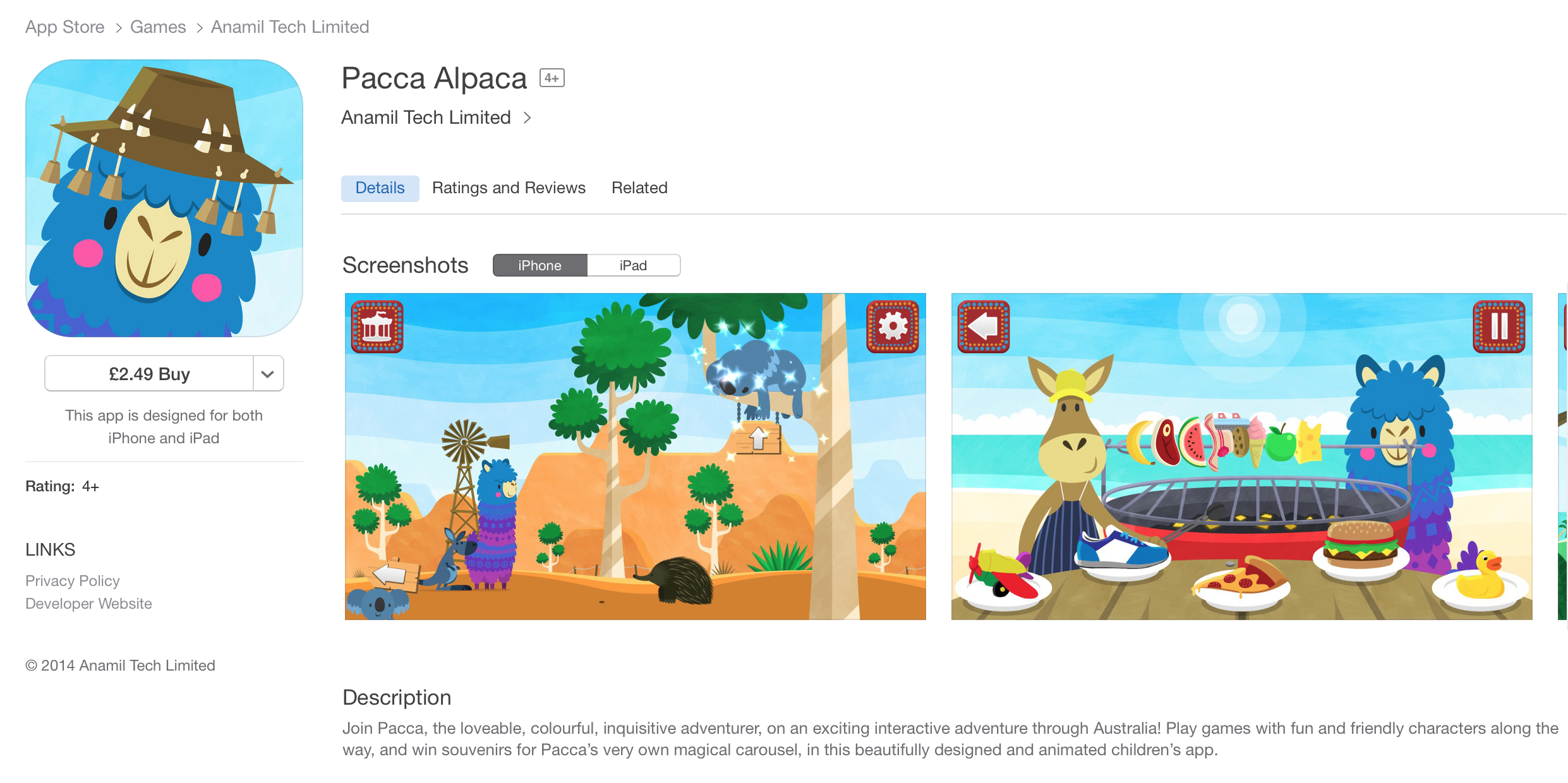
Introducing Pacca Alpaca, a language learning app for little people!
http://youtu.be/QEds9SfUgIU
I’ve been working with Anamil Tech on the Spanish dimension of this app and am pleased to say that it is now available in the iTunes and GooglePlay stores where it has already received a review!
It was lovely to work with Nicole again after the success of The Lingo Show which she created and produced (I did the Spanish on that too!) as I knew that the concept would be fun and interactive.
Pacca is a funny quirky and very inquisitive alpaca who travels on a magical carousel from his home in the Andes to explore, learning languages on the way as well as exploring his new environment. In this first instalment, he pops off to Australia!
Here’s what the ‘blurb’ says:
Pacca Alpaca – Australia!
Pacca Alpaca – Australia is a multilingual app aimed at children aged two to six and designed to encourage them to learn new languages and understand the world around them as they embark on an Australian adventure with Pacca the alpaca.
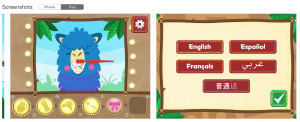
Pacca’s adventure unfolds in his home in the Andes Mountains, as he spots a new destination from afar and flies off in his magical carousel to investigate. When he lands with a bump in Australia, a local host greets him and takes him on a tour of the country. Along the way, the two play games, meet other animals and learn about shapes, colours and numbers. While they play, children can earn rewards as they complete challenges and learn new words in their chosen language – French, Spanish, Mandarin, Arabic or English.
The app is the first in a series of adventure apps following Pacca and his friends on their travels across the globe, so watch this space for the next installment!
Things I like about it:
Pacca is a lovely character; very friendly and fun
you can complete the activities in several languages using the same app
there are no advertisements/pop ups/in app purchases
the language is clearly spoken by a child (the Spanish voice actor was a delight; a really sweet little girl from Canarias and it was a shame I didn’t actually get to meet her!) which I think is important in an app aimed at little ones
it’s fun to play the games and you are rewarded with souvenirs for the carousel
all the vocabulary you’ve learned is stored in your suitcase and can be reviewed when you wish
you can start again and recollect all the souvenirs when you’ve finished – and in another language if you want
there’s a Grown Ups page that explains the educational background and a TopTips document giving ideas of how to use the app too
you discover a new country/culture as you learn e.g. aboriginal style artwork is used for the colours, famous landmarks are shown
there’s the promise of more adventures to different places!
It’s not a free app – it costs £2.49 – so having it on a class set of iPads would need some negotiation but I’ll definitely add it to my list of apps that I recommend to parents/grandparents who want ideas for engaging children in learning outside of the classroom as well as putting it on my iPad for individual/paired play.