¡Vámonos! – Page 17 – "The decision to learn a language is an act of friendship. It is an outstretched hand." John le Carré


Teaching the time is a trying task in any language; I’ve been comparing notes with my Y3 colleagues who have been battling through the time with their classes in Maths lessons as I’ve been working on it with Y5 in Spanish. And back in the day when I taught KS3 and 4 it was also a challenge as I invariably had to ‘remind’ them of how to tell the time full stop! It seems that, for some, the time is viewed much as the gif above – wobbly wobbly and hard to pin down.

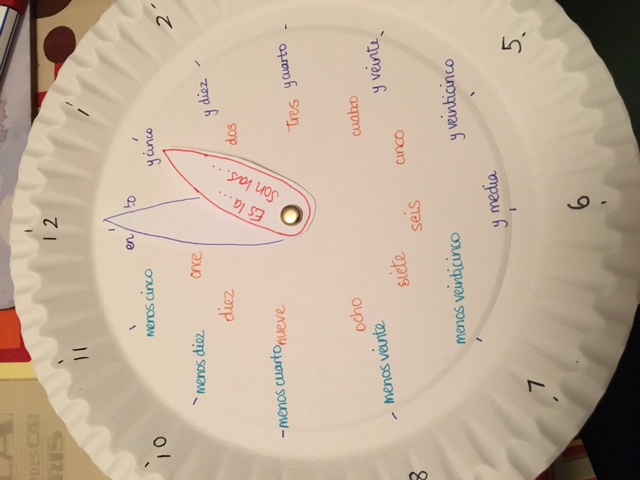
So this year I put on my thinking cap and considered what might make it easier. Active things like TimeBallet help with hour and half past, possibly quarter past/to, but tends to get too complicated/fall apart for many with minutes. Singing songs like Uno dos tres ¿Qué hora es? works for the question form and hour/half past. Using mini clocks works for some but I wanted something a bit more supportive. So I decided we’d all make a prop to help them.

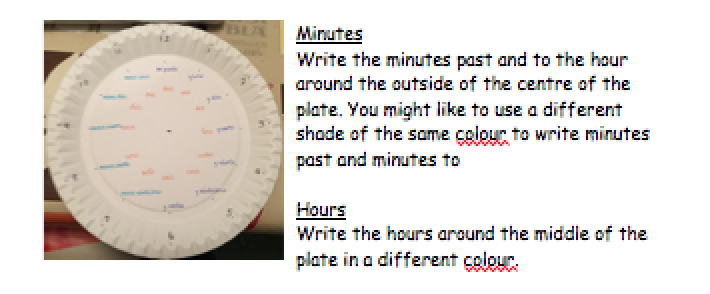
Cue the purchase of lots of paper plates and split pins, and the sharing of my gel pens, felt tips and fine liners. The idea – not very original perhaps but quite effective – was to make a personalised plate clock with key phrases on it to support learners as we rehearsed the time.
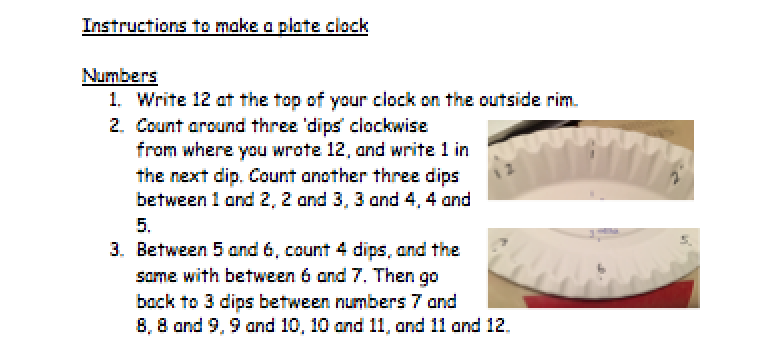
I demonstrated how to make it but also wrote a set of instructions (in 4 screenshots below and downloadable in one document from here) for the learners to follow after the demonstration, along with providing a larger image plate clock diagram between two so that the writing was clearer.

By putting the hours hand on top of the minute hand, I hoped to emphasise that the hour always comes first, and we wrote the verb Es la/Son las on it to remind learners how the sentence started. And by writing the hours and minutes in separate colours that corresponded to the colour of the hand was another attempt to make it clearer which phrase to use.
 

Everyone enjoyed making the clocks although some were a little wonky and needed a bit of ‘Sra Stevens magic’ before functioning correctly, and we’ve used them in two lessons now. On the whole, once we got over fiddling with the hands constantly and concentrated, it seemed to help some learners, and it was good to see them being used, much as they use the Maths equipment in numeracy lessons, to help children work out the answers to write in their books as well as in speaking work. Turn the hands to show the time then read the Spanish if the question is in English, or turn the hands so that they match the phrase in Spanish to work out where to draw the hands on a blank clock. Plus the children are all desperate to take them home which I’ve promised they can do once we’ve finished the unit.

There are some other good ideas on how to teach time here from Erzsi and Clare.

I’ve used the clock mini book idea in previous years with success as a self differentiating assessment activity:  pupils have to choose six times to demonstrate their understanding and confidence at telling the time so they need to choose carefully those that they know. Might yet do it this year…

If you have any ideas to add, feel free to leave a comment!
 

I’ve been working with Anamil Tech on Pacca Alpaca for a while now. The apps Pacca Alpaca and Pacca Alpaca Travel Playtime have proved very popular and are now available in English, Arabic, French, German, Spanish, Mandarin and Welsh.

Well, there is now a Youtube channel of free videos to accompany the app. You can subscribe to Pacca Alpaca for more kids learning videos in Spanish, English, French and Arabic here – http://bit.ly/paccayoutube

Here’s the first Spanish video, released today!


screen-shot-2016-11-06-at-14-51-48
As I said in my previous post, I’ve just come back from the Practical Pedagogies conference in Toulouse. Last year I attended the inaugural #pracped conference and presented about Using technology to enhance primary language teaching and learning  As you can see from this post which charts my impressions, I vowed I wanted to attend the next one. And that post also explains what I was asked to speak on this time.

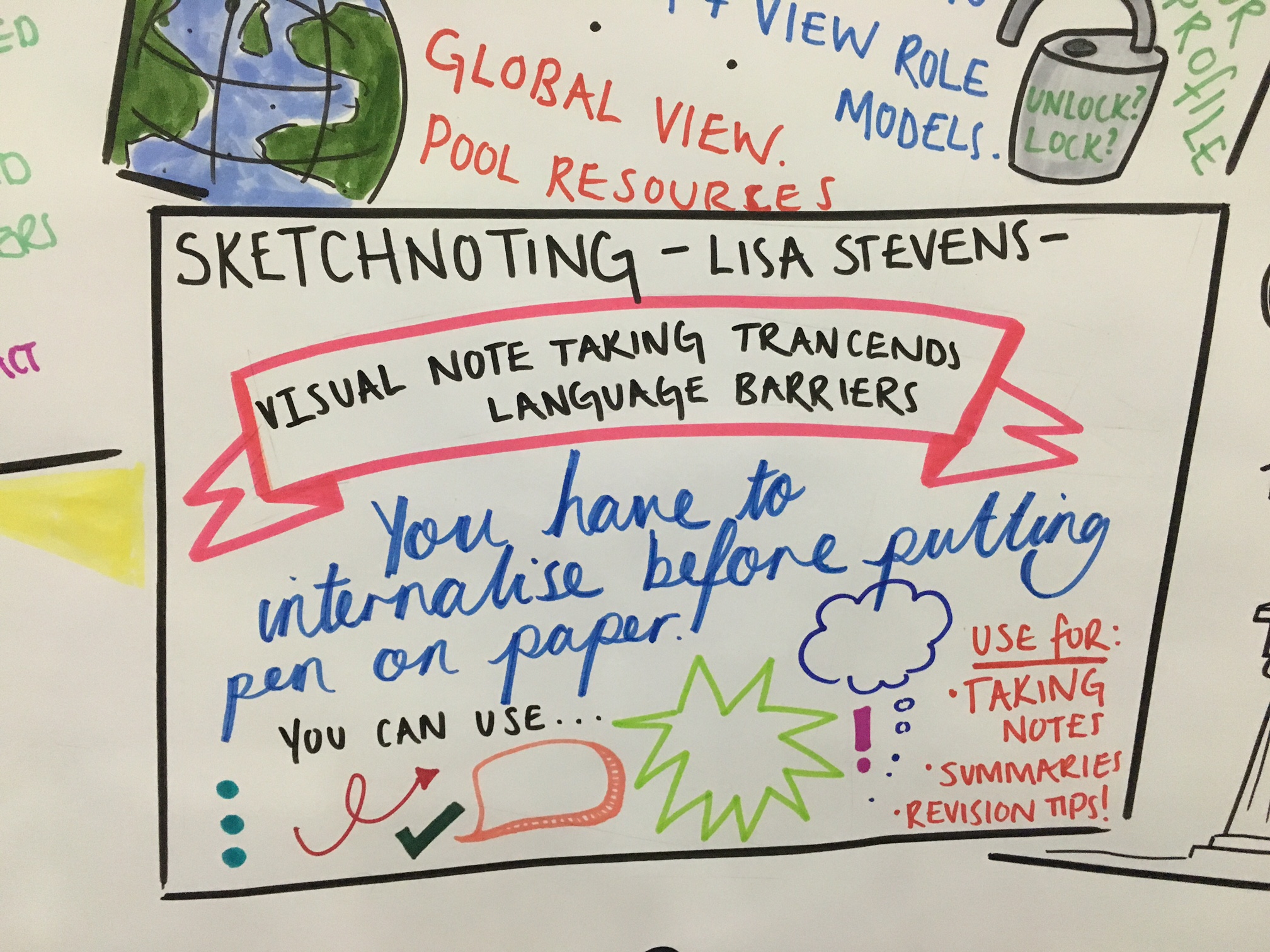
I have, over the last 18 months, discovered sketch noting or visual note taking to be an excellent tool. I sketch noted last year’s conference and several people commented that i should do a workshop on it. So I did!

Below is my presentation. You can’t read the notes so I’ve added some below that.

I’d also like to highlight certain things:

    1. Slide 7 in the presentation is a slide deck of the development of my sketch noting but only the last slide is showing. You can see more of my sketch notes in my Flickr album Sketchnotes – bit.ly/lisibosketch – where you can see for yourself how my style has developed!
    2. There are several books that I recommend in the presentation; if you click on the book covers, I’ve linked to where you can purchase them. I wanted to highlight the free iBook Sketchnoting for teaching and learning that  is downloadable from iTunes (see slide 39). I didn’t know that it was finished in time to share it at the conference but @lanclassrach (one of the authors) put me right and shared the link with the description “the book is designed by teachers for teachers to help them get going with sketch noting.” Recommended reading, especially if you want to know more about using technology to sketch note.
    3. I wanted to highlight one of the blog post mentioned on slide34 – 4 quick myth busters about visual notes in the classroom. It’s a good summation of a large part of Wendi’s book and gives practical answers to questions that are often asked about getting pupils to use visual note taking.
    4. Slide 38 is Sylvia Duckworth’s guide to sketch noting digitally. She has further advice since then and says ‘ I draw on the iPad with Procreate app (tutorials here and here) and the Musemee Notier Prime Stylus (If you buy one, make sure to get extra replacement tips as well). Thanks to Sylvia for giving me permission to share her sketch notes and for her advice!
    5. As I finished my workshop I discovered a new Twitter account just started by the lady who made the image on slide 51, so please follow @sketchadoodle for more beautiful visual notes.
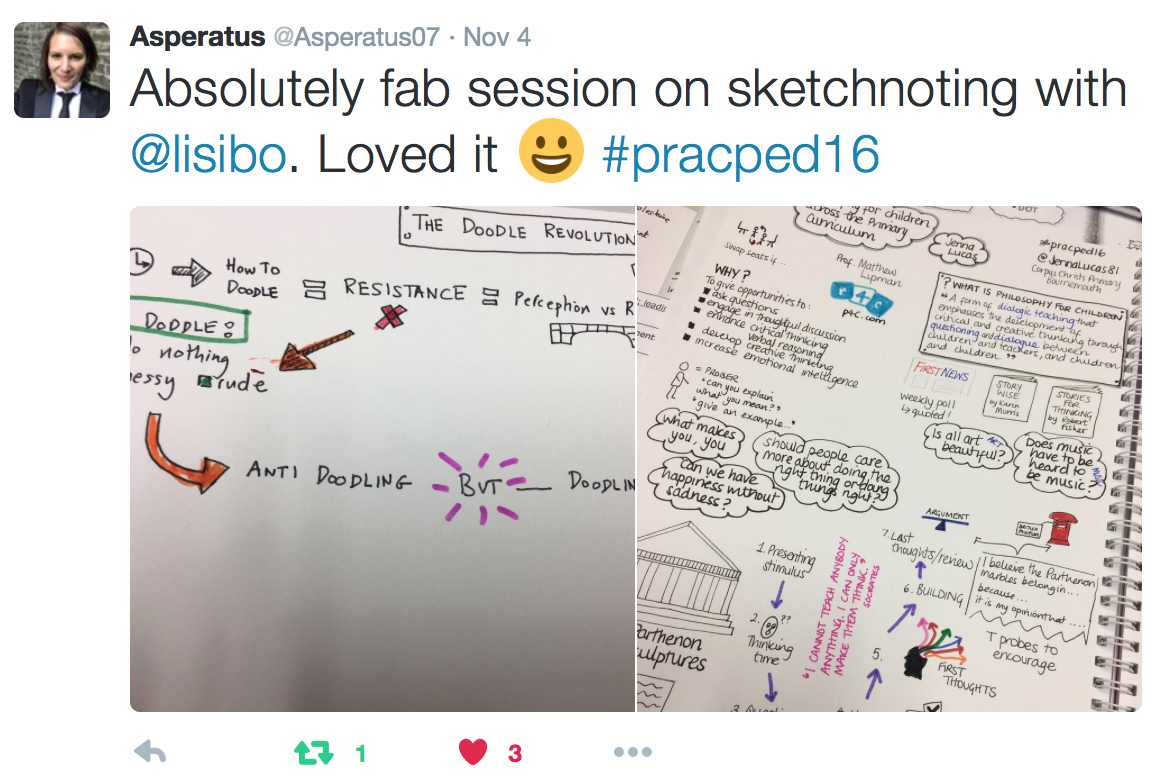
    6. Finally, proof that you just need to try – one of the delegates went straight from my session and had a go during the next workshop. Here’s the evidence! Well done @asperatus07!cwavkpjwgaa6dsr

Notes:

Brad Ovenell-Carter says “Sketchnotes are intelligent note-taking. The note-taking process is normally passive. But with sketchnotes, you don’t write anything down until your thoughts are there. It’s already digested.” https://plus.google.com/communities/115990332552316650304 

“When you draw an object, the mind becomes deeply, intensely attentive,” says the designer Milton Glaser, an author of a 2008 monograph titled Drawing Is Thinking. “And it’s that act of attention that allows you to really grasp something, to become fully conscious of it.”

Arguably, making graphic marks predates verbal language, so whether as a simple doodle or a more deliberate free-hand drawing, the act is essential to expressing spontaneous concepts and emotions.

What’s more, according to a study published in the Journal of Applied Cognitive Psychology, doodlers find it easier to recall dull information (even 29 percent more) than non-doodlers, because the latter are more likely to daydream.


practical_pedagogies__choose_your_sessions_I’ve just got back from the Practical Pedagogies conference at the International School of Toulouse. Organised by Russel Tarr, the two day conference brought together educators from around the globe. Here’s the rationale behind the conference which explains why I travelled to Toulouse at my own expense to speak (I wasn’t paid to it):

“Educational conferences can be prohibitively expensive for ordinary teachers, and often focus on abstract theory delivered by professional academics with very little hands-on classroom experience. Such events often appear more concerned with making money than with genuinely improving the quality of education being delivered within schools.

In contrast, “Practical Pedagogies” comes out of the belief that the best teacher-training conferences are delivered by practising teachers, for the benefit of each other and their students, as not-for-profit events.”

I attended some excellent workshops and chatted to so many people that further inspired me.

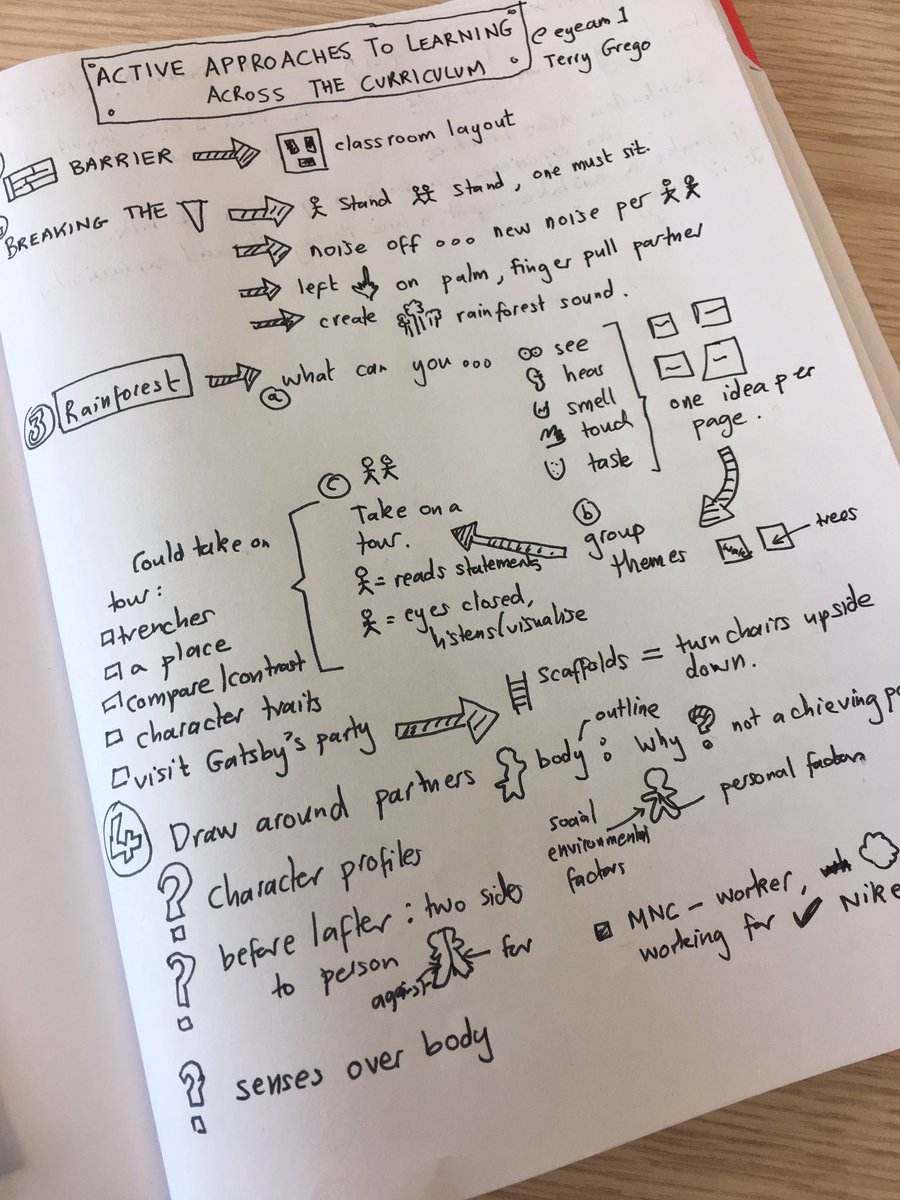
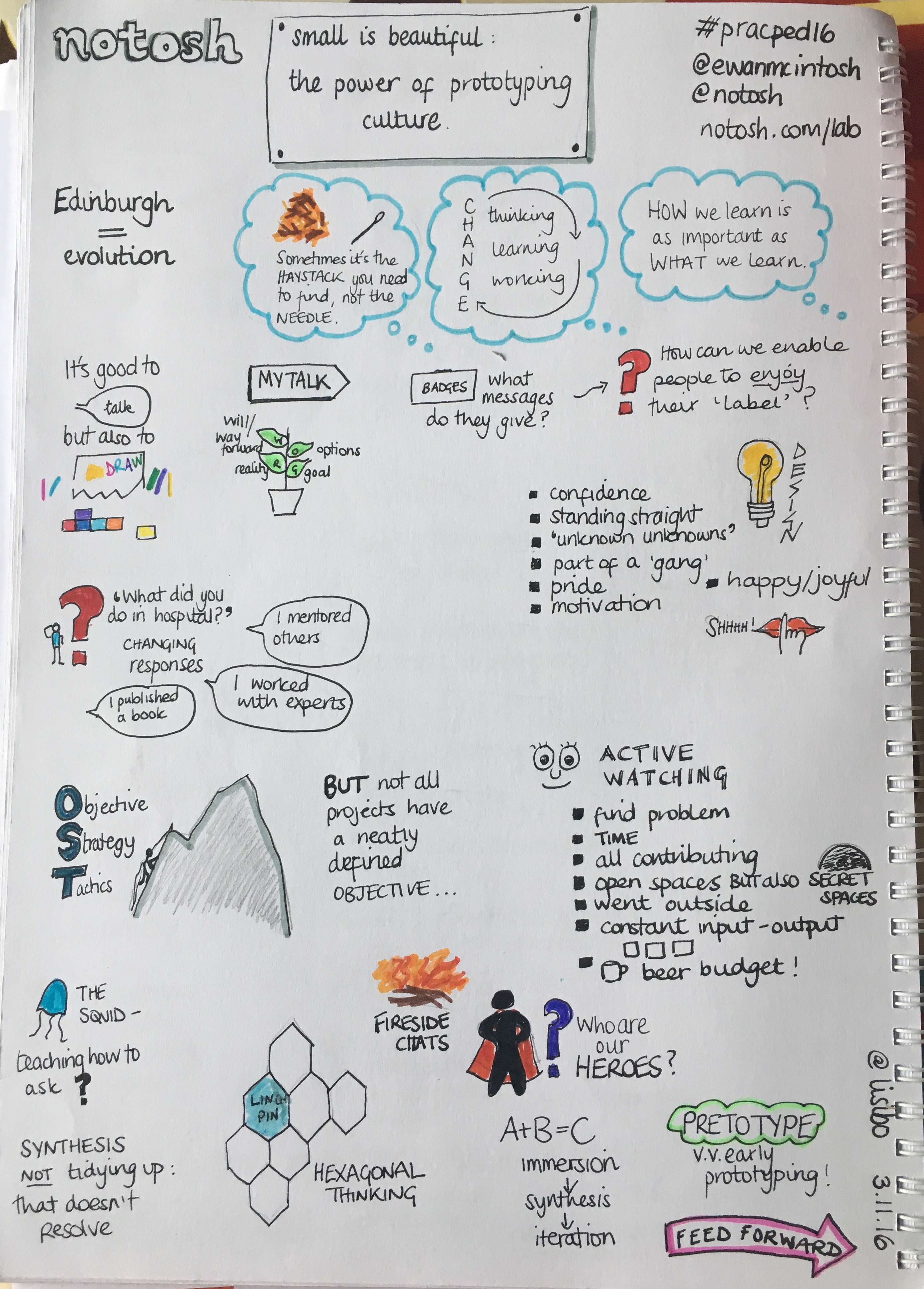
Below are my sketch notes of the conference that document the sessions I attended. I hope that they give you a flavour of the conference. You can find out more by checking out the Twitter hashtag #pracped16 (which was trending at various points in various countries over the two days!) or by looking at the conference website. I’m sure that many will share their presentations and that there’ll be lost of blogging so I’ll update the post over the next week or so to share them.

Opening Keynote by Ewan McIntosh of NoTosh.

Opening Keynote by Ewan McIntosh. @ewanmcintosh @notosh


Curriculum, controversy and current affairs: manoeuvring in a multicultural world by Mariusz Galczynski

Curriculum, controversy and current affairs: manoeuvring in a multicultural world by Mariusz Galczynski @MariuszEDU


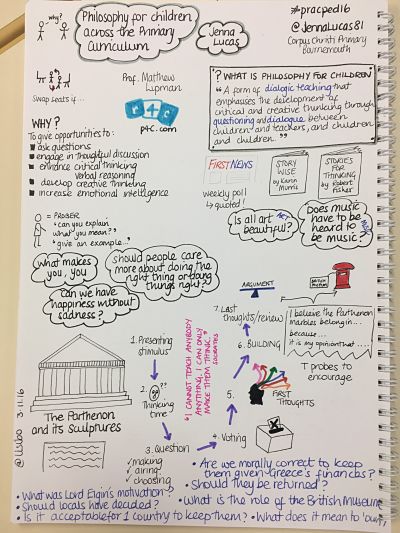
Philosophy for Children across the primary Curriculum by Jenna Lucas @JennaLucas81

Philosophy for Children across the primary Curriculum by Jenna Lucas @JennaLucas81


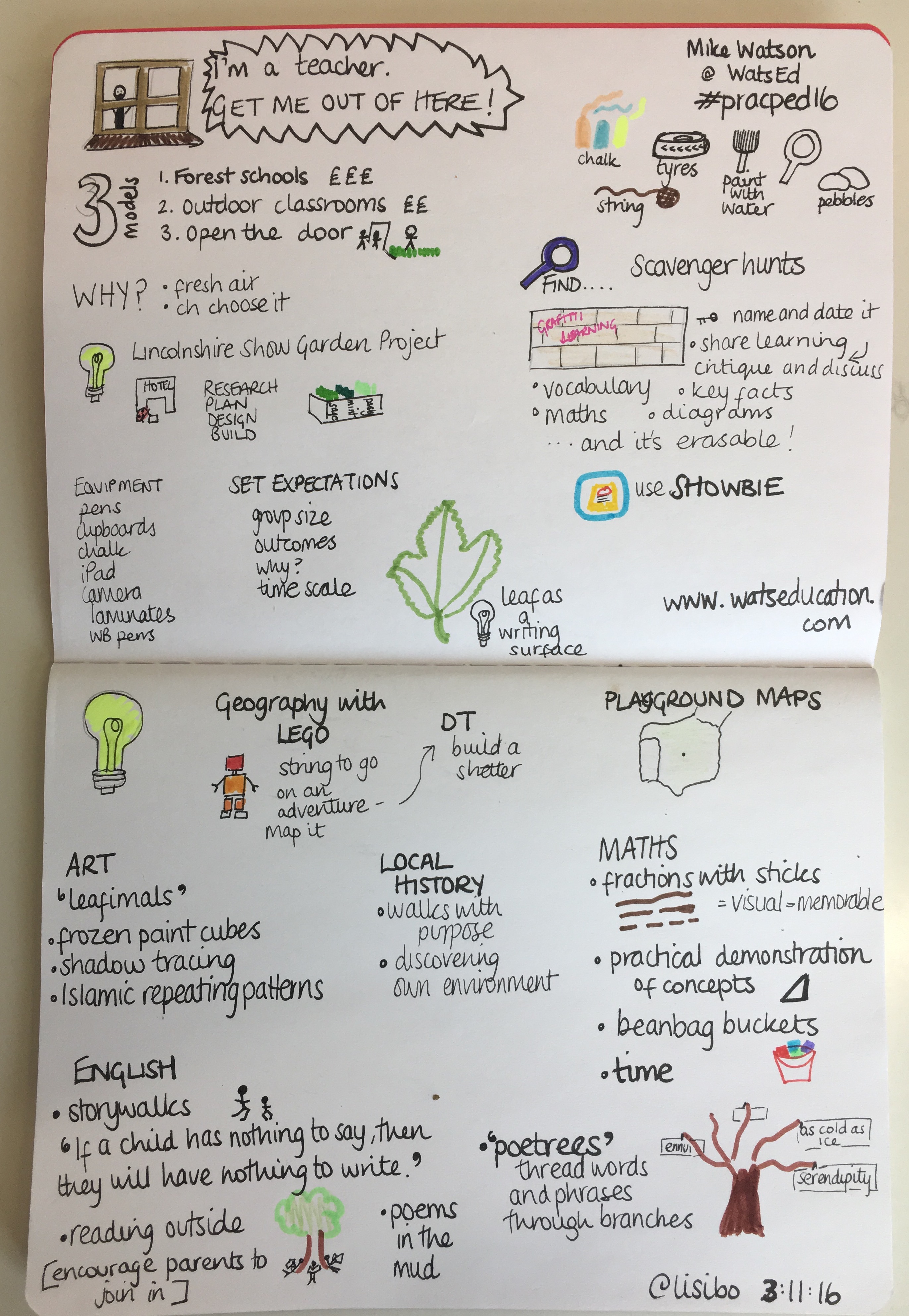
I'm a teacher: Get me out of here! by Mike Watson @WatsEd

I’m a teacher: Get me out of here! by Mike Watson @WatsEd


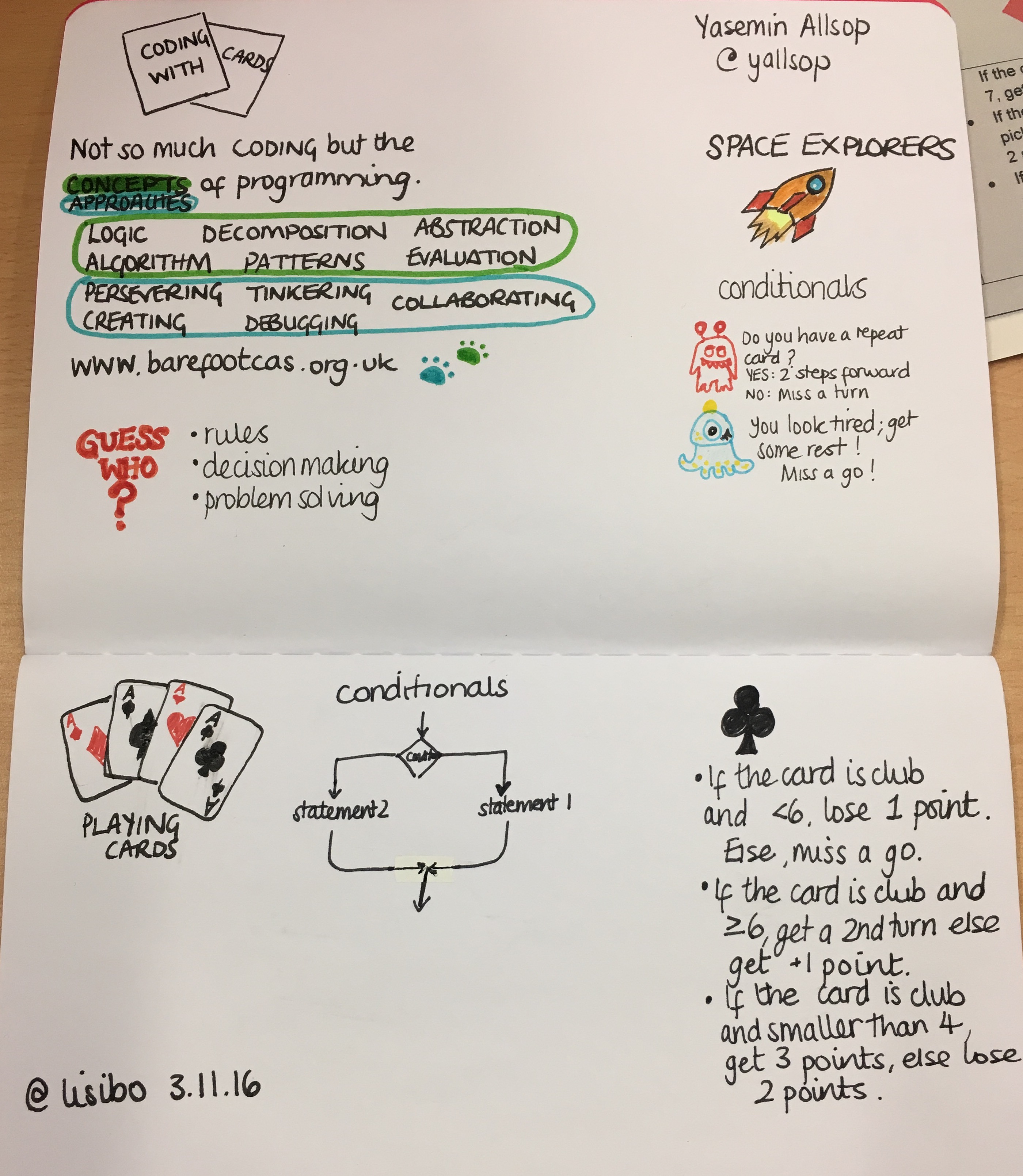
Coding with cards by Yasemin Allsop @yallsop

Coding with cards by Yasemin Allsop @yallsop


The Art of Voice:bringing characters to life by Ben Culverhouse @ben_culverhouse

The Art of Voice:bringing characters to life by Ben Culverhouse @ben_culverhouse


You shipping it? Closing keynote by Ewan McIntosh @ewanmcintosh @notosh

You shipping it? Closing keynote by Ewan McIntosh @ewanmcintosh @notosh


However you feel about it, it’s time to go back to school in England. Some went back this week, others (like me) start next Monday. I can’t believe that i’ve not posted all summer but in a way that’s a good thing as it means I’ve relaxed and not thought about ‘work’. Having said that, as much as I love my holidays, I do enjoy my job (mostly) and am looking forward to going back. Not sure I’ll be as quick to jump out of bed as Pocoyo come Monday morning though…

¡Feliz vuelta al cole!

“Llegó la vuelta al cole.
Oh, Oh, Oh.
Sé que será divertido estar con mis amigos y profes otra vez, empieza un nuevo reto una nueva aventura hay tanto que aprender.
Sé que será divertido”

347598578_2055495130I’ve been asked to share the following project to ensure that as many people as possible hear about it and have the opportunity to participate. I wish I was a teenager again as I think I’d have jumped at the chance!


GUERNICA: SPEAKING TO MANKIND

“Guernica is to painting what Beethoven’s Ninth Symphony is to music: a cultural icon that speaks to mankind not only against war but also of hope and peace.” Alejandro Escalona

80 years on from the start of the Spanish Civil War in 1936, Picasso’s painting Guernica is as powerful and disquieting today as it was when the artist expressed in paint his revulsion and outrage over the first ever bombing of civilians within Europe.

The GAP Arts Project is looking for 20 motivated, creative young people aged 11-18 who are interested in immersing themselves in an exploration of the most controversial and moving anti-war painting of the 20th century, exploring its impact, its component images and reflecting on their resonances in today’s 21st century world.

Over three weeks the assembled company will engage in practical workshops, creative activities and rehearsals, working towards devising a collective artistic response – a performance utilizing a variety of artforms such as drama, movement, poetry and more, to be produced for a public audience.

If you are excited by this chance to work creatively as part of a team, to explore this key turning point in the history of Europe and to devise and perform your artistic response publicly, we’d love to hear from you. Whether your interest is in Drama, Art, Movement, Poetry or History, this project is for you. No experience needed, just enthusiasm, curiosity, an open mind and a willingness to explore.

Dates: 8 – 29 August 2016                   Times: Tbc (initially daytimes, potentially some additional evenings/weekends in last week)

Director: Ian Yeoman, formerly artistic director of Theatr Powys, 30 years experience of directing and devising theatre for and with young people. (Ian and all adults working on the project are DBS certificated)

Venue: The GAP, Jubilee Centre, Pershore Street, B5 6ND (city centre)

Cost: £80 per participant. This covers all rehearsals, costumes, production costs etc, PLUS membership of The GAP – Birmingham’s only young people’s arts space – and all the associated benefits –free arts events, free wifi, free tea & coffee, arts library, and the opportunity to be part of The GAP’s young creative community.

Contact: Ceri Townsend             07533456387

Reservation: To reserve a place please go to https://guernica-thenandnow.eventbrite.co.uk/

Payment: To confirm your place please pay online at www.gaparts.org.

Deadline is 9pm Wednesday 20July.     NB: Places are limited so please reserve and confirm your place asap!

Further details are attached here: GUERNICA


Walking the walk as well as talking the talk, I’ve tidied up my sketch notes from Nottingham and the National eTwinning Conference, added references that I needed to look up and completed quotations that I’d not managed to finish.

They’re presented below in chronological order. I hope that they give you a taste of the weekend’s sessions if not the atmosphere of communication, collaboration and celebration of all things eTwinning. If you have any questions, please leave me a comment and I’ll try and answer them!

Opening thoughts from Susan Linklater and the NSS

Opening thoughts from Susan Linklater and the NSS.


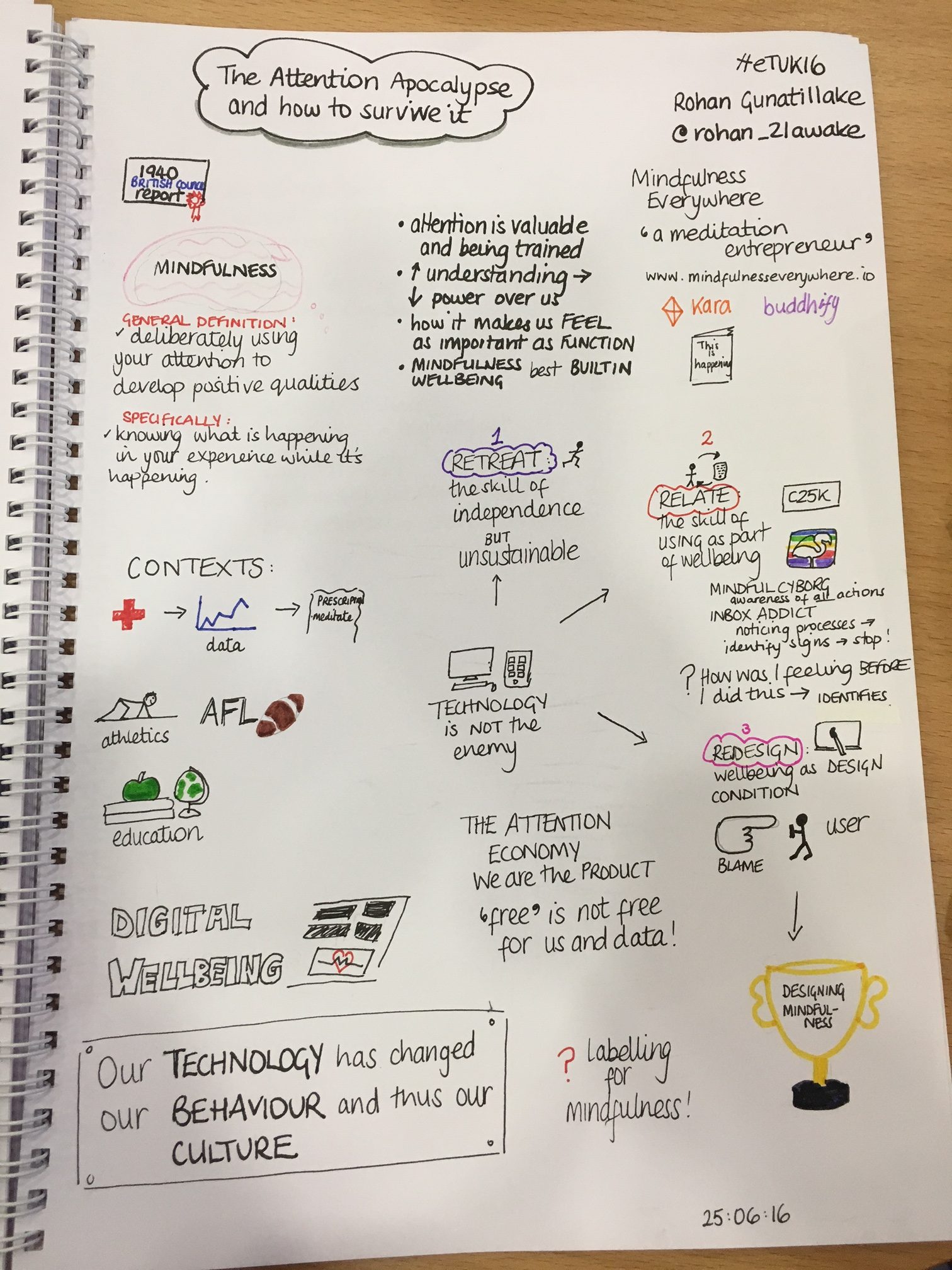
Keynote by Rohan Guntillake about digital wellbeing, and the connection between mindfulness and technology.

Keynote by Rohan Guntillake about digital wellbeing, and the connection between mindfulness and technology.


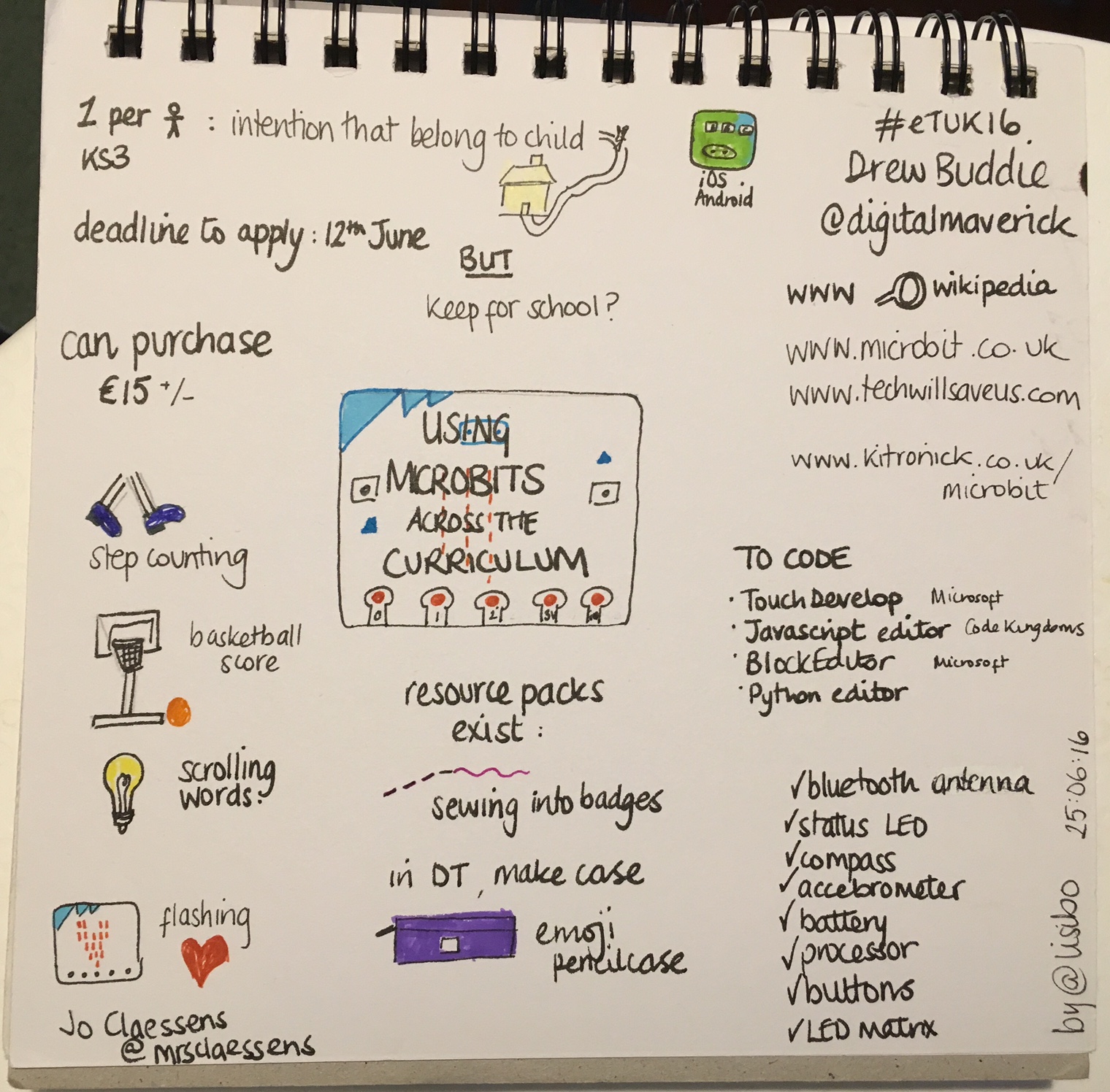
Drew Buddie talked about how you might use Microbits in the curriculum and in projects.

Drew Buddie talked about how you might use Microbits in the curriculum and in projects.


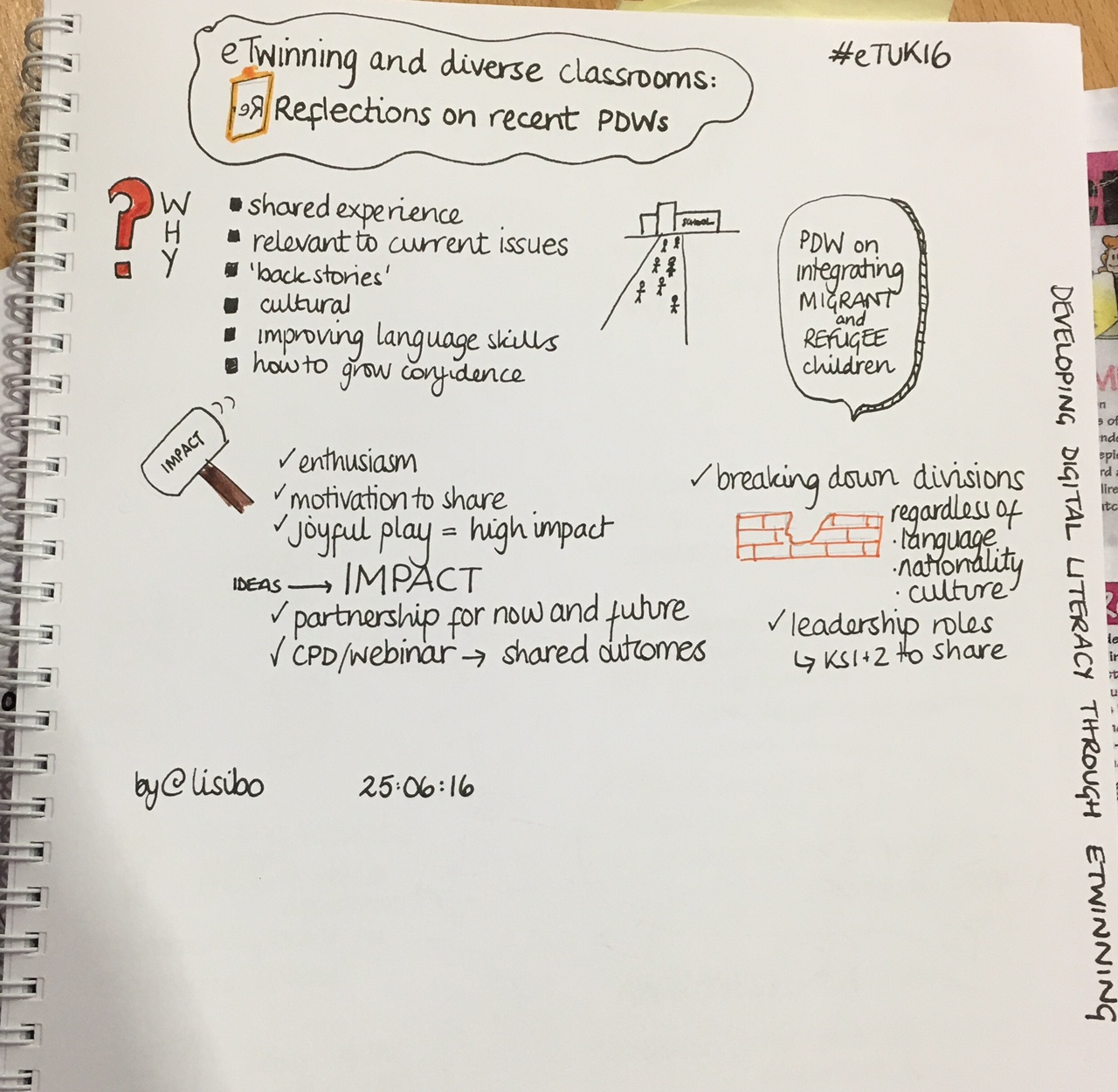
Participants in a recent PDW reflect on their experiences.

Participants in a recent PDW reflect on their experiences.


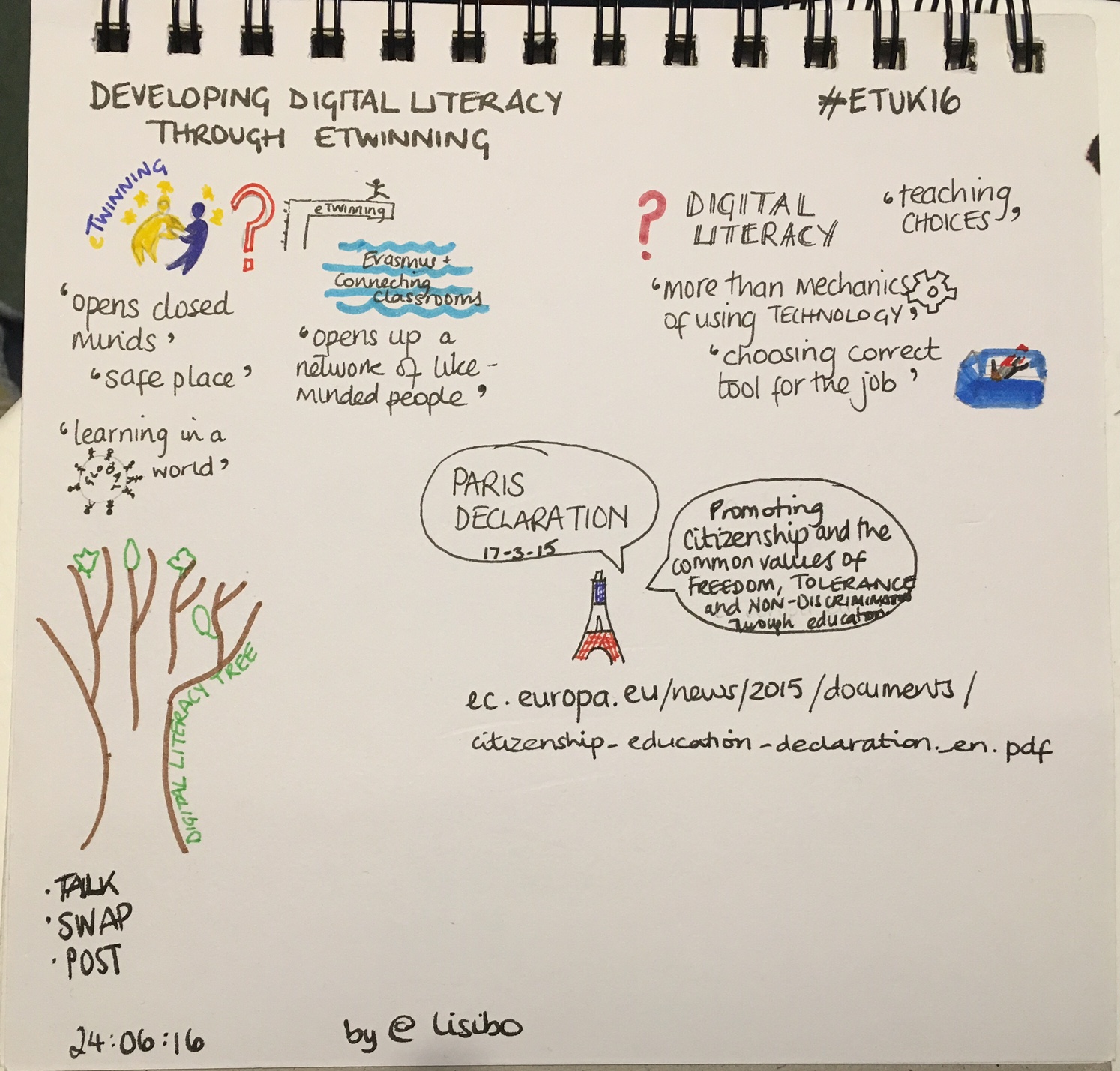
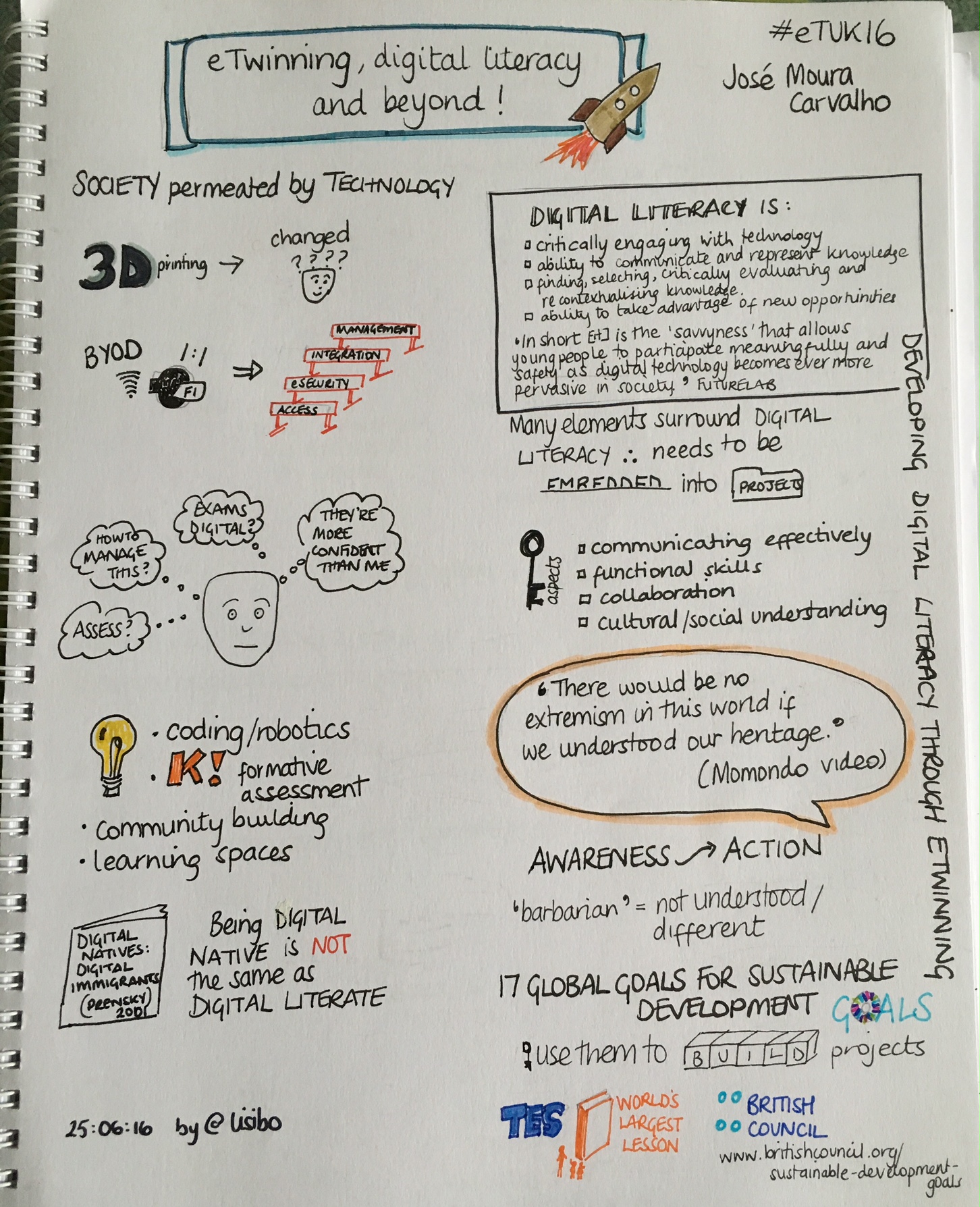
eTwinning, digital literacy and beyond - a presentation by José Mour Carvalho about society, technology and the need for awareness to lead to action.

eTwinning, digital literacy and beyond – a presentation by José Mour Carvalho about society, technology and the need for awareness to lead to action.


Ray Chambers talks about Minecraft in education; lots of ideas of how Minecraft can be used in curricular projects.

Ray Chambers talks about Minecraft in education; lots of ideas of how Minecraft can be used in curricular projects.


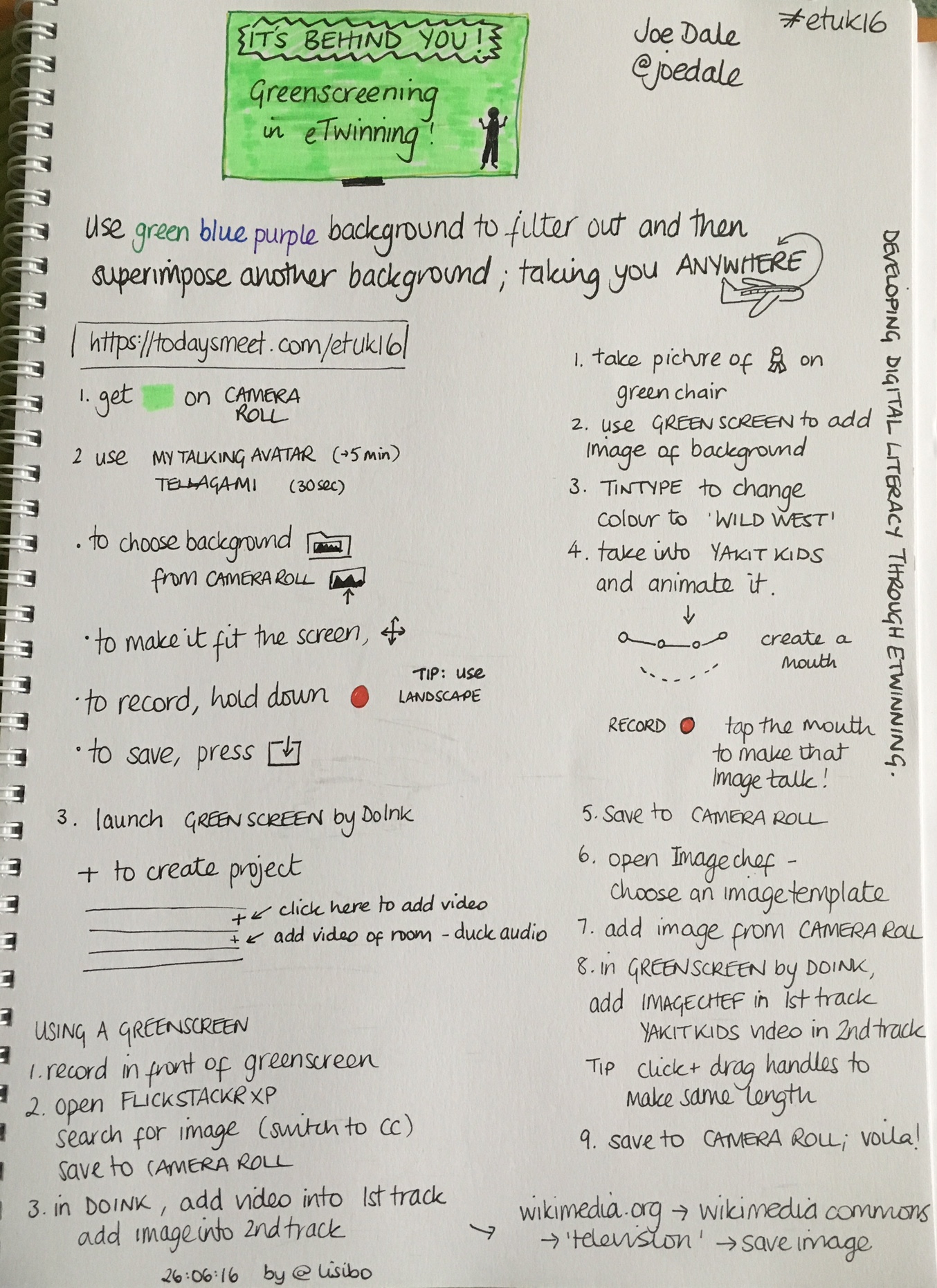
Joe Dale's session on Green screening - very practical but tried hard to take notes too ;)

Joe Dale’s session on Green screening – very practical but tried hard to take notes too 😉

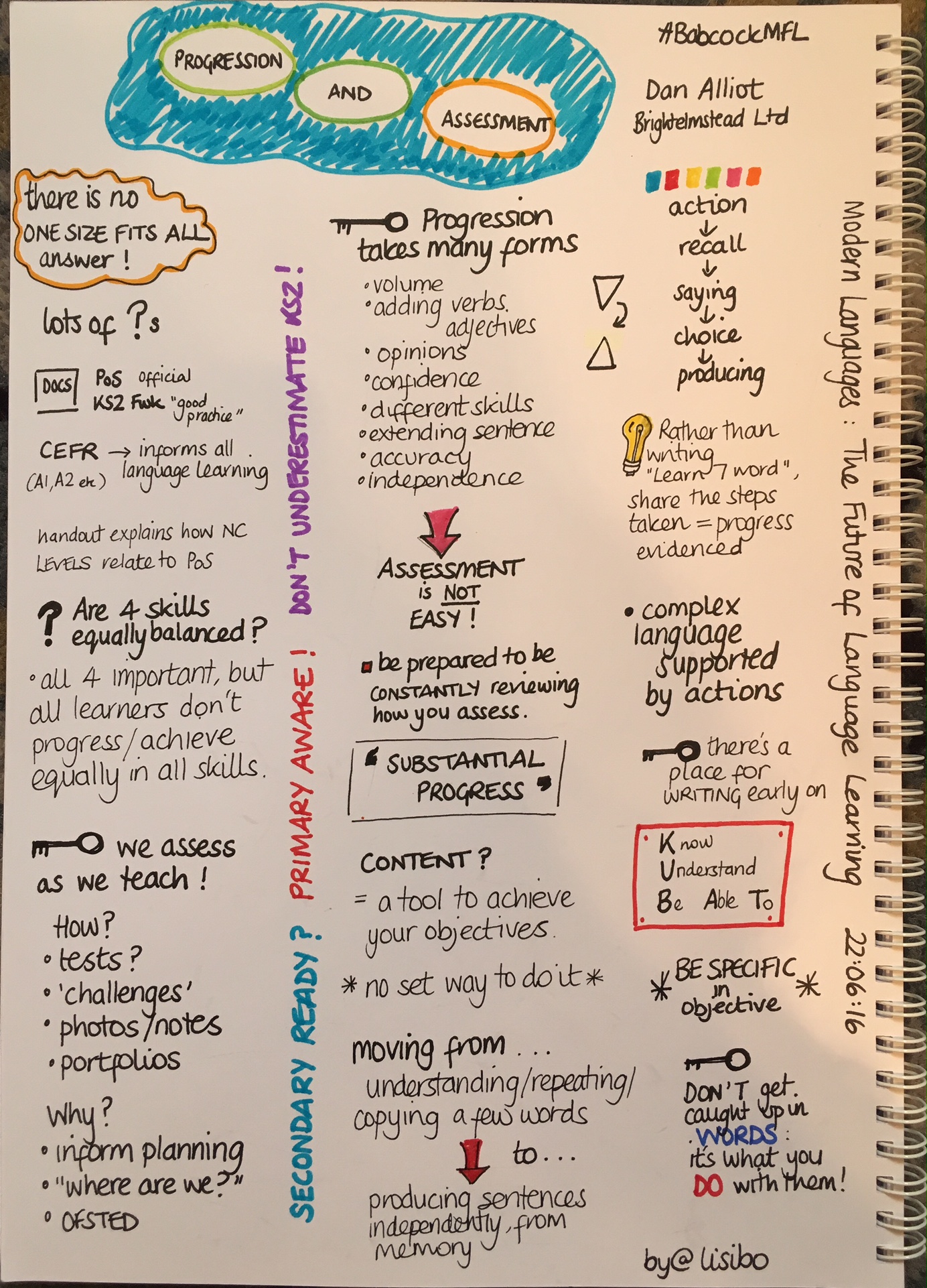
I’ve finally had a moment to photograph and upload my sketch notes from last week’s Babcock4S conference, The Future of Language Learning to add to my earlier post on my session. Hopefully they provide a flavour of the day, and allow you to benefit from some of the words of wisdom! If you want further explanation/elaboration, please leave a comment!
Janet Lloyd's keynote address, complete with hot chocolate and balloons.

Janet Lloyd’s keynote address, complete with hot chocolate and balloons.


Dan Alliot talks about Progression and Assessment.

Dan Alliot talks about Progression and Assessment.


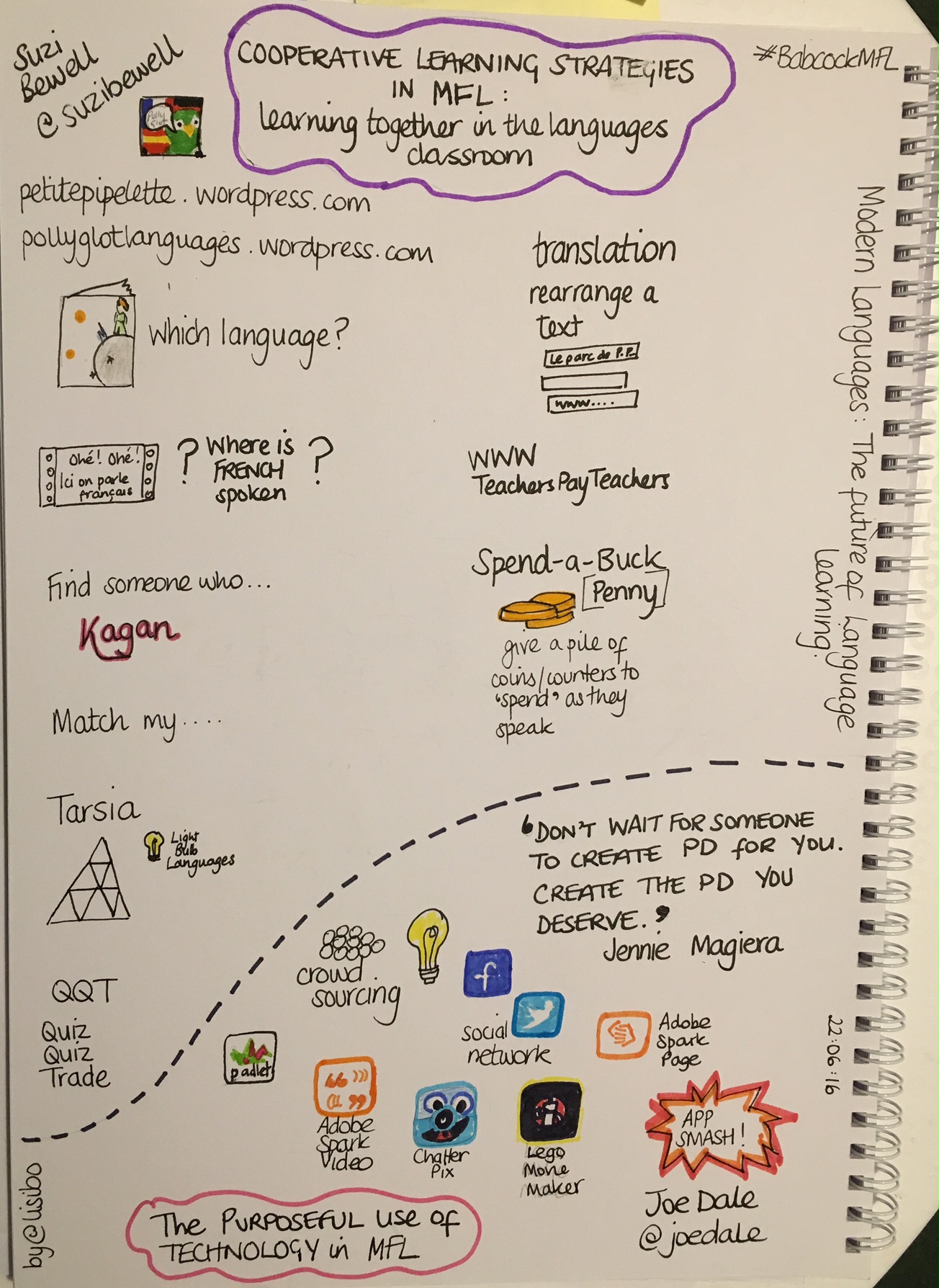
Two sessions on one #sketchnote! Suzi Bewell talking about Cooperative Learning in MFL, and Joe Dale shares some top tips for using technology in the MFL classroom.

Two sessions on one #sketchnote! Suzi Bewell talking about Cooperative Learning in MFL, and Joe Dale shares some top tips for using technology in the MFL classroom.

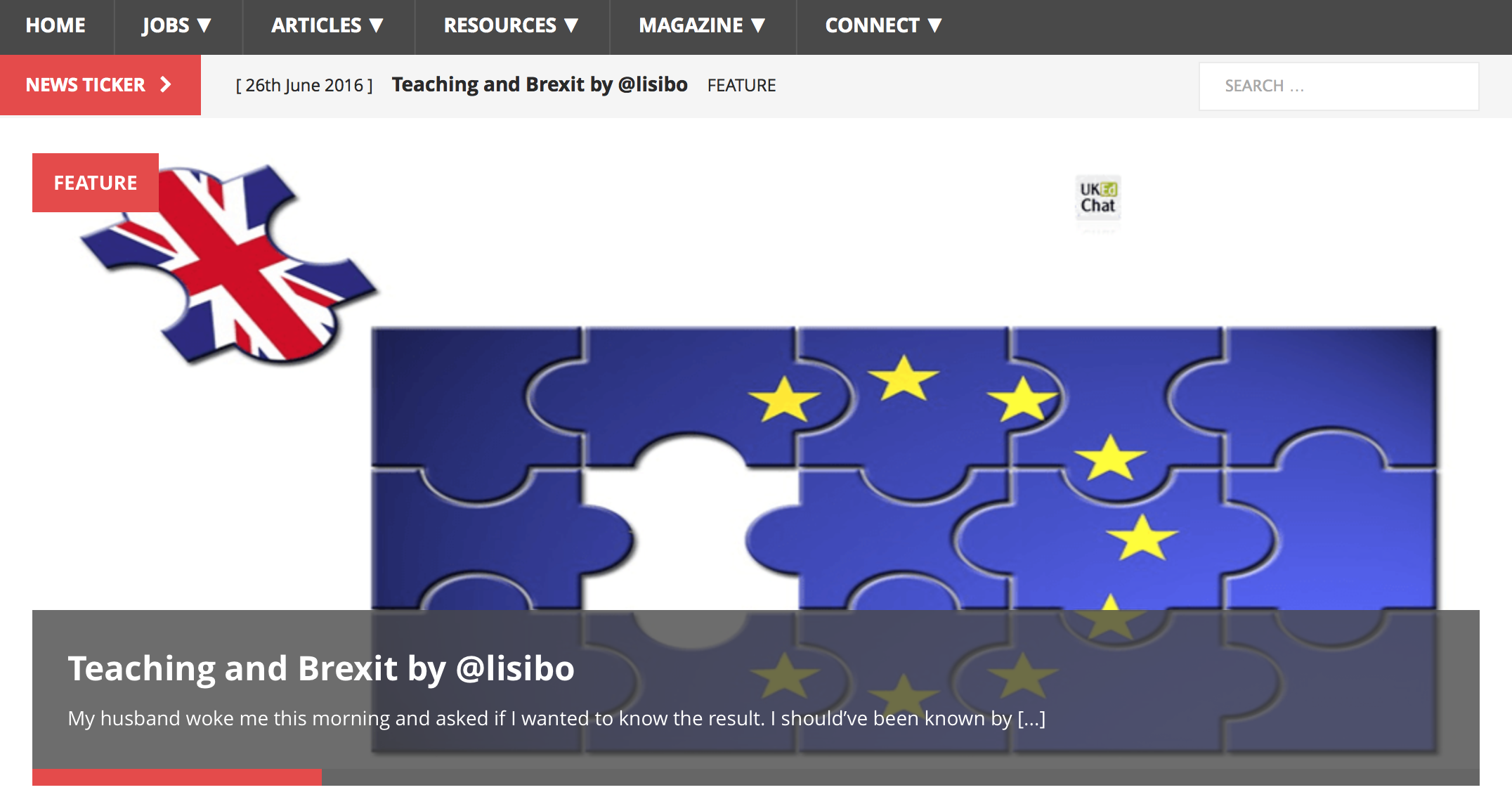
Screen Shot 2016-06-26 at 20.53.57At about 1130am on Friday I was contacted and asked by UKEDChat if I wanted to write a guest blog post about the impact Brexit could/will have on language learning. I didn’t write it straight away for several reasons not least that I didn’t actually have time until very late that night to think. When I did, I wrote my personal reflection on the events and implications.

The post can be found on the UKEdChat website and the text is reproduced below:

My husband woke me this morning and asked if I wanted to know the result. I should’ve been known by his voice but when he said ‘It was Leave by 52% to 48%’ it hit me like a ton of bricks and I burst into tears.

My first thought was my friends and pupils and how some of them would now feel.

I am a language teacher and many of my friends and colleagues across the country are ‘native speakers’ e.g. French/Spanish/German nationals who teach their native language. Others fell in love and moved here to be with their partners. Some have lived in this country for many years and have never felt the need to go to the (not inconsiderable) expense of officially become British.  Many have British partners, children who have grown up here and consider themselves part of this country, working, paying taxes, contributing to their communities. They could not vote. You can read what one felt here.

The Referendum may have been about whether we stay in the EU or not, but the waters were unfortunately muddied by the issue of immigration.  As I turned on social media, my fears were confirmed. I wasn’t in school but I know that several children were aware of what a ‘Leave’ verdict could mean for their families.

My job as a language teacher isn’t just about teaching words, structures and grammar. It’s about a context for that language, be it in Spain or South America, France, Belgium, Senegal. It’s about culture, lifestyle, food that may be different to ‘our’ ways. It involves encouraging discussion of our differences to help us understand more about ourselves, and then the joy of seeing things from someone else’s perspective, celebrating that we’re not all identical.

Through eTwinning, Comenius, Comenius Reggio and Erasmus +, all funded by the EU, my school has changed over the last ten years to be the globally minded place that it is now.  Teachers have visited colleagues in Europe, we’ve received visitors and much work has been done online, via Skype and vieo conferencing.

So what will Leave mean?

My initial reaction was posted at 8:15am

This morning I am distraught. Can’t put it into words but can I just say to my many friends who now feel unwelcome in the country that is their home – I love you. Farage, Gove, Johnson et al do not speak for me and my family. I don’t know what the future holds but I know that as long as I have breath I’ll still be championing cooperation, understanding, compassion and celebrating diversity. “We have more in common with each other than things that divide us.

Taking my eldest son to a university open day gave me time to think and reflect. My conclusion?

My task hasn’t really changed. I will still teach Spanish the same way I always did. I will still see Intercultural understanding as a vital part of my role. I will still find ways to bring other countries into my classroom. It will be harder as there is uncertainty about what will happen to the wonderful programmes like eTwinning. As a school we will still celebrate the languages and cultures of our pupils as we did whilst people were voting in another building on our site. My son and others intending to study languages at university may find their year abroad harder to fund without Erasmus funding. I might get asked more often ‘why do we learn Spanish; everyone speaks English!’ but my answer will remain the same. If anything, I see my role as even more important than before. My son reminded me of the postcard that was on the shelf at the bottom of our stairs at home featuring the words of Nelson Mandela:

If you talk to a man in a language he understands, that goes to his head. If you talk to him in his language, that goes to his heart.

His point was that, given the number of treaties, agreements and the like that the United Kingdom  now need to renegotiate, language skills will be all the more important, a point born out by experience.

The Leave vote doesn’t mean that we are no longer European.  I am European, speaking several languages, having lived in three European countries and that hasn’t changed. Time will tell the full implications for languages and the global dimension; statements from The British Council and ALL make me more optimistic.  So whilst my tears have ceased, my determination has not and, judging by the comments on social media and in person, nor has that of my fellow linguists!

We may need to work harder for opportunities but …

IMG_0120

by InkyEllieC www.inkythinking.com

This weekend I’ve been in Nottingham at the NCL (I think that’s what it’s now called!) for the National eTwinning Conference. “Interesting” given the events on Friday but also good timing as I can’t think of anywhere I’d rather have been at such a time, reaffirming the joy and value of collaboration.

After several requests following fascination with my sketchnoting at last year’s conference, I volunteered to lead a seminar on sketch noting, thus completing my busy week with a third presentation. You can see a very similar presentation on my Slideshare channel here. I also sketchnoted as many sessions as I could, trying not to be intimidated by the wonderful @inkythinking InkyEllieC from inkythinking.com who was provided ‘real time graphic animation’ of the event.

I’ll post my sketchnotes as soon as I’ve had time to tidy them up (not a spare moment all weekend!) as well as my reflections on the event. A hint: I had a great time!

¡Vámonos! ©2025. All Rights Reserved.
Powered by WordPress. Theme by Phoenix Web Solutions