lisibo – ¡Vámonos!
 

Tag: lisibo

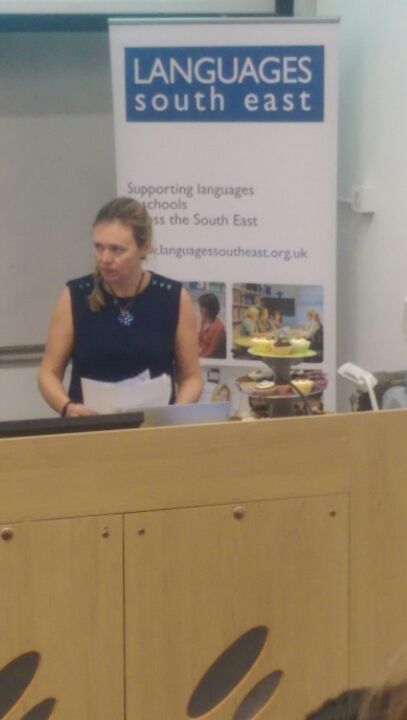
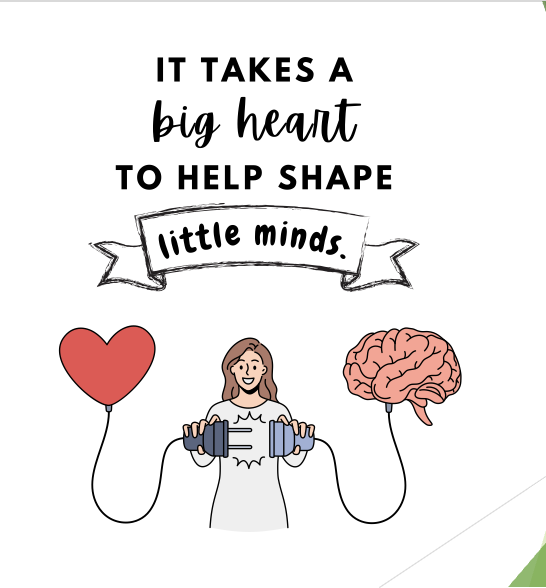
As part of presentation at Language World #LW2026 I intended to share a couple of examples or ‘case studies’ that exemplified what I was saying about the interplay between heart and mind in language learning, and the need to engage both for optimal success.

The first I was able to explain but time was against me and the second was left untold. Below, I share both.
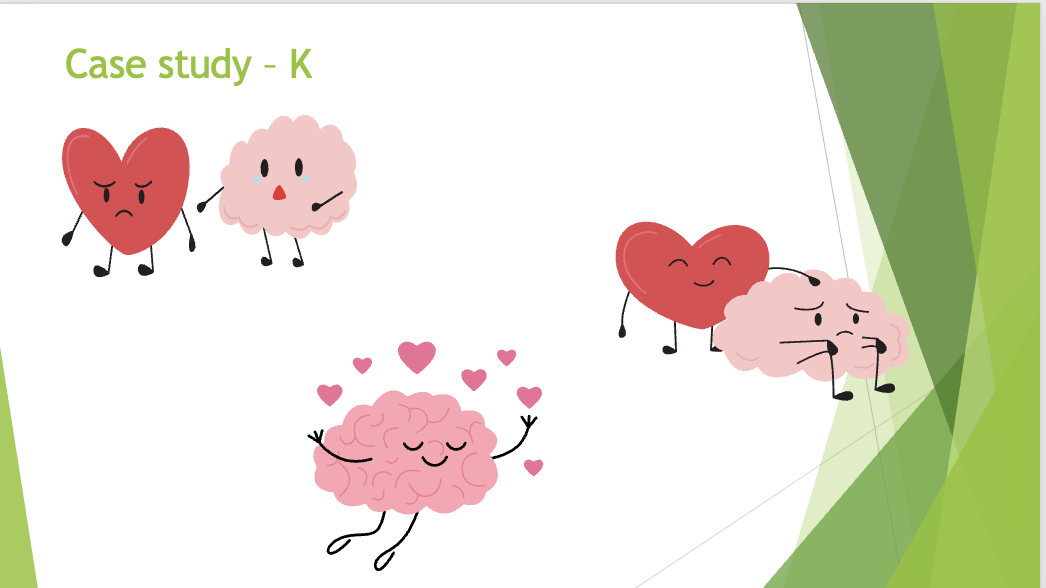
The first concerned a pupil I called K.


In Y3 he struggled to engage in Spanish lessons. His feelings of self efficacy were very low and his expectancy was low so he had little to no motivation. His response when questioned was “I can’t do this. My brain hurts. It’s too hard.” His heart and mind/brain were upset.
Having discovered this, we had a few low key chats outside lesson time, initially not even about Spanish. When he said it was hard, I acknowledged his feelings and talked about how it was my job to help him and make his brain “hurt less” as he put it; we can do it together. I offered support to build his confidence and praised any effort he made. He began to see that he could do it and experienced small successes – he started to enjoy lessons and his heart was in it.
After the summer holidays, K came into Y4 and began the year slowly but with growing confidence. This term there has been an amazing difference – he sees himself as a language learner, experiences success, and is confident to participate. His work isn’t perfect – sometimes he gets overexcited and goes a bit ‘rogue’ and he’s obsessed with Spanish being spoken outside Spain – but he bounces into lessons, wants to talk and is so excited about everything he achieves.


The second case study was more personal as it is my language learning story.
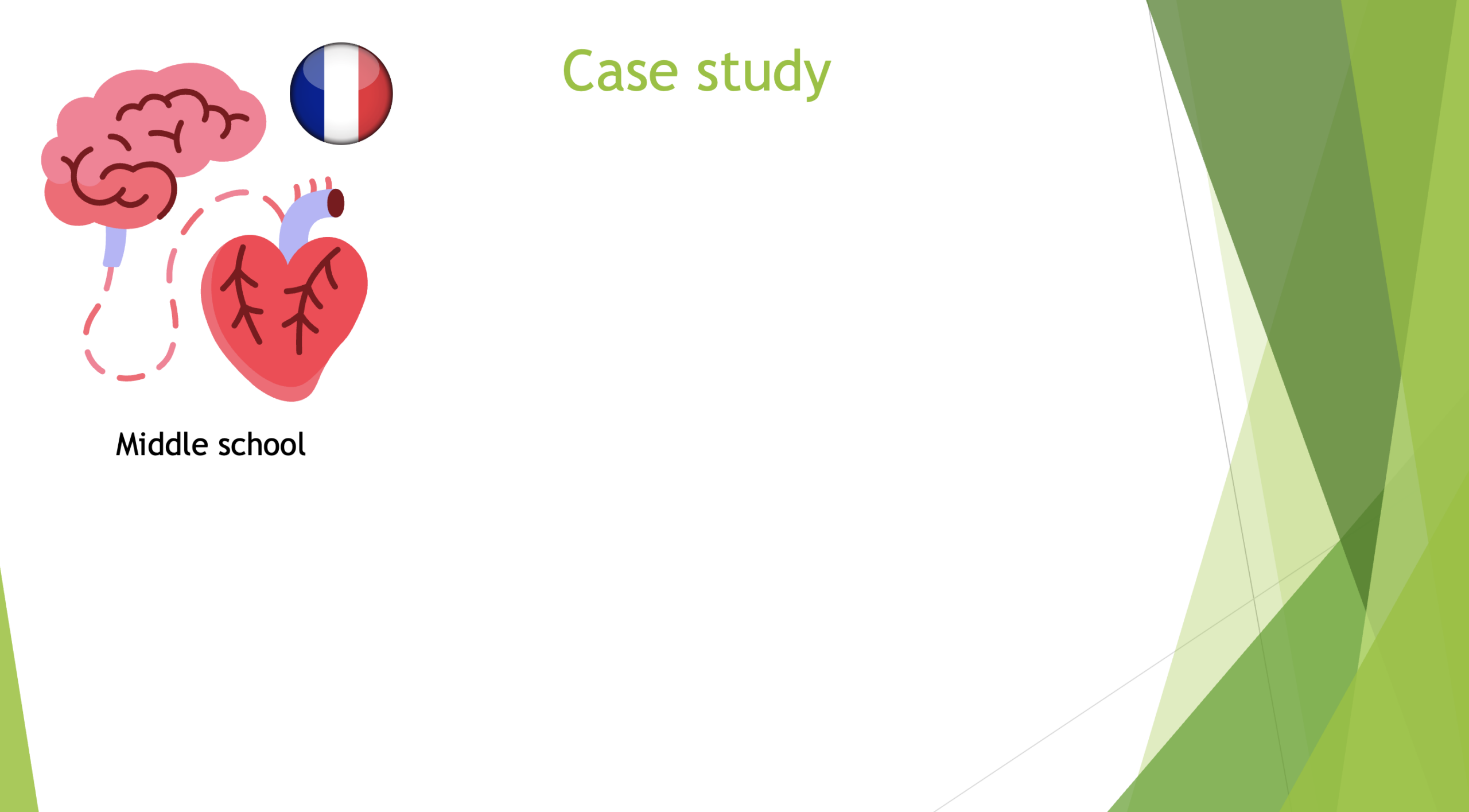
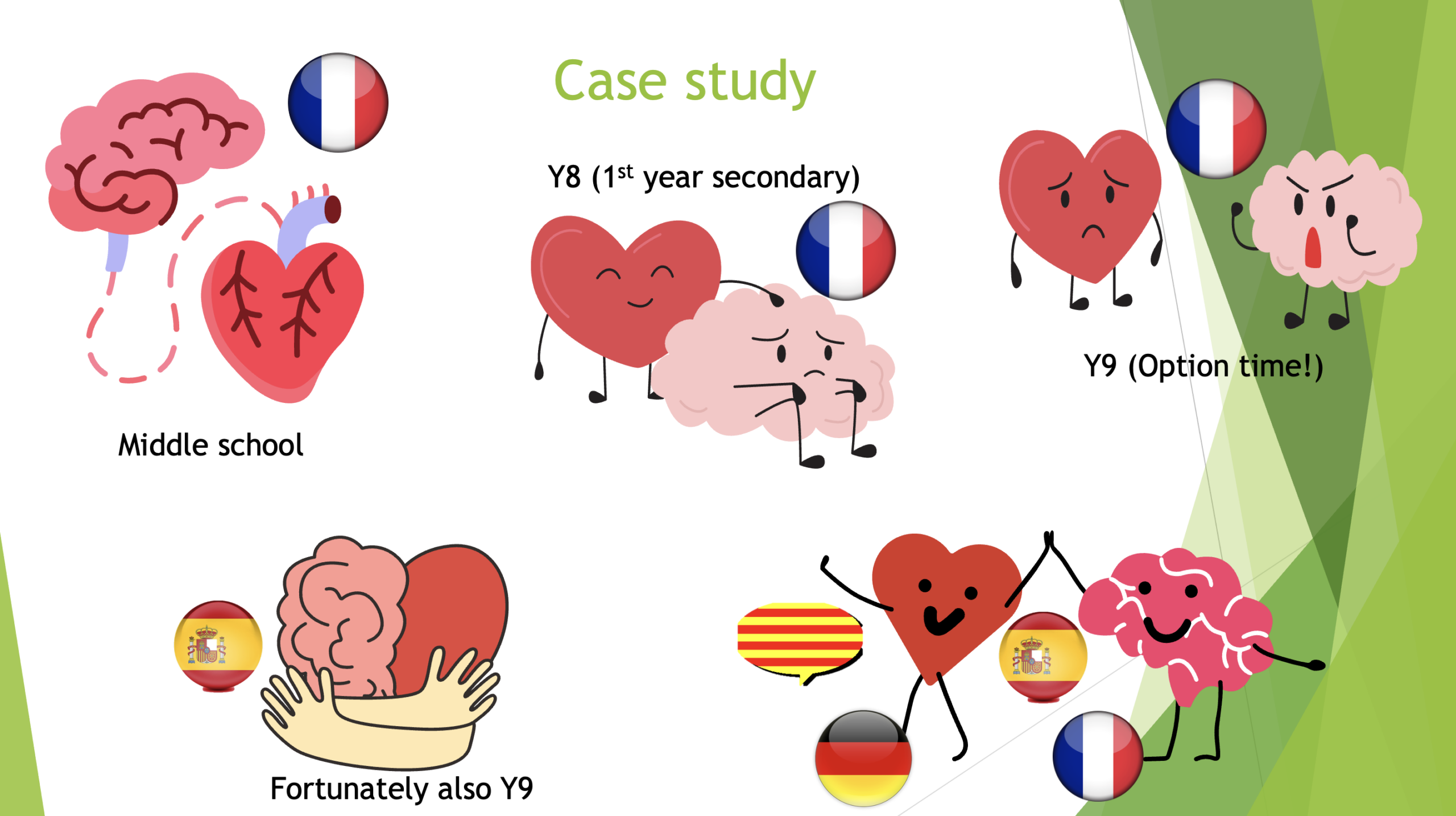
When I started middle school, I began to learn French. I had lovely teachers – Mrs Reeves and Mrs Whiteway – and really enjoyed learning. I’d happily get 100% in vocabulary tests and loved translating booklets about Nicole and Xavier – I remember Xavier falling into a river and shouting “Zut alors! Mon tricot!” My brain enjoyed the challenge of deciphering these unfamiliar words using a dictionary and my heart was set on learning more. In fact my desire to be a teacher, and specifically a primary language teacher was born at this time.
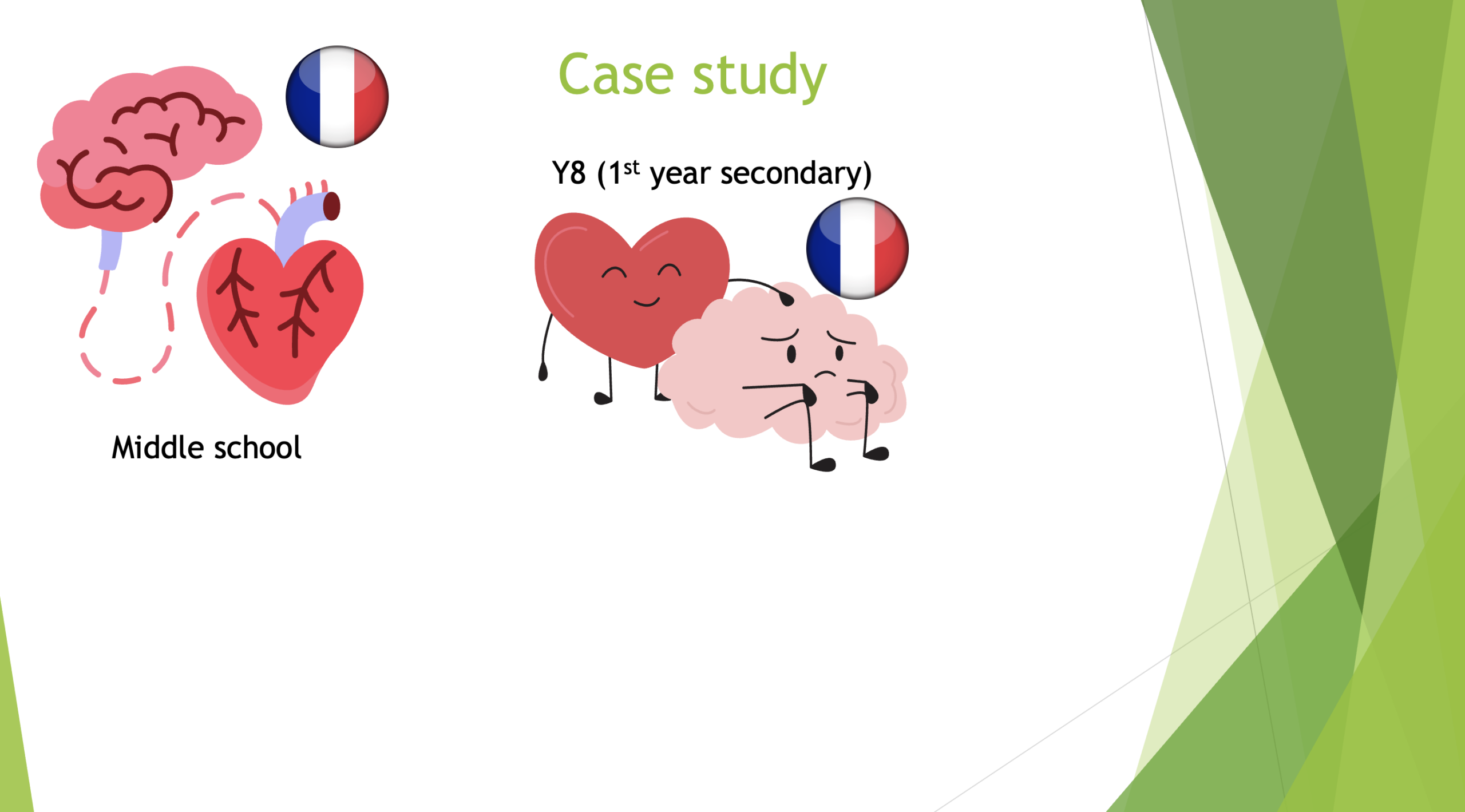
Unless you went to one of the King Edwards Grammar schools (I refused to take the exam much to the annoyance of my teachers) you moved school at the end of Y7.
Y8 dawned and off I went to secondary school and French lessons continued. You’d think I’d be really pleased. Initially I was, as was my teacher who loved my ability to consistently score high marks at Dictée and string sentences together. But my brain was unhappy as there was no challenge; I was repeating everything I’d learned at primary and I was bored. My heart was losing the battle.
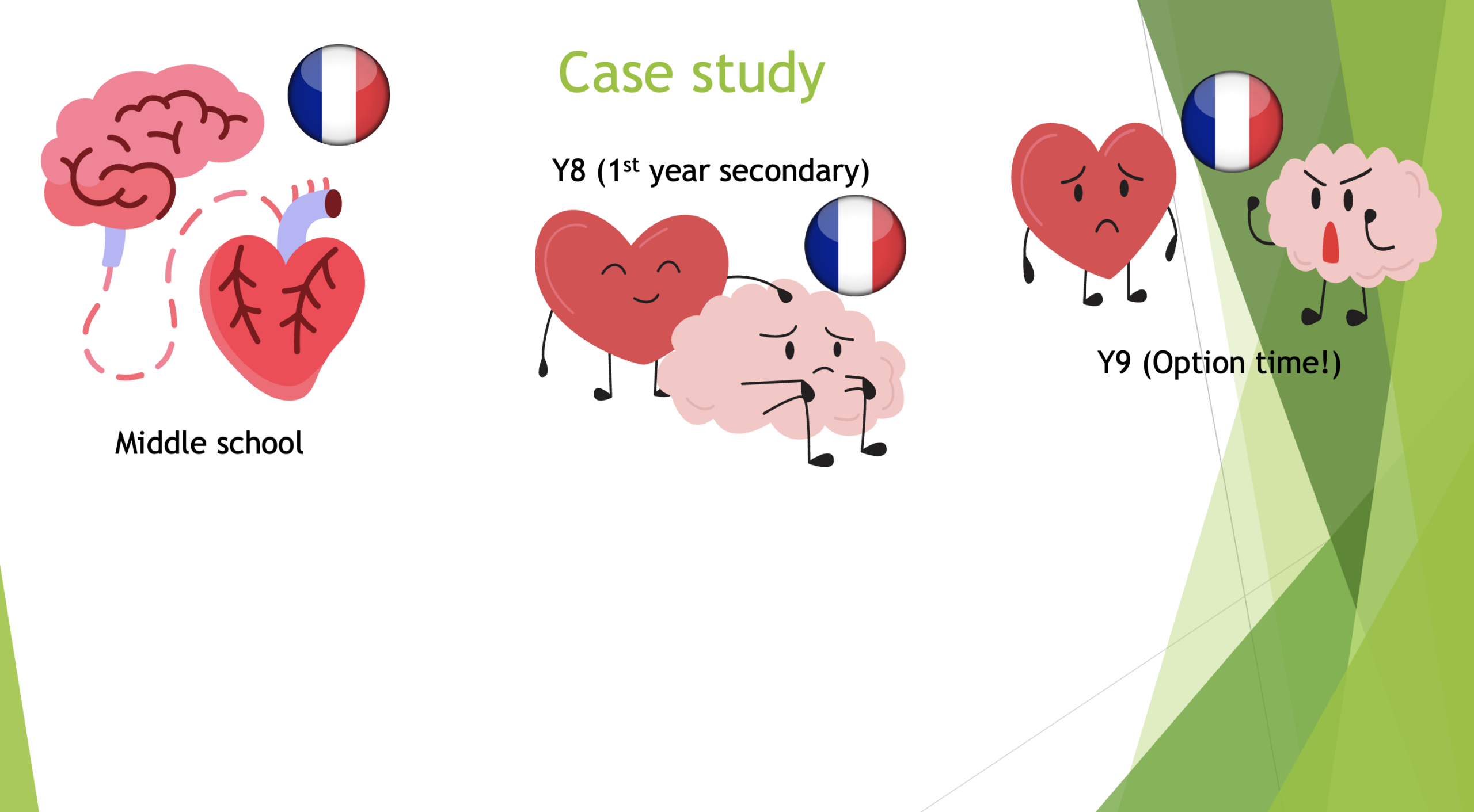
Come the time to choose my options for KS3 and although I was still successful and scored top of my class in our French exam, I was completely fed up with the lack of challenge and there was no way I was choosing French, no matter how much my teacher pleaded with me. I was out of love with French and all that joy and passion I’d had were gone.
This could have been a very sad story but, as you can probably surmise from the fact that I am a language teacher, that’s not the end of the story!
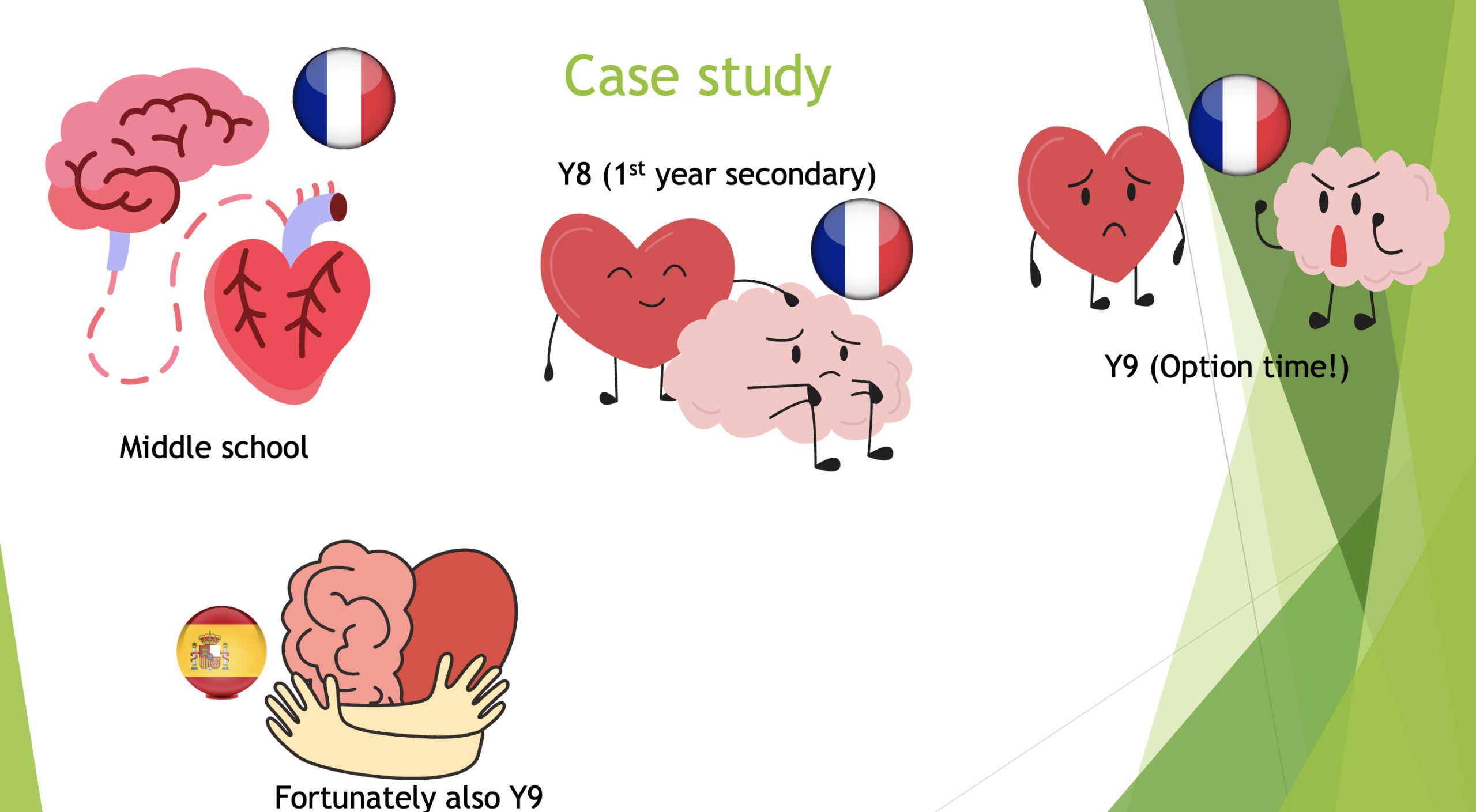
Fortunately, if you were any good at French, in Y9 you had the opportunity to start Spanish or German depending on which half of the year you were in. Having first been to Spain as a baby, travelling in my baby car seat bolted to the floor of my parents’ Morris Minor, and visited several times over my childhood years including being flooded out of our tent in Salou at the age of 5, I was pleased I was in the Spanish half. In class I met Señora Sánchez-Richardson who I can only describe as a crazy Colombian phenomenon who intrigued me and inspired me from day 1. She was strict, demanding, had the highest expectations and the driest sense of humour. Her favourite phrase was ‘Really?’ said with a raised eyebrow and look of incredulity! Every lesson I was challenged to learn not just words and grammar but also little nuggets of culture and ‘real life’ Spain. I talked about my undying love for and gratitude to Señora Sánchez-Richardson at ILLC 5 in 2015 but it’s worth repeating. Continuing the analogy – she engaged my brain with her academic rigour and captured my heart with those snippets of life, nurturing my love of languages back to life. Her name was Luz – quite literally a light in my life!
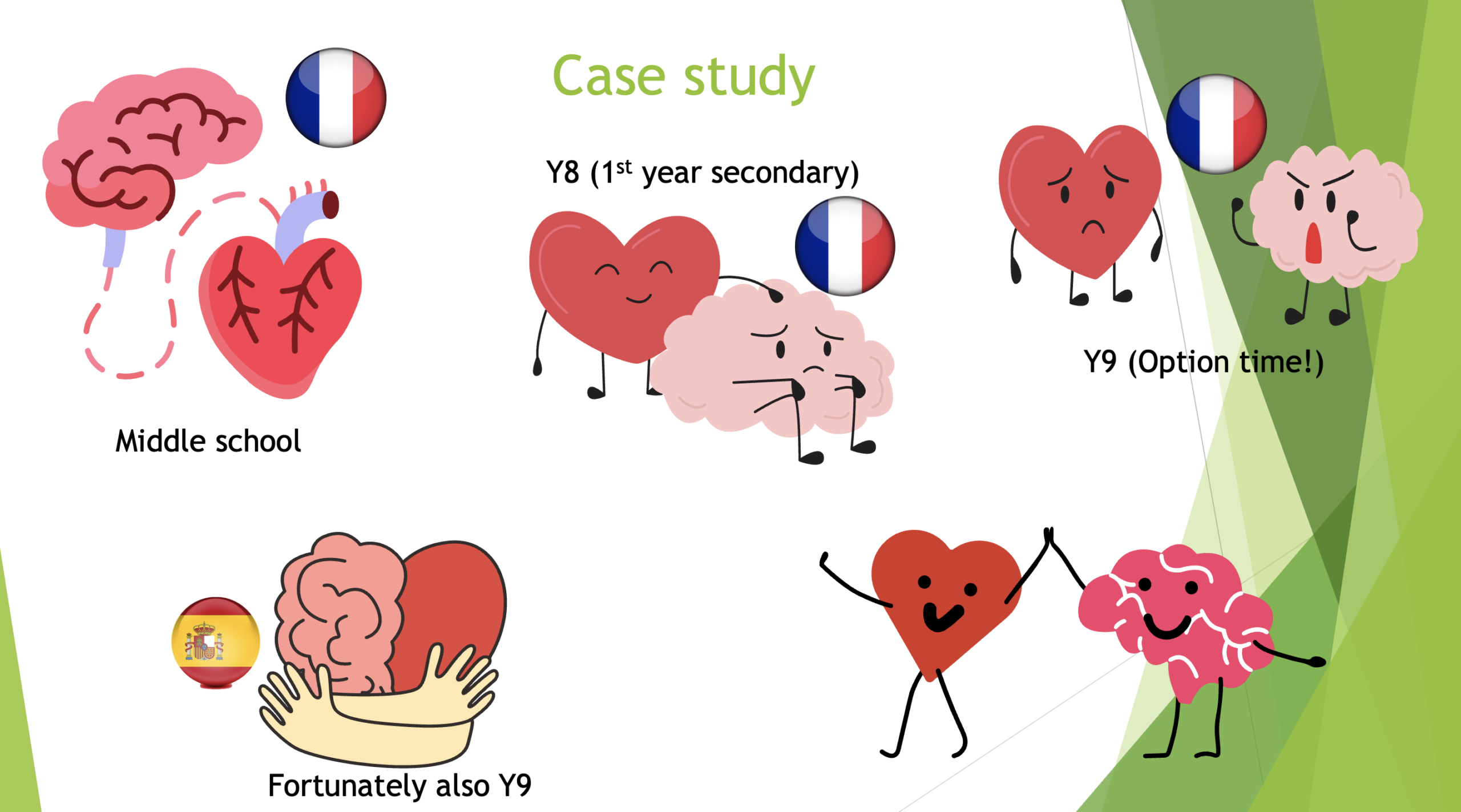
GCSE Spanish was a no brainer and then A level Spanish – Señora S-R continued to teach me joined by Mrs Gunning from the grammar school as we had half our lessons by ‘consortium’ and I discovered Spanish literature. Heart and mind together, skipping happily!
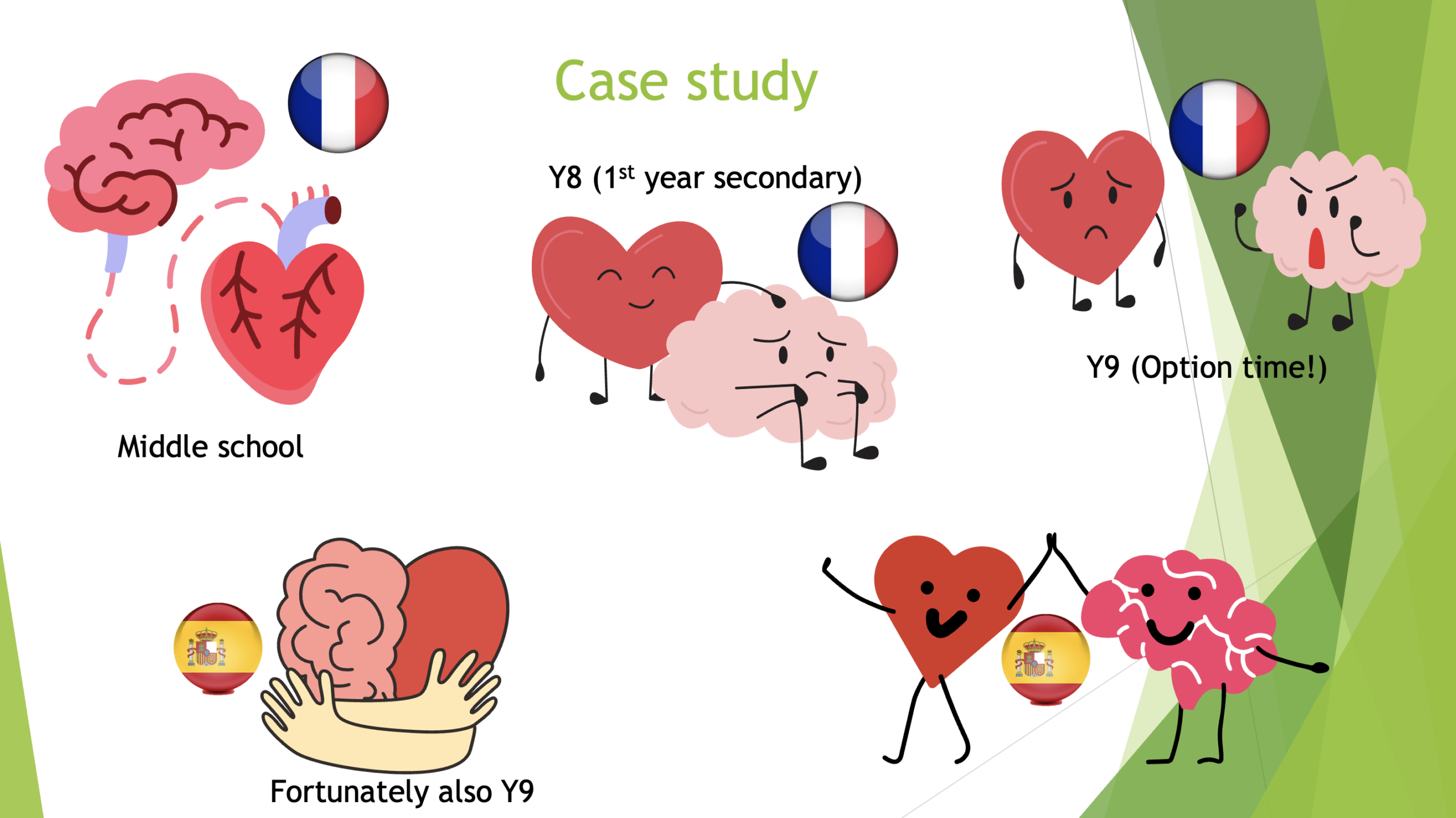
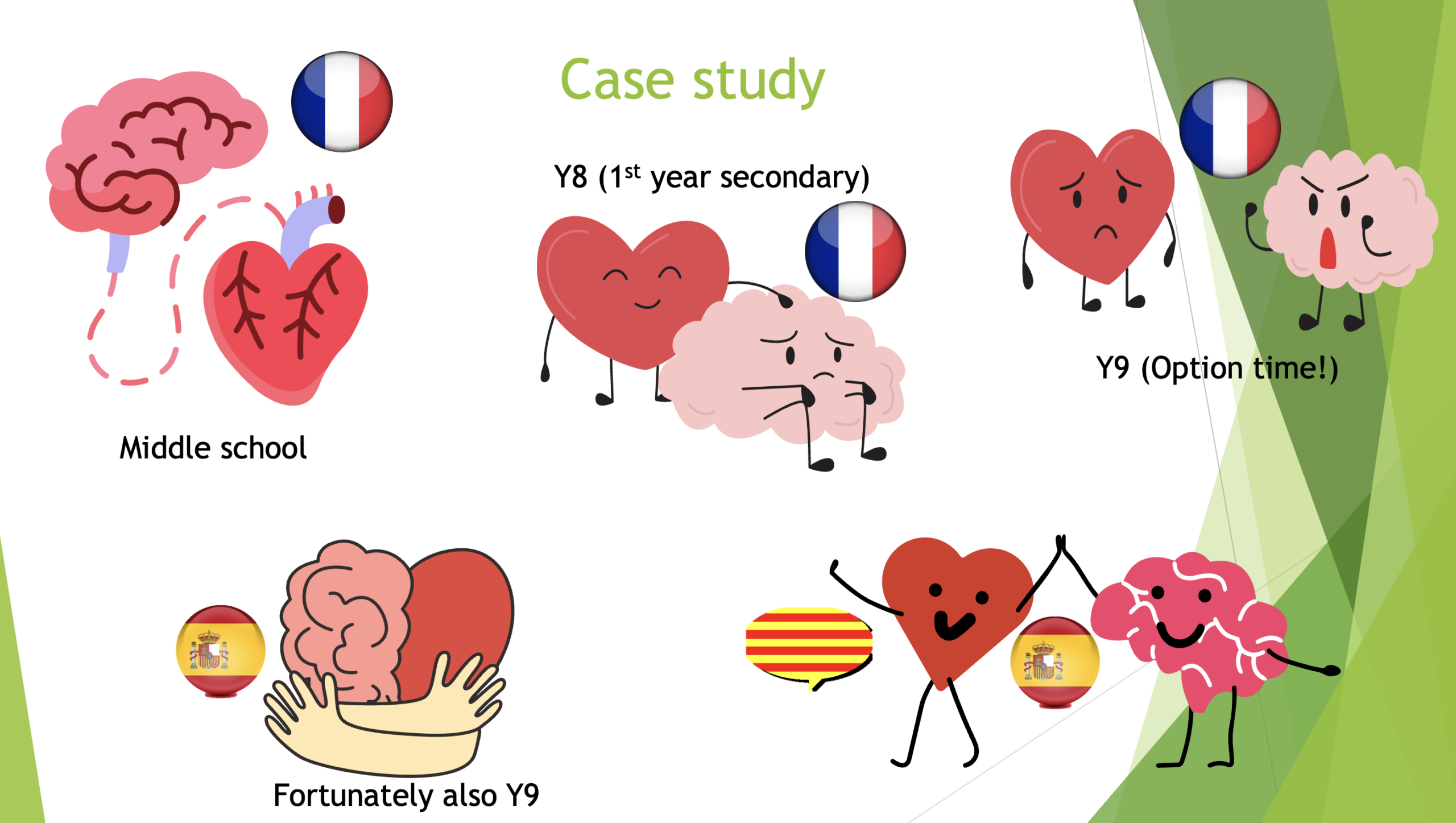
University beckoned and a degree in Spanish. I did look at doing French as one of my 1st year options (you had to do three subjects and I was doing Spanish and English Literature) but without a GCSE it wasn’t possible. Very annoying! In the second year I learned Catalan with the enigmatic Professor Yates and spent a year developing a Mallorquin accent at Universitat des Illes Balears. Years later, this would come in useful when my school was involved in a project with Barcelona, and cause great amusement and then delight to the children who weren’t expecting me to speak their language albeit with an accent that they said made me sound like a peasant!

And my love of language learning continued. Sadly by the time I was old enough to train, it wasn’t possible for me to train as a primary teacher with a language speciality but I did become a teacher – of Spanish and French. In fact, my second job was taking over from my beloved Señora Sánchez-Richardson as Head of Spanish. (She’s also responsible for me joining ALL!) After ten years in secondary I left to follow what I really wanted to do and started to teach primary first at a Prep school and then at my current school. Heart and mind were once more happy and in synch. Twenty plus years later, I still love it.
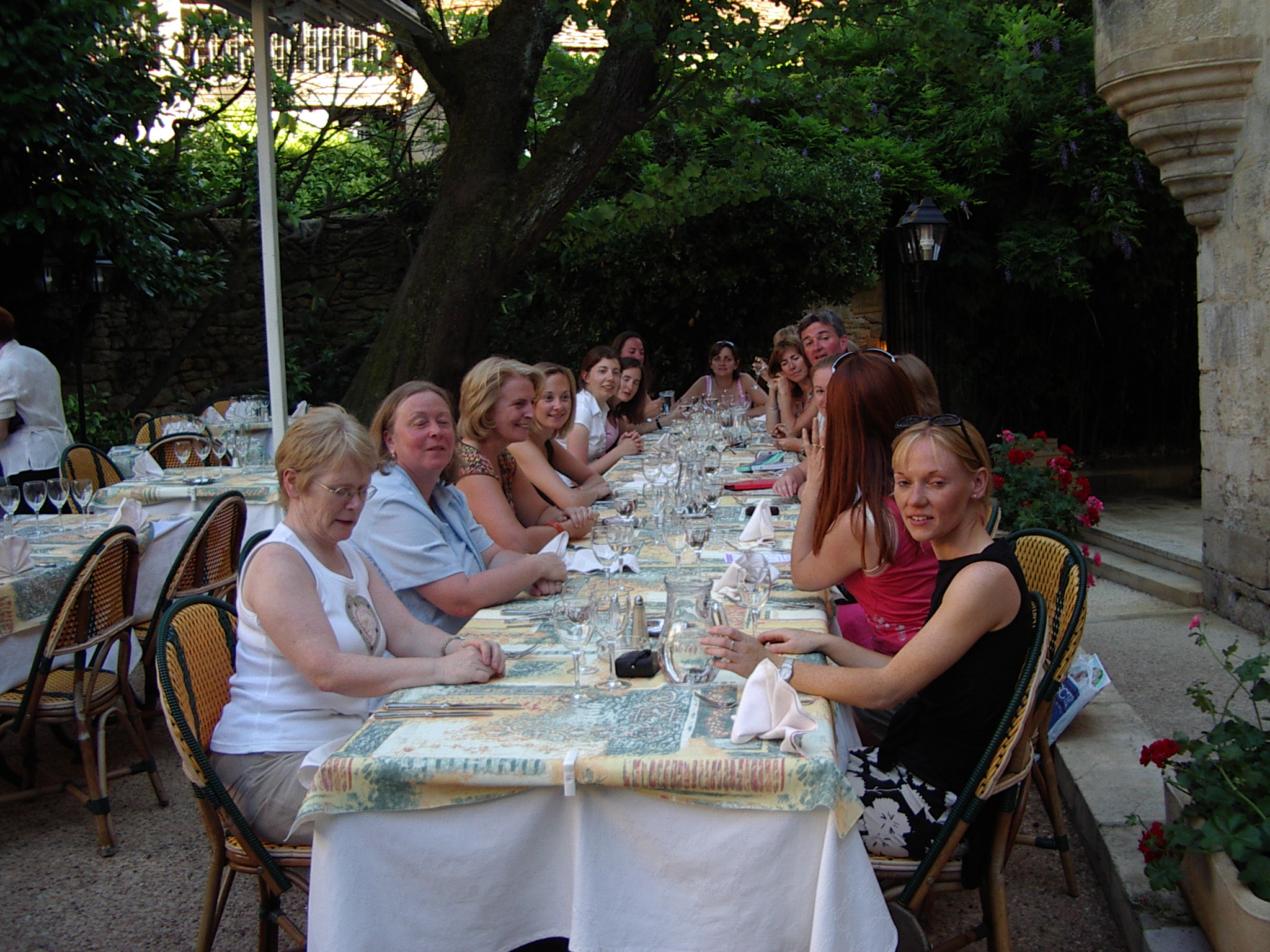
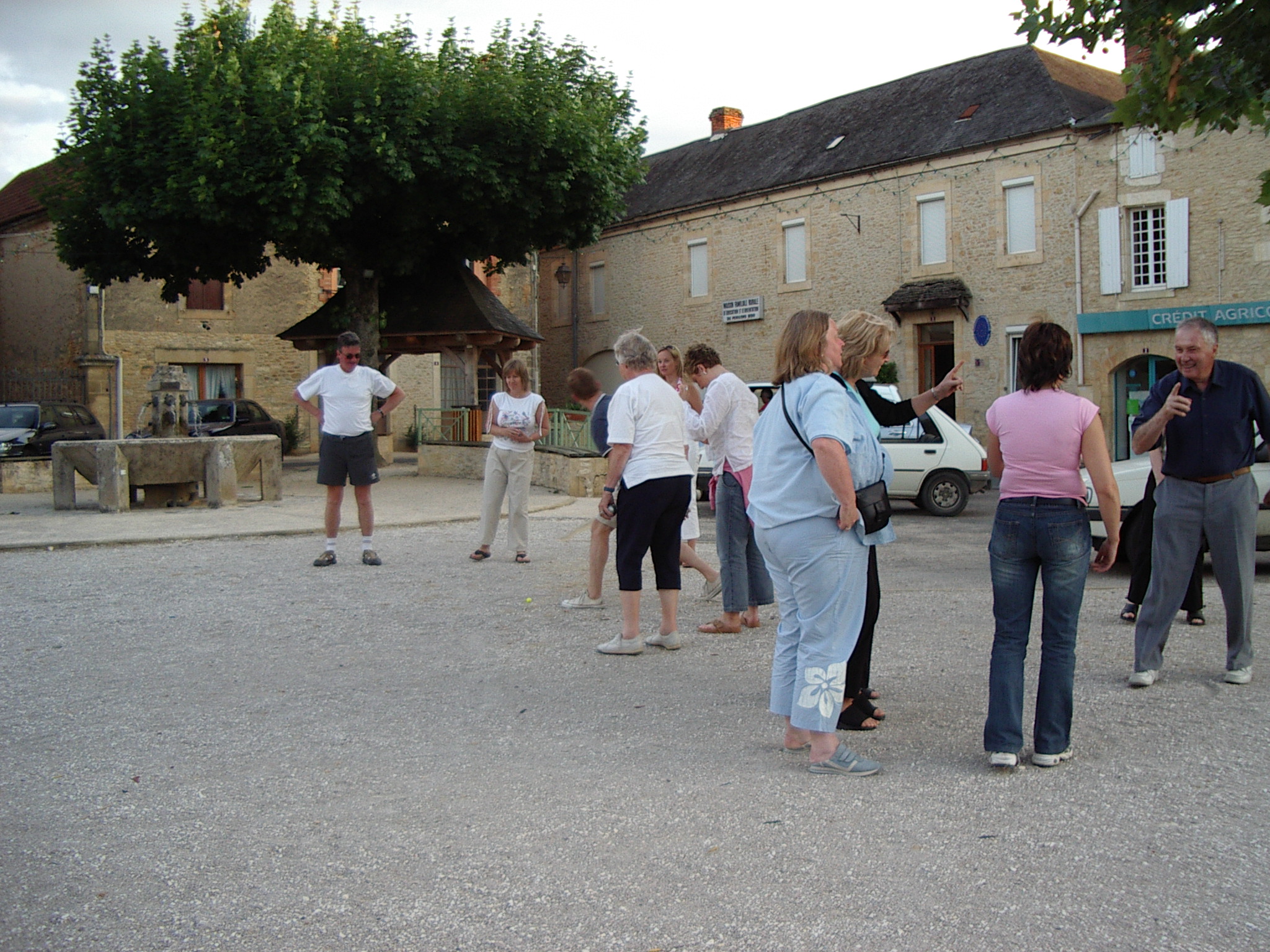
Whilst at the Prep school, I asked to go on a course all about primary pedagogy and French – and the principal said yes. So, leaving my little boys in the care of Mr S, off I went to Salignac in the Dordogne for a week with LFEE and the wonderful . It was really great course with some brilliant people. Not only did I get to connect with my Scottish roots – most of the other participants were Scottish – I also learned lots. However, the most important thing of all to me, and the thing that I will always remember is that I fell back in love with French. As my mind retrieved vocabulary and grammar hidden in the filing cabinet of my brain, my heart began to beat faster and I remembered why I had fallen in love with it in the first place. I remember bursting into tears and blurting out “I love French again!” Thank you Richard (and Elise) 🫶
I went to evening class to carry on my French – until they were stopped! – and then started a German course that led to a certificate, also at evening class. My Dad fell seriously ill and I missed a whole block of lessons but I’d paid for the exam so I turned up and, thanks to my language learning skills and a bit of logic, I passed (and my mark wasn’t too shabby!)
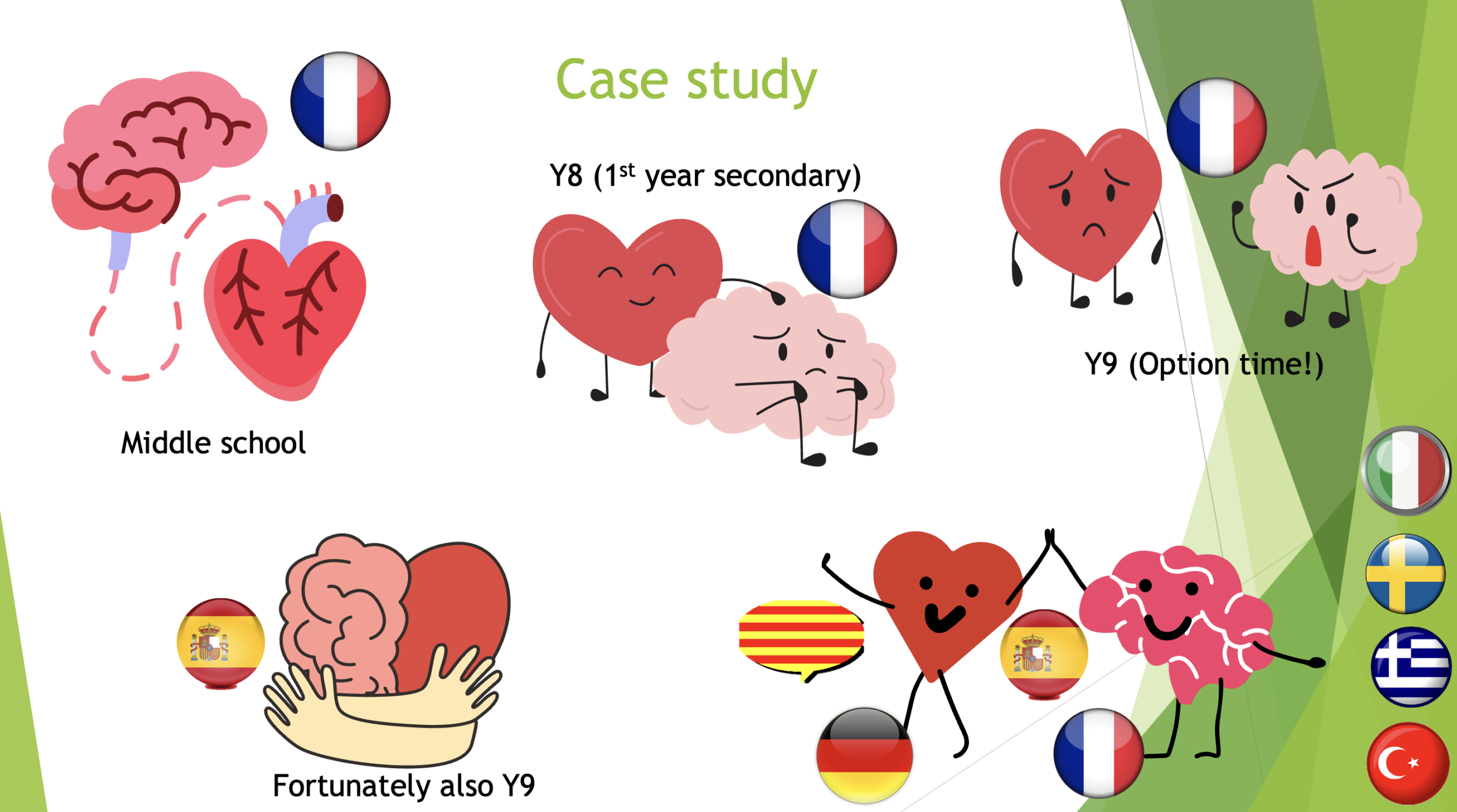
Fast forward a few years and my husband’s job took us to Switzerland for a couple of years and that German was useful – although most of my neighbours preferred to speak to me in English as it wasn’t Schweizerdeutsch. Classes got me to A2 level German. Heart and brain are happy with German because it’s so different from other languages I know and I love the expressions and compound words. I admit that I’ve probably used German more since we came back to England than I did in Winti but I tried really hard! I’m now B1 (according to Duolingo whose course I have completed now!)

I find it really hard when I can’t communicate with people so prior to holidays I try to learn some phrases to help. I’ve tried Italian and Swedish (my husband worked for a Swedish company for a while) – the former was a bit helpful, the latter not so as everyone spoke to me in English but did appreciate my efforts!

And when I was involved in an Erasmus+ project between my school and schools in Spain, Austria, Greece and Türkiye, languages once more linked hearts and minds. In Spain, I was called upon to translate from English to Spanish, and also Spanish to German at times, and was really frustrated that I couldn’t help the Greek and Turkish delegates that were struggling with English. I even had to translate a speech by a local politician without any warning – and it was on the local news! In Austria, we were expecting to do a lesson on Guy Fawkes in English but quickly realised it was going over their heads so off I went, launching into as much German as I could muster- with a lot of acting and sound effects – apparently pretending to be a feuerwerk was much talked about! Come the mobilities in Türkiye and Greece, I was worried that I wouldn’t have the same experience as I had in Spain and Austria, being able to talk to the pupils in their own language, so I made an effort to learn some very basic Turkish so I could at least say my name and ask how people were plus some courtesies and essential phrases!

This quotation has always spoken to me and was proved true in Türkiye where as soon as I spoke two phrases of Turkish I was mobbed by children and followed around like a popstar. It didn’t matter that I really didn’t know much more but I’d spoken their language and they wanted to speak to me. I did learn a little more – especially how to say stop! and careful! as at one point I was nearly knocked off my feet by a swirling mass of children wanting a sticker – but a little went a long way, and our hosts were also really appreciative. Prior to the Greek mobilisation, two of the Austrian partners joined in the language learning and we all had a go at learning some Greek – to the point that it became a bit of a thing and we were given a Greek ‘exam’ Once more, using my mind, led by my heart desire to communicate had engaged hearts and minds.

This has ended up being longer than I’d planned but I wanted to tell the story as to me it perfectly explains my point about knowledge (what you know) not being enough to sustain learning – your heart (how you feel) has to be engaged too.

And that goes for teachers too!
I’ve been working with Anamil Tech on Pacca Alpaca for a while now. The apps Pacca Alpaca and Pacca Alpaca Travel Playtime have proved very popular and are now available in English, Arabic, French, German, Spanish, Mandarin and Welsh.

Well, there is now a Youtube channel of free videos to accompany the app. You can subscribe to Pacca Alpaca for more kids learning videos in Spanish, English, French and Arabic here – http://bit.ly/paccayoutube

Here’s the first Spanish video, released today!


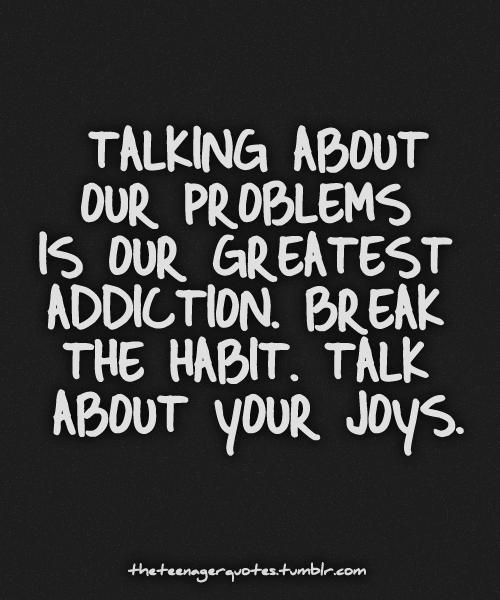
I choose joy

| 2 Comments

On Sunday I posted the following image on Twitter with the comment I choose joy.

I’ve  pondered this post all week and finally found time to write it. It’s provoked by an increasing trend to point out all that is bad in life, and more specifically, education.

Whilst I am quite aware that there are a myriad ways in which our world is broken, a multitude of things that drive me bananas about education and multiple aspects of my working life that I’d like to be different, I make a choice to not wallow like a hippo. I’m not ignoring the problems; they’re sometimes fairly important and need addressing. However, if I focus solely on them, my life is frankly miserable and unpleasant.

I make another choice, the choice to (try to) find solutions, and if not solutions, work arounds, compromises and ways to make difficulties less burdensome. I don’t have an answer to everything, in fact, I have answers to very few things but I do my best.

We follow a PSHE programme called SUMO at one of my schools, and one of the principles is not to be Doris Day (which is counterintuitive as I grew up wanting to be her so badly!) and claim “Que será, será.  Whatever will be, will be. The future’s not ours you see.” As a teacher I know that the near future is mine but the longer future belongs to my pupils (and to my children), and my role is to prepare and equip them for it. We teach our pupils to question and find solutions to their problems, to talk to one another, to celebrate successes and share and support one another in hard times. Surely if we model misery and moaning that sets the wrong example?

Don’t get me wrong, I have a whinge with the best of them from time to time, especially when I’m tired but all the time? I’ve written before about this in a post called Transformers and Reepsiepie added to my Optimist Prime/Negatron analogy by talking about Radiators and Drains; in every staffroom, workplace and social media site, there are those who drain all positivity and life. I want to sit next to the radiator! Increasingly I am choosing not to spend long periods of time on Twitter for just this reason, and likewise I have left groups on other social media platforms as their negativity was dragging me down.

I haven’t left Languages in Primary Schools though as, just like the marvellous Talkabout Primary MFL used to be, it is a place of celebrating all that is going well, sharing ideas, and helping out people with queries, worries and emergencies. The members are realistic about the task we face – and who couldn’t do with more time to teach their subject, less last minute changes of plan, decreased paperwork, 100% attention and more energy and time to do all we’d like to do – but it’s a place full of radiators who, when the going is tough, share their experience, and to continue the analogy, warmth with others. And isn’t that far better than pointing out all the things that the person did wrong, or adding to their woes with a list of your own?  I’d like to think that this website is a radiator too.

For me, life can sometimes be uphill struggle which may surprise some who only ever see a smiling bouncy Lisibo, but it’s true. Sometimes that bounce is an act of will and only happens because I’m working hard at it, like a swan madly swimming under the water. My decision to choose joy is a lifestyle, and lifesaving, choice.

I write a Grateful blog each day in which I write things for which I am grateful; last year it was things that made me smile. Sometimes I don’t get it written and published because I’m tired but the thought is still there. I’d encourage you to do the same.

Yes, life is challenging and teaching is hard for a variety of reasons, but there are so many joys too. I could focus on the fact that yesterday I was on break duty, I didn’t get my lunch eaten and Y6 took advantage of my good nature, there was staff meeting, I didn’t get to teach the classes I was supposed to and I got an impatient email asking me to do something that I’d already said I’d do which isn’t due until next week anyway. I’d rather list my joys: I spent lunchtime yesterday dancing around the dining hall with pupils as they ate their Christmas lunch, singing at the top of my lungs and getting very hot. In the afternoon, we watched Y1 and 2 perform their play. We opened Christmas cards from partner schools in Finland, Spain and Poland, and borrowed a Polish pupil from his class to read us the latter. He glowed with pride! A whole stream of Reception children (who I have never taught) walked past me as I was photocopying and smiled, and quite a few responded to my ¡Buenos días! with a cheerful ¡Hola! A colleague helped me find my mislaid iPad case; a volunteer student stayed inside with a child at playtime so I could go to the toilet and get a cup of tea. At some point, a child stuck a sticker to my jumper – no idea who did it but it made me smile. A child saw two others about to have a fight and intervened before it escalated, sending someone to fetch me in case. I was met with groans of disappointment when I said there was no Spanish next week. I sang in the staff meeting.  We hatched a plan for the teachers to sing a song in the end of term concert.

And that’s just one day.

You may also like this post on a similar theme:

Ser optimista

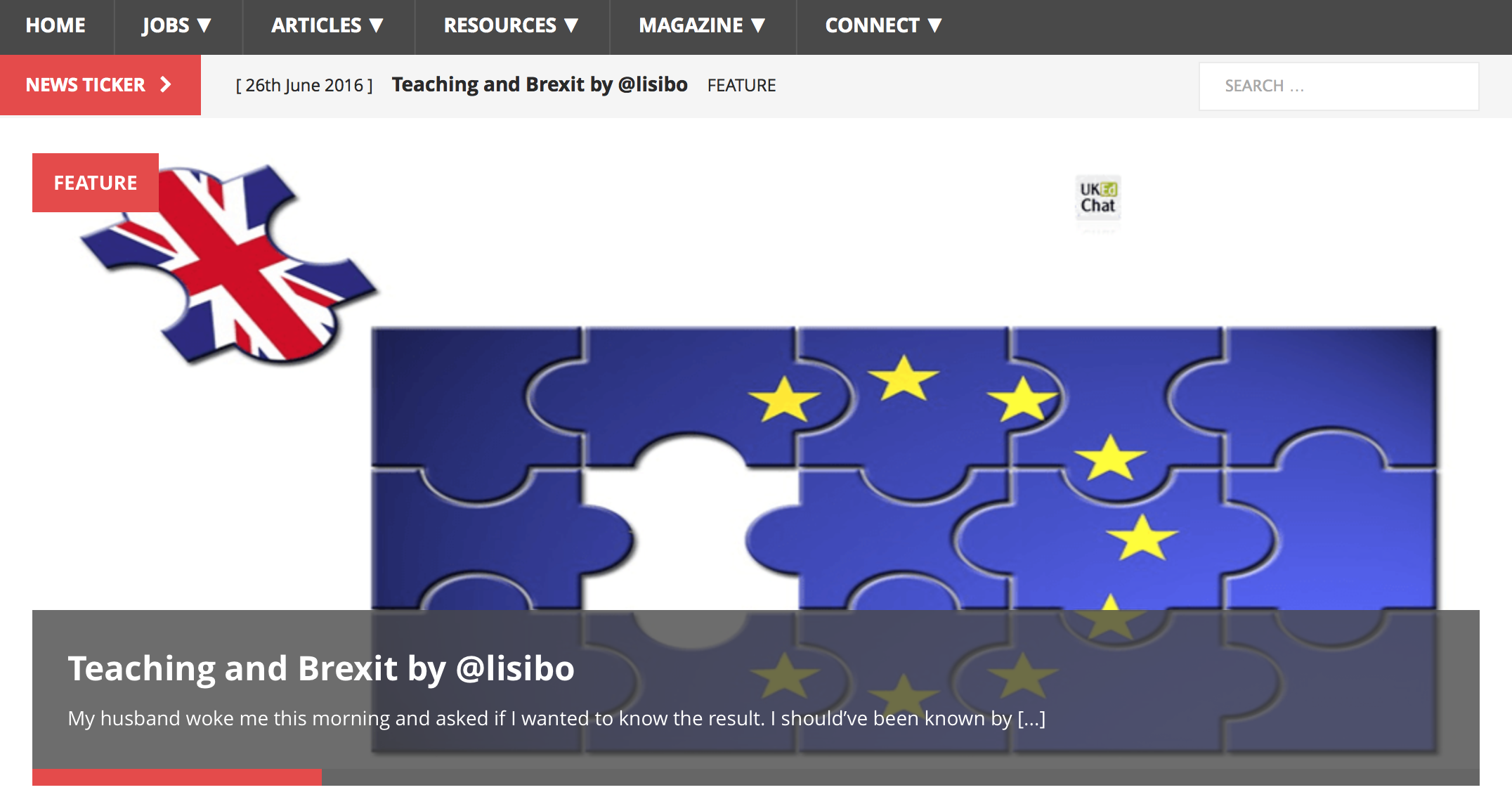
Screen Shot 2016-06-26 at 20.53.57At about 1130am on Friday I was contacted and asked by UKEDChat if I wanted to write a guest blog post about the impact Brexit could/will have on language learning. I didn’t write it straight away for several reasons not least that I didn’t actually have time until very late that night to think. When I did, I wrote my personal reflection on the events and implications.

The post can be found on the UKEdChat website and the text is reproduced below:

My husband woke me this morning and asked if I wanted to know the result. I should’ve been known by his voice but when he said ‘It was Leave by 52% to 48%’ it hit me like a ton of bricks and I burst into tears.

My first thought was my friends and pupils and how some of them would now feel.

I am a language teacher and many of my friends and colleagues across the country are ‘native speakers’ e.g. French/Spanish/German nationals who teach their native language. Others fell in love and moved here to be with their partners. Some have lived in this country for many years and have never felt the need to go to the (not inconsiderable) expense of officially become British.  Many have British partners, children who have grown up here and consider themselves part of this country, working, paying taxes, contributing to their communities. They could not vote. You can read what one felt here.

The Referendum may have been about whether we stay in the EU or not, but the waters were unfortunately muddied by the issue of immigration.  As I turned on social media, my fears were confirmed. I wasn’t in school but I know that several children were aware of what a ‘Leave’ verdict could mean for their families.

My job as a language teacher isn’t just about teaching words, structures and grammar. It’s about a context for that language, be it in Spain or South America, France, Belgium, Senegal. It’s about culture, lifestyle, food that may be different to ‘our’ ways. It involves encouraging discussion of our differences to help us understand more about ourselves, and then the joy of seeing things from someone else’s perspective, celebrating that we’re not all identical.

Through eTwinning, Comenius, Comenius Reggio and Erasmus +, all funded by the EU, my school has changed over the last ten years to be the globally minded place that it is now.  Teachers have visited colleagues in Europe, we’ve received visitors and much work has been done online, via Skype and vieo conferencing.

So what will Leave mean?

My initial reaction was posted at 8:15am

This morning I am distraught. Can’t put it into words but can I just say to my many friends who now feel unwelcome in the country that is their home – I love you. Farage, Gove, Johnson et al do not speak for me and my family. I don’t know what the future holds but I know that as long as I have breath I’ll still be championing cooperation, understanding, compassion and celebrating diversity. “We have more in common with each other than things that divide us.

Taking my eldest son to a university open day gave me time to think and reflect. My conclusion?

My task hasn’t really changed. I will still teach Spanish the same way I always did. I will still see Intercultural understanding as a vital part of my role. I will still find ways to bring other countries into my classroom. It will be harder as there is uncertainty about what will happen to the wonderful programmes like eTwinning. As a school we will still celebrate the languages and cultures of our pupils as we did whilst people were voting in another building on our site. My son and others intending to study languages at university may find their year abroad harder to fund without Erasmus funding. I might get asked more often ‘why do we learn Spanish; everyone speaks English!’ but my answer will remain the same. If anything, I see my role as even more important than before. My son reminded me of the postcard that was on the shelf at the bottom of our stairs at home featuring the words of Nelson Mandela:

If you talk to a man in a language he understands, that goes to his head. If you talk to him in his language, that goes to his heart.

His point was that, given the number of treaties, agreements and the like that the United Kingdom  now need to renegotiate, language skills will be all the more important, a point born out by experience.

The Leave vote doesn’t mean that we are no longer European.  I am European, speaking several languages, having lived in three European countries and that hasn’t changed. Time will tell the full implications for languages and the global dimension; statements from The British Council and ALL make me more optimistic.  So whilst my tears have ceased, my determination has not and, judging by the comments on social media and in person, nor has that of my fellow linguists!

We may need to work harder for opportunities but …

Lisibo will be very busy over the next two weeks with three talks in the space of 8 days. Bit like buses 😉

Screen Shot 2016-06-10 at 19.34.03

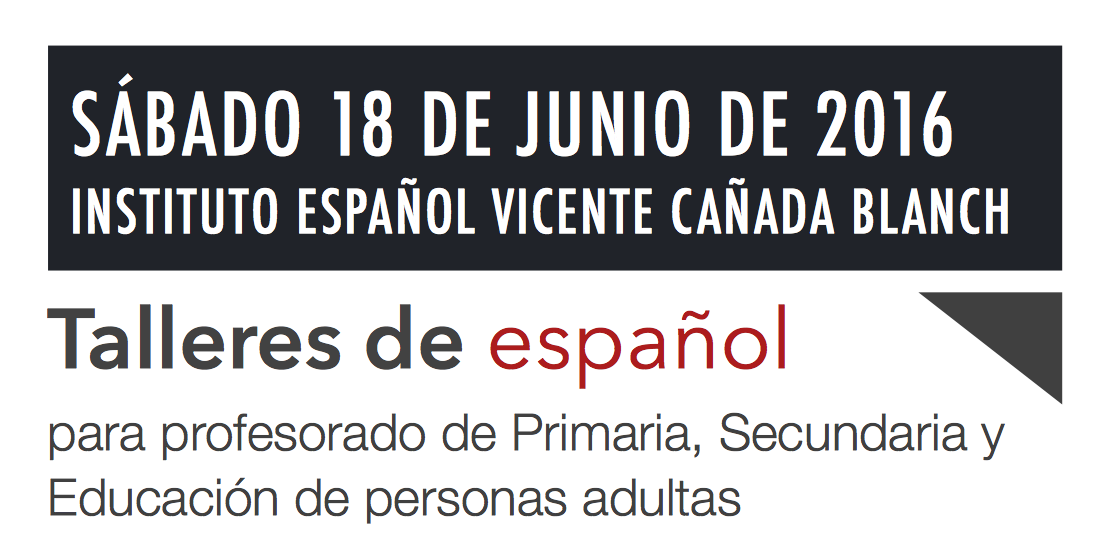
Following on from Language World and the success of the Show and Tell, Jesús from the Consejería de Educación asked if I could facilitate one at the annual Talleres de Español. Unfortunately my partner in crime Clare is unavailable so I’m going it alone. However, I hope that there will be participants who want to share their ideas, celebrate their successes and suggest suitable resources during the session so I don’t end up talking for the entire 50 minutes.

The programme offers sessions in the morning tailored specifically to Primary and Secondary colleagues followed by general sessions and cultural workshops after lunch (which is always very special!) I’m speaking at both of the morning sessions which means I can’t attend the parallel Primary sessions (hoping someone will take notes for me – any volunteers?) but am spoilt for choice in the afternoon.

Click to download the programme


I spoke at the Talleres in 2011 – you can read all about it here and it will be wonderful to return to Instituto Español Vicente Cañada Blanch. And I always enjoy meeting others and discovering new ideas! Why not join me?

Above is the flyer and below are the details of each session and the presenter bios.

And here’s how to register:

If you’ve read the July edition of UKEDmagazine you may have read my article entitled Top ten tips for Primary Language Learning. If you haven’t, you can read the unedited version below or the official version at this link

Top ten tips for Primary Language Learning

A wide variety of people teach languages in Primary schools, probably more than in any other ‘subject’. Whether you’re a class teacher with or without language skills, a reluctant language coordinator or a visiting language specialist (to name but a few possibilities) here are my top ten tips for primary language teaching and learning.

  1. Phonics are vital

It doesn’t matter which language you teach, making the correct sounds of that language is key. Working on phonics from the start builds a strong foundation on which learners can build, enabling them to see new words and say them accurately. Have a look at Rachel Hawkes’ website where there are links to free resources covering French Spanish German and Italian. http://www.rachelhawkes.com/Resources/Phonics/Phonics.php


  1. Songs and rhymes motivate and teach

A good way to increase confidence in reading and speaking the language is by sharing songs, poems and rhymes. This is also a good way to reinforce phonic knowledge and explore the rhythms of the language. Mama Lisa has songs and rhymes in many languages, often with a sound file giving the correct pronunciation and a translation into English so you know what you’re saying! There are also many songs and rhymes on Youtube on channels such as Basho and Friends or by searching for the artist such as Alain le lait


  1. Dramatic stories

Using stories – in translation or original language – is another great tool for language learning as they are familiar and often very repetitive. My favourites include Oso pardo, ¿qué ves?, Le navet enorme and Kleiner weisser Fisch as they lend themselves to acting out (even Y6 like acting!) and are easy for learners to adapt into their own stories. For example, Y5 invented stories based on Le navet enorme that included a child who didn’t want to get in the bath and had to be pulled to the bathroom, a teacher stuck in the PE cupboard and a car that broke down and needed to be pushed.


  1. Technology has its place

There are many opportunities for using technology to enhance language learning such as recording, reviewing and refining speaking activities using Audacity or an app like VoiceRecordPro, or performing speeches and role plays using Tellagami, YakitKids, or Puppet Pals.  BookCreator app is an excellent tool for creating multimedia books including text, sound, video, hyperlinks, doodles and pictures; incredibly easy to use and suitable for young children as well as those who are less confident with technology. And why not use Build Your Wildself or Switchzoo to create hybrid animals then describe them in the language.


  1. Share!

Using technology is also a great way to enable sharing of the great things that go on in language learning. Whether it is via the school website or VLE, tweeted or shared on a class/school blog, celebrating language learning gives it status and also provides an audience and a purpose for learning. Additionally, learners are able to take their learning home with them digitally; the excitement of pupils when we made our first podcast nine or ten years ago was great. “I’m on my Gran’s iPod!” was my favourite comment.


  1. Use anything you can get your hands on

The primary classroom is full of things that can be used and adapted for language learning. Number fans are great for counting and also giving feedback with numbered images for example. Mini whiteboards allow learners to write and correct without committing it to paper as well as drawing images to show understanding of vocabulary or instructions. Unifix cubes can be used for ordering ideas or vocabulary and cushions make great impromptu puppets for speaking or islands for phoneme sorting!


  1. Grammar isn’t a dirty word

Primary learners are very familiar with grammatical terms and enjoy comparing the grammar of other languages, making links and finding differences. Sorting words into boxes according to gender, making human sentences to explore word order and creating verb flowers or spiders are just some ways of making grammar fun and memorable.


  1. Integrate language learning into the curriculum

Language learning shouldn’t be seen as a standalone but, as much as possible, integrated into the primary curriculum. As there is no prescribed content in the KS2 PoS, it’s possible to teach the skills through whatever topic if you use a little imagination. And where full integration is tricky or where a specialist delivers the lesson, a class teacher can always build language into routines such as PE warmups, lining up, the register and so on, even if their knowledge of the language is limited.


  1. Make links

Don’t just make cross curricular links, but also cross country and cross cultural links. Making contact with children that speak the language you’re learning is very motivating and gives a real purpose to learning. It also increases learners’ understanding of other cultures as well as considering their own in new ways. The British Council SchoolsOnline is a good place to start the search for partners.


  1. Celebrate all languages

Most of all, celebrate all languages. Many learners already speak more than one language which is a valuable skill. Encourage them to share how to say things in their languages; comparing and contrasting numbers or colours in a variety of languages is a fun activity as learners try to group similar words together.

This article first appeared in the July 2015 Edition of UKEdMagazine

If you’d like to read more of the magazine that includes other articles about language learning including one of target language by @reebekwylie and Progress in MFL by @jakehuntonMFL the links are below.

You can buy a printed copy of the magazine by clicking here, or

Freely read online by clicking Here

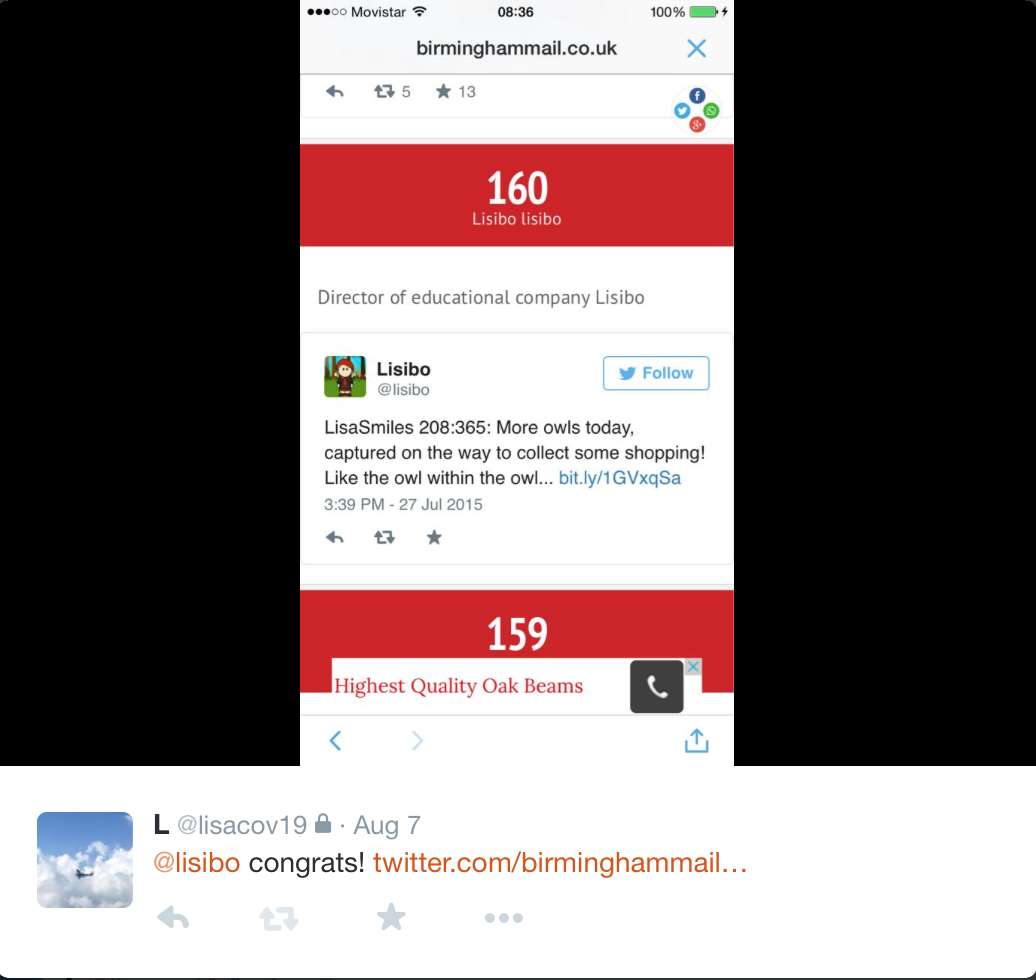
IMG_4570I received this tweet from @lisacov19 whilst I was holiday, offering congratulations.

Screen Shot 2015-08-26 at 15.57.10

I had no idea what I’d done – surely I wasn’t been congratulated on collecting owls? So had to check out the link which explained more.

Social media analysts Lissted have created a list of the top 250 Twitter accounts across Birmingham, Solihull and the Black Country which have with the biggest impact on the UK.

And it seems that I claimed 160th place. Of course, I then wanted to know who I’d superseded in ‘influence.’

So, apart from Black Sabbath (191st) and the Donkey Sanctuary (164th), I am more influential than Emma Jesson (ITV weather girl 196th) Bradley Will Simpson (frontman of The Vamps 187th), The Education Show (184th), Fifth Gear (177th) the Birmingham City FC newsroom (170th) Jaguar LandRover (167th) and Lloyds Pharmacy (162nd). I even beat The Bullring by one place – that pleased me!

And then onto the question of who’s more influential than me.

Birmingham Police and The Library of Birmingham are just ahead of me in 158th and 156th respectively. Ian Bell (cricketer 148th) CBSO (133rd) Birmingham Royal Ballet (131st) Ofqual (121st) Ed James (96th) DuranDuran (91st) Joleon Lescott (73rd – not beating him was a cause of much dismay to my boys!) The Gadget Show (55th) and Katherine Merry, 400m athletic hero of my childhood (although she never replaced Kathy Cook in my affections) in 50th all have more influence over

The top 49 can be found here. It includes paraolympian Ellie Simmonds, presenter Alison Hammond, various universities and quite few MPs ; in fact the top three are Liam Byrne (Labour MP for Hodge Hill), Michael Fabricant (Conservative MP for Lichfield) and number 1 is Tom Watson, MP for West Bromwich East and aspiring Deputy Leader of the Labour Party.

I can’t find any teachers ahead of me. There are a few parenting bloggers – Mama Geek @zoecorkhill and @V82CHRIS are 103rd and 102nd and @mrsshilts and @ericahughes are 70th and 69th – and Paul Bradshaw who is a media lecturer at Birmingham City University as well as ‘a data journalist’ is 5th.

So does that make me the most influential tweeting teacher in Birmingham, Solihull and the Black Country?  

Perhaps I should add that to my presentation next time I talk about Twitter


Related posts:

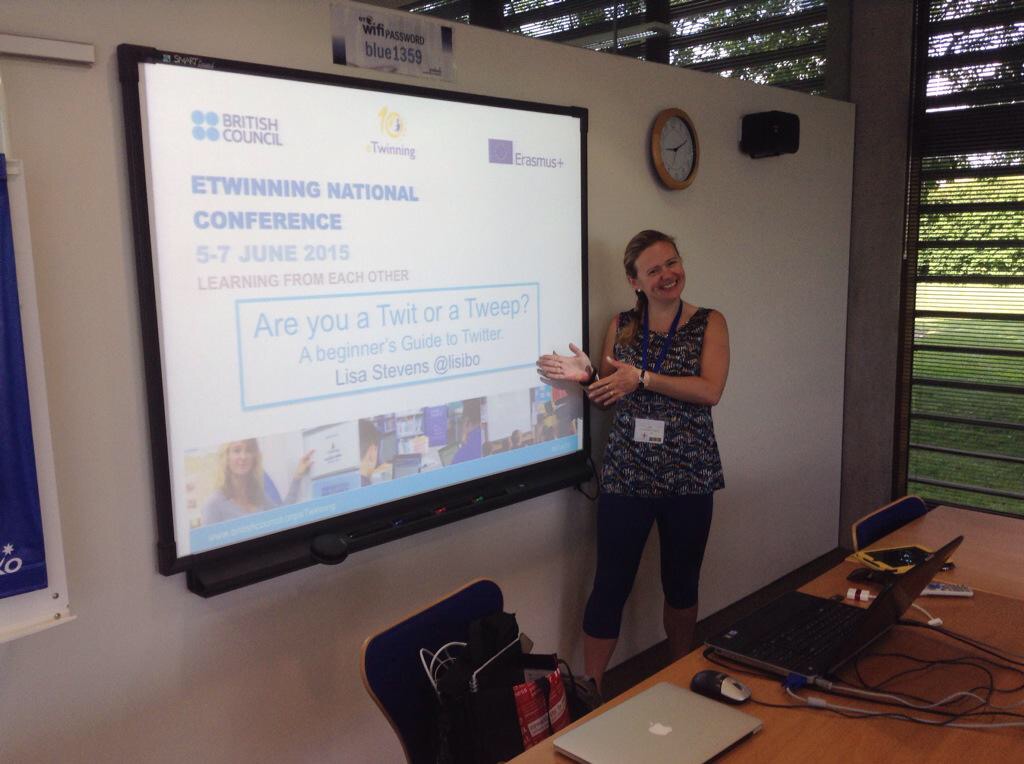
eTwinning National Conference 2015 

#ililc5 Are you a twit or a tweep?

Twitter thoughts – the results


IMG_3849

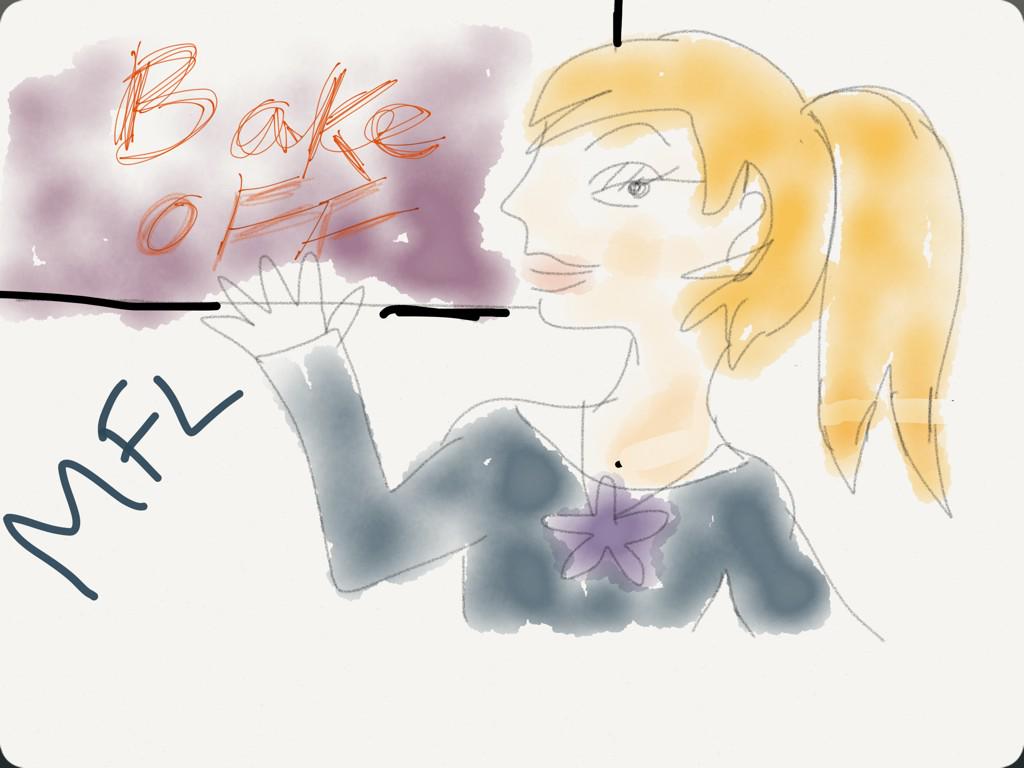
Thanks for the drawing, @catairf 🙂

I was rather gobsmacked when Zena asked me to do the closing keynote at #ililc5. An offer I couldn’t refuse but daunting nonetheless. Especially as there was no ‘theme’ this year so I could talk about ‘anything’ according to my instructions!

As Christmas came and passed and I still hadn’t really been inspired, I grew more concerned. It wasn’t until mid January that a seed of an idea formed in my head. I’d been prepared to talk about Cupcakes and Smiles at TeachMeet BETT, a short presentation on education being about ‘feeding’ minds but also celebrating and rewarding learning, and that we did it for those ‘smiles’ that happen when the lightbulb goes on, when the unexpected happens, when you’re speechless at something a child has said and so on. There was no time for my presentation then – although I still shared my cakes. I was a bit annoyed as lugging a few dozen cupcakes from Birmingham and around London on the train and Tube is no fun and nor is being told off for daring to ice them in the presence of Sir Ken Robinson but that’s the way it works. Still, I liked the idea of cupcakes and when there were queries as to why I made cupcakes for TeachMeetBETT but not ILILC, the idea began to germinate.
Over the next few weeks I still wasn’t entirely sure what I’d say but a thought here and there occurred to me. Stupidly I didn’t write them down and I’m sure some ‘got away’. However, with help from my husband John (who must be fed up of my food/language analogies!) who told me to get a grip (and a notepad), Cooking on gas (other fuels are available) grew.

Ready to start?

On the day, armed with new shoes and an assortment of cupcakes, I shared my thoughts about language teaching and learning with the remnant that had managed to survive to the (not so bitter) end. And it was recorded! (I’d forgotten about that part until I was standing there.) You can watch it here.
As my presentation was in Keynote and delivered from my own MBP, the slides don’t show up in the recording but are all synced and appear alongside (thank you to the lovely Matt for doing that!) I’ve added the videos that you can’t see but can hear at the bottom of this post; I know that the Intermarché one about Les fruits et légumes moches has already proved helpful to more than one person!
I summarised some of the main messages right at the end (go to 45 minutes) if you don’t have time for the whole thing, and I’ve also added a Storify of the tweeting that was going on during the presentation; I certainly found it interesting to see what people had taken from my words and thoughts. And I was gobsmacked by the sketch notes too. Thank you Clare, Simone, Jane, Rachel and Catrin, and Alex, Jonathan and Ceri who had a cupcake in their ILILC5 summary sketch notes too. (If I’ve missed any, apologies and please tell me; I’ve been in a bit of stupor all week!)
It’s very different when you’re sharing your personal thoughts, reflections and passions; it made me feel very vulnerable so I’m really glad that people picked up on and identified with the key messages I wanted to share.

Start at 1.10 until 1.30 for the key bit:

PS At 23 minutes, I start talking about my language hero, and whilst I think I communicated that she was special, I didn’t share all that I might have done as time was pressing and I was getting choked up. So in my next post, I’ll tell you all about Luz Sánchez-Richardson, my language hero!

twitter-312464_1280Here is the presentation and notes for my introduction to Twitter session at #ililc5.

I’d delivered a similar presentation before at the National eTwinning Conference in July but since then, new possibilities have arisen and these have been added. For example, you can now send video directly from the Twitter app (record it and send) rather than going via another app, and there is also the possibility of group DMs. Additionally, I’ve added a page of links to other useful material as well as making the ideas more language centred.

I hope those that attended found it useful – I know at least one started tweeting so that’s success in my book!


My idea to share at the Show and Tell was based on a post I wrote in August –

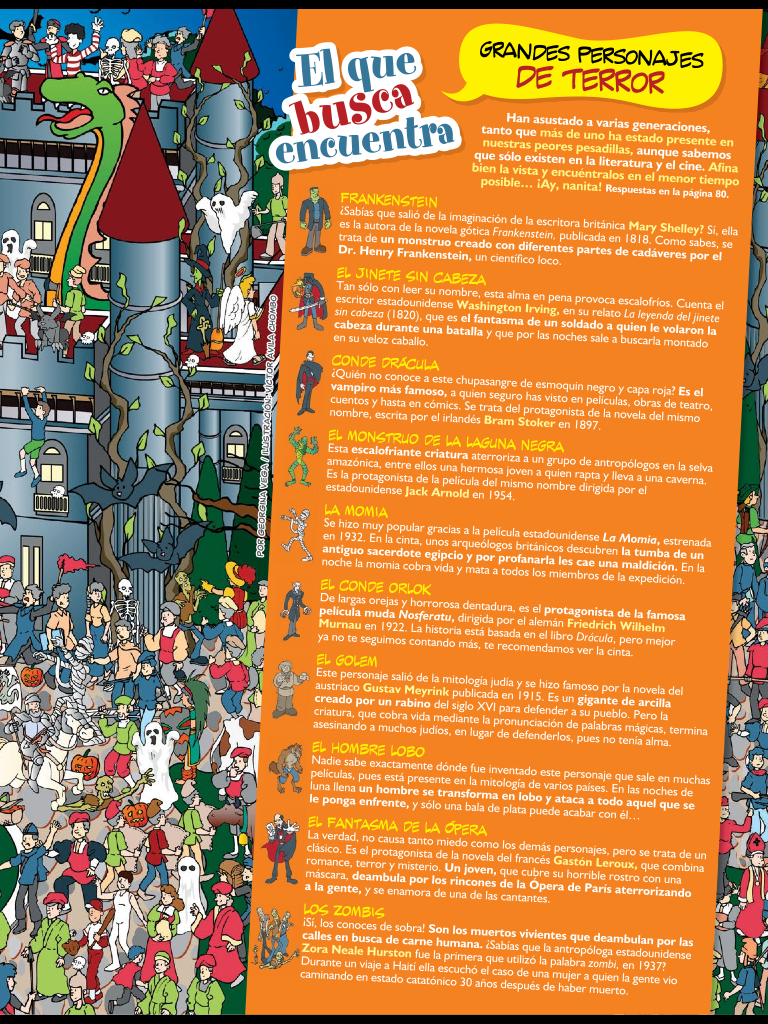
El que busca encuentra

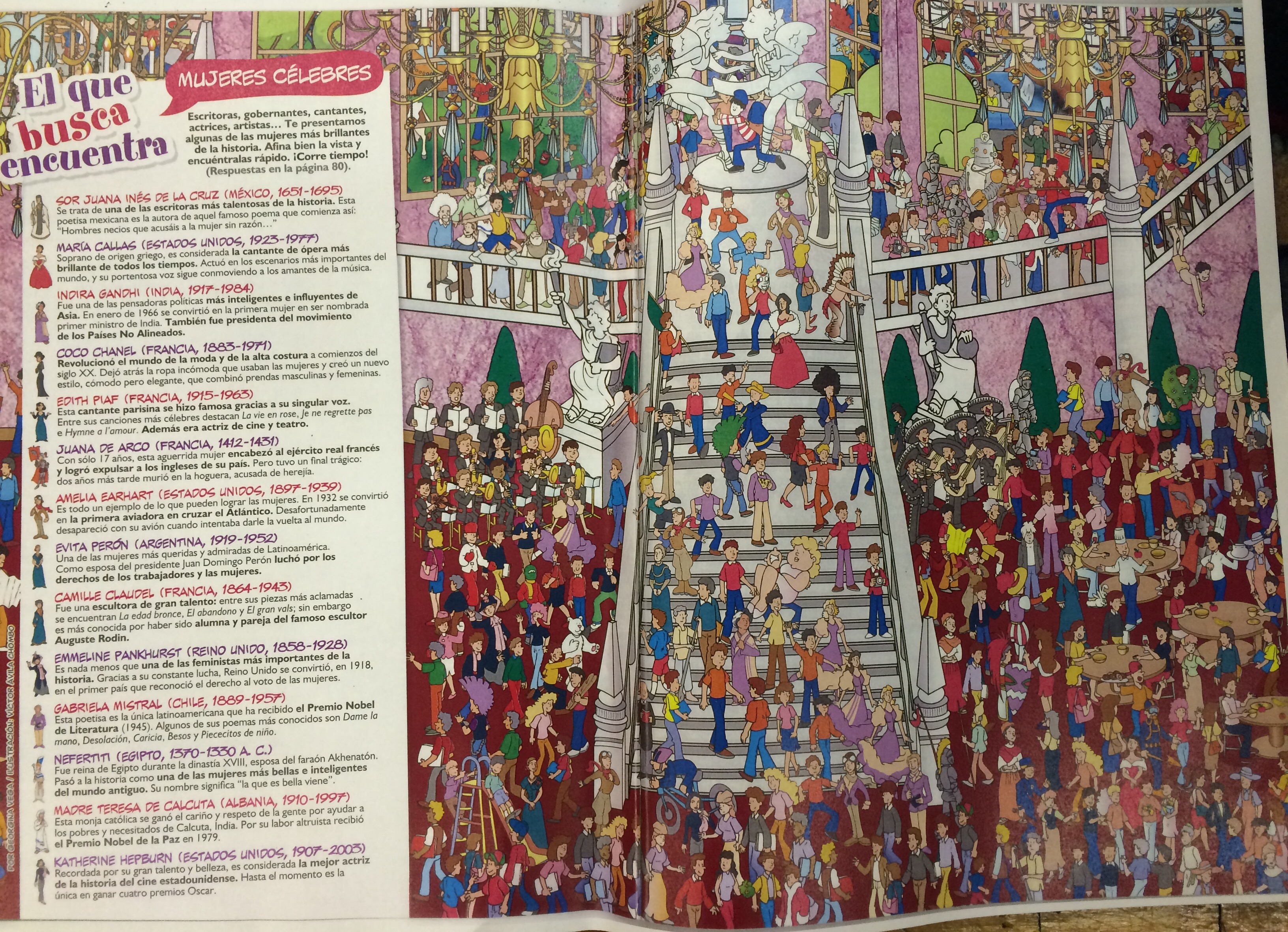
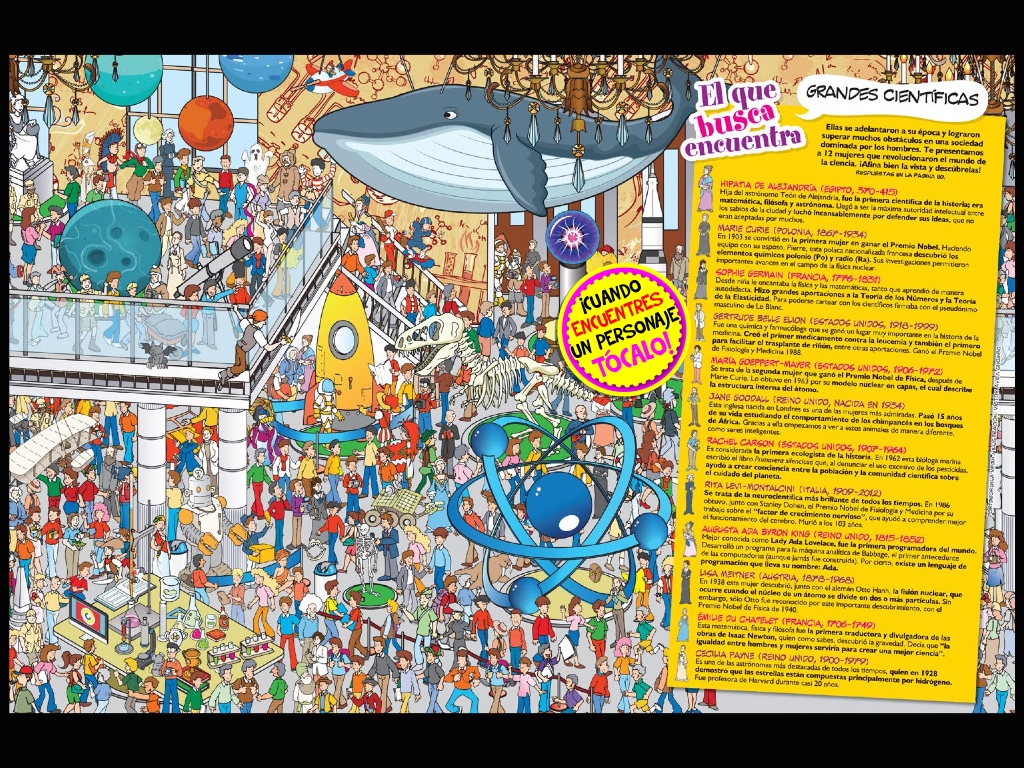
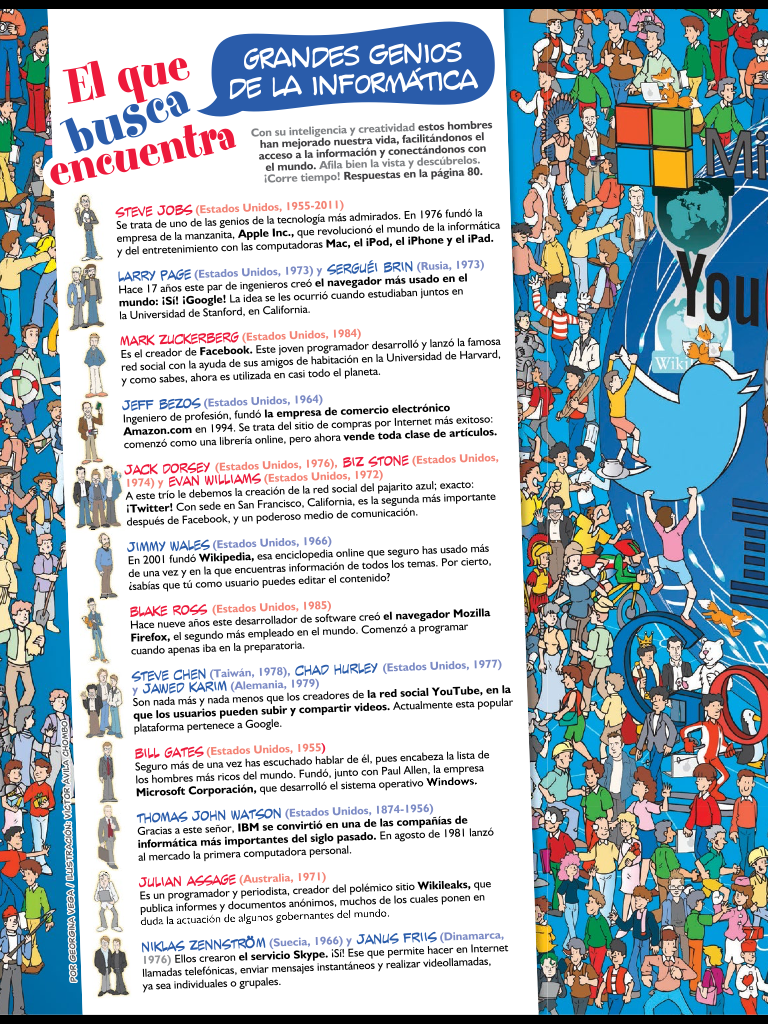
The picture I shared is on that post (in two parts) and below I’ve uploaded it as one image. I’ve also shared another couple that don’t have questions.

el que busca

Mujeres célebres

Grandes científicas

Grandes científicas

IMG_0568 IMG_0569

Grandes genios de la informática (arriba)

Grandes personajes de terror (abajo) – perhaps for next Halloween?

IMG_0566 IMG_0567

Apart from the ideas in the previous blogpost, I was going to suggest that any Where’s Wally?/Où est Charlie?/Wo ist Walter?/¿Dónde está Wally? could be used in a similar way:

1. explain where Wally is using prepositions/positional language.

2. provide descriptions of other characters to be found: could be done as a reading or a listening activity .

3. learners could do the above with a partner, or in small groups

4. learners imagine the life of one of the characters and provide a biography, or put themselves into their shoes and introduce themselves (a little like Janet Lloyd’s ‘In the picture’ activity)

and so on!

(Apologies for taking so long to upload – I’ve suffered severe post -#ililc5 exhaustion this week!)

¡Vámonos! ©2026. All Rights Reserved.
Powered by WordPress. Theme by Phoenix Web Solutions