Like this video clip on counting from 0-9. Seems to be like the Spanish version of TenTown?
httpv://www.youtube.com/watch?v=-69eHd3SHSQ
Like this video clip on counting from 0-9. Seems to be like the Spanish version of TenTown?
httpv://www.youtube.com/watch?v=-69eHd3SHSQ

Just (re)discovered ZooBurst thanks to Carolyn Jones and her message on the Yahoo MFL resources group giving the LinkBunchURL from TeachMeet Sheffield. It’s something about which I’ve heard before. And I’ll be investigating further.
ZooBurst is a digital storytelling tool that lets anyone easily create his or her own 3D pop-up books.
ZooBurst allows you to write your own stories and animate them as pop up books. As the pages turn, the characters pop up, and can be made to speak.
As with Storybird, you can search an online gallery of other people’s stories.
Having had a little look, I came across these stories Celebrando el Bicentenario en Chile.
 As a MYLO ambassador, I’m pleased to say that, following a long hiatus in proceedings caused by the change in Government, MYLO is live!
MYLO, the free online language learning resource for students aged from 14 to 16, is live and online.
MYLO is the latest way for students to learn French, German, Spanish and Mandarin through computer activities which include producing a TV advert, working in a French fashion house and designing a football kit. With practice materials, online dictionaries, phrase books, background information and plenty of hints and tips, learners have everything they need to complete tasks online. Crucially the site also provides opportunities for students to use their productive skills working on writing and speaking projects.
Kate Board, Chief Executive of CILT, the National Centre for Languages, says: ‘The fun, innovative and creative approach to learning that MYLO offers is an ideal way for young people to learn a new language. If we want to reverse the downward trend in GCSE take-up, we need to connect with young people in a way they can relate to – and show them how they could use languages in a whole range of situations in later life.’
MYLO has been piloted and developed with the input of a number of schools, educational bodies and teachers. They report that it gets young people excited about languages, and helps them develop skills in delegating, group work and project management. One Year 8 student from Bradford described the activities as ‘fun and cool and something we are interested in’, whilst another talked of how it is ‘very different to anything we do in language lessons.’
MYLO also has a social networking element that allows students to become part of a MYLO community. Once their school is registered with MYLO, students can create their own online profile, comment on the work of their peers, get feedback from their teachers online and even compete against other schools. Teachers will also be able to create special playlists of projects for their pupils, to tie in with their own study requirements and personal interests.
To sign up for MYLO, and get more information on how it will work, go to mylo.dcsf.gov.uk

Love the spectacle of this – especially since I had a go in Barcelona!
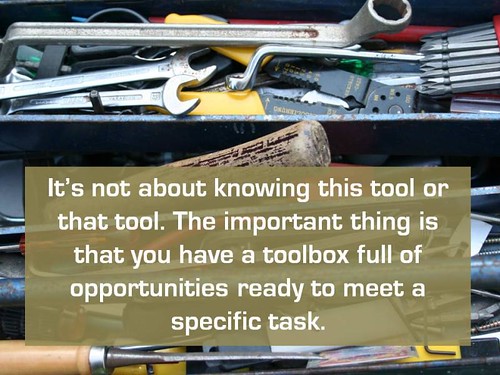
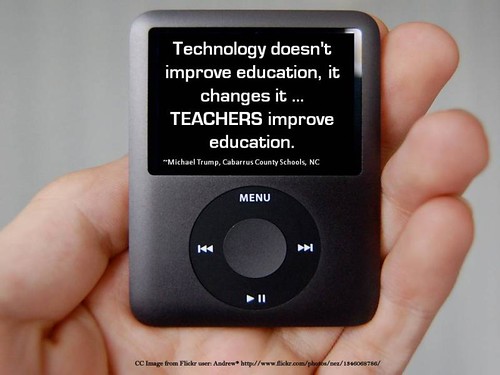
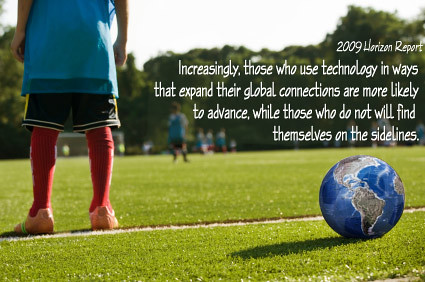
These images pretty much sum up my thinking on the use of ICT.

By Photo by and (c)2008 Derek Ramsey (Ram-Man). Co-attribution must be given to the Chanticleer Garden. (Own Picture) [GFDL (www.gnu.org/copyleft/fdl.html) or CC-BY-SA-3.0 (www.creativecommons.org/licenses/by-sa/3.0/)], via Wikimedia Commons
The final session today was focussed on learning styles and preferences.

All the above affect our learning if conditions aren’t ideal for us.
Personally, I like to work in daylight, lying on the floor or with my feet up, don’t like being hot and like a murmur of noise to learn best.
I loved Ian’s assertion that adolescents become ‘pseudo stupid’ as their brains adapt to all the changes going on in their brains. Makes a lot of sense!
We looked at VAK approaches and learned how to make history RE and Geography more kinaesthetic.
People moved from country to city due to wealth, industry, education, a better standard of living and better housing. I remembered that by holding out my left arm, travelling from the country (my armpit) to the the city (my hand) and looking at my fingers.
The Linkword approach in the 80s worked on a similar principle to pegging, linking images to things you need to remember. In language learning, masculine nouns were recalled with an image of a boxer, feminine with perfume. Language learning skills that are a key feature of current language teaching use ideas like this, encouraging making links to aid recall. For example, la sandia – a watermelon is well stuck in my pupils’ minds as we talked about how you eat it on the beach and if you drop it, it gets sandier.
Looking at Gardner’s multiple intelligences, Ian assigned each one a famous person-
Carol Vorderman – mathematical logical
The A A man / David Beckham – physical intelligence
Princess Di – interpersonal social
Mother Teresa – intrapersonal / empathy
Picasso – visual spatial
Mozart – musical
Charlie Dimmock / David Attenborough- naturalistic
Shakespeare – verbal linguistic
How can we teach to all these people? Perhaps not every lesson, but on a regualr basis?
I had to leave early to fetch J from school, but by this stage my brain was really buzzing and quite full!
I hope I’ve managed to effectively communicate some of the ideas and thoughts from today!
 I’ve already blogged about Thunks and making kids’ brains hurt which were the key ideas in this session.
However, a few other things that were interesting.
1. A useful reference for philosophy for kids – SAPERE
2. When we ask questions, we’re not comfortable with leaving silence. On average, we wait 0.9 sec before filling the silene with the answer. Thus, ‘learned helplessness’ starts. Sometimes we need time to think and process, sometimes we need to struggle for an answer to stimulate our brain.
3. The 4 Bs for finding things out
Brain
Book/board
Buddies
Boss (teacher)
4. ask for three answers to a question – allows multiple answers, multiple contributions and multiple involvement.
5. Can you raise someone else’s self esteem? Surely it’s their self esteem so you can only create the conditions for improvement to be possible. As educators, we are literally moulding the brains that will decide the future by helping the neurones in brain amke trillions of connections.
6. The difference between the arrogant and confident person is that the arrogant person will make you feel worse about yourself.
7. Self esteem is determined by feeling loveable and capable. Childen need to be hugged and praised.
More brain stuff
There are three parts to the brain –
Reptilian (lizard) – fight flight hunt
Mammalian (dog) – emotions and memories
Neo cortex – the human bit
The PFC (pre frontal cortex) holds the key to our reactions. The amygdala ‘calms’ it from its rashness. So using STAR gives the amygdala a chance to work.
Stop
Think
Act
Review
Some quotations to finish –
To teach you need to contain, entertain and explain.
Intelligence is what you use when you don’t know what to do. – Piaget

¡Vámonos! ©2026. All Rights Reserved.
Powered by WordPress.
Theme by Phoenix Web Solutions