lisibo – Page 17 – ¡Vámonos!
 

Author: lisibo

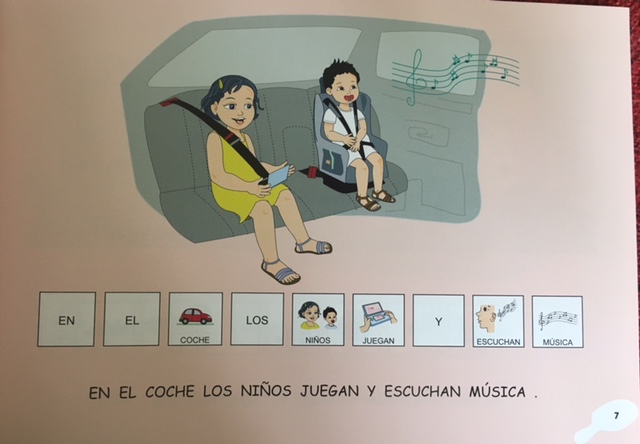
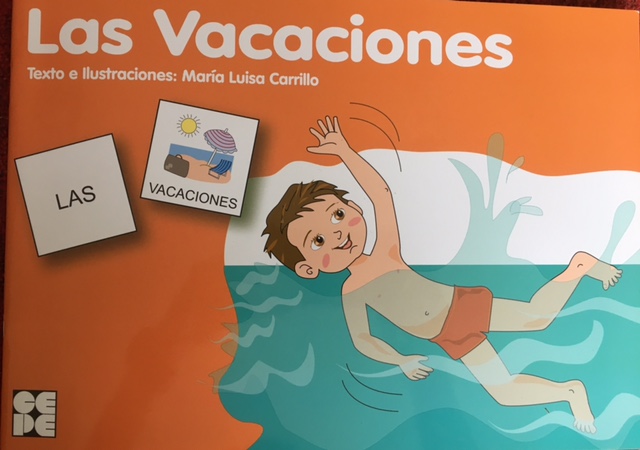
Another of my purchases in Bilbao was Las vacaciones  which comes from a series called Colección Pictogramas described the publisher, CEPE (Ciencias de la Educación Preescolar y Especial) as forming part of a series  “para favorecer la integración de los alumnos con n.e.e. [Necesidades Educativas Especiales], sobre todo los que presentan dificultades lectoras y/o de comprensión” (to support the integration of students with SEND, especially those who have difficulties with reading and/or comprehension.)

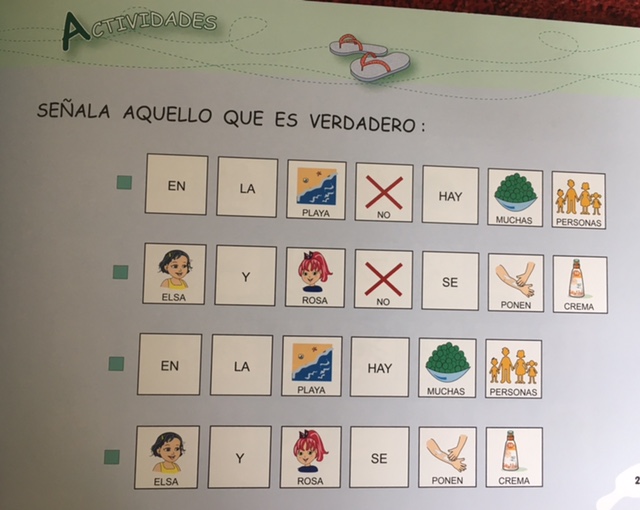
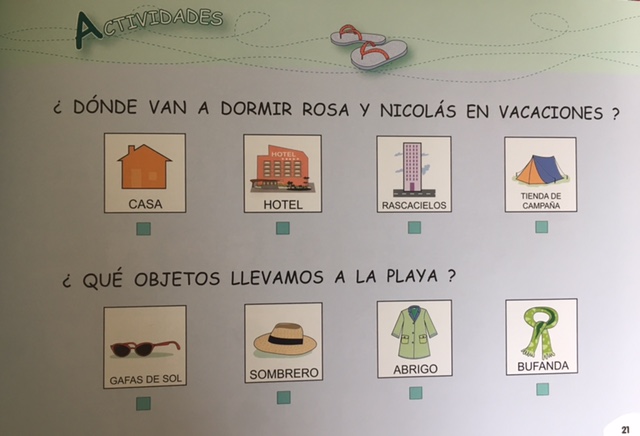
I was drawn to the book as it has a very simple text and is on the subject of holidays and the seaside which one of the topics covered by Y1 at my school. However the thing that drew me most was that the text is accompanied by pictograms, small images to support understanding of the text.
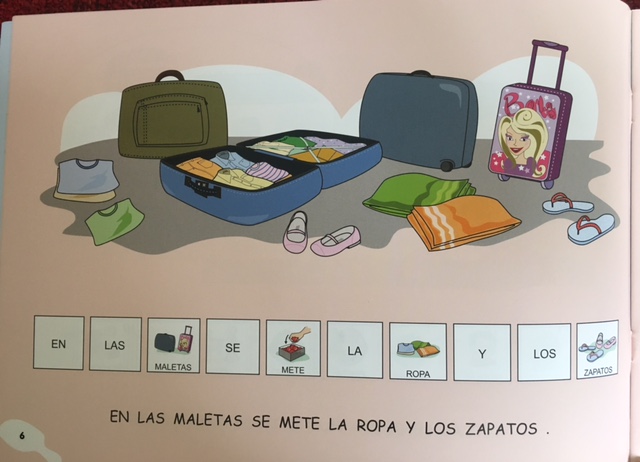
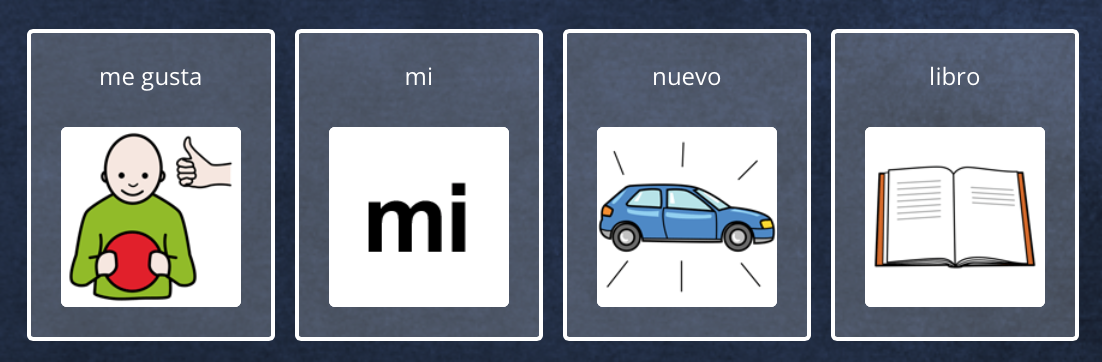
At both of my schools we use pictograms or widgets for visual timetables to support all pupils in following the flow of the day as well as on key rings for individual pupils who use them to communicate. At one of my schools we use Communication in Print (now called InPrint3) just as Las Vacaciones does to support reading and comprehension across the curriculum. I’ve used it in RE lessons to retell stories from the Bible and Quran with success but have found it more fiddly with Spanish as it doesn’t recognise the words. A while back Clare Seccombe talked about finding a Spanish version and when I bought the book, I had this in mind but couldn’t find the name of it. Fortunately, she wrote a post about it a few days ago!

Pictotraductor will enable me to translate resources to support my pupils, but also to support non specialists who deliver Spanish lessons, much as the resource below helped the Y1 teachers to use the story of Ricitos de Oro until they discovered the Pictocuentos version (and subsequently enjoyed Caperucita Roja and El Patito Feo!)

And here is a video version of the story using pictograms as the characters and activities using pictograms that I found on this blog that shares resources for ‘Educación Especial’. In this post he recommends using Adapro or  AraWord (with the library of images from ARASAAC), both of which are freely downloadable from SourceForge. I do think that Pictotraductor looks easier to use as you don’t have to be at a specific computer but you need to be online to use it whereas the options above are downloaded programmes on your computer so could be done on a train for example.

I wish I’d bought more of the series of books but I’ve found the website and catalogue online so will perhaps get more when I’m next in Spain or persuade someone to take delivery and post them to me 😉
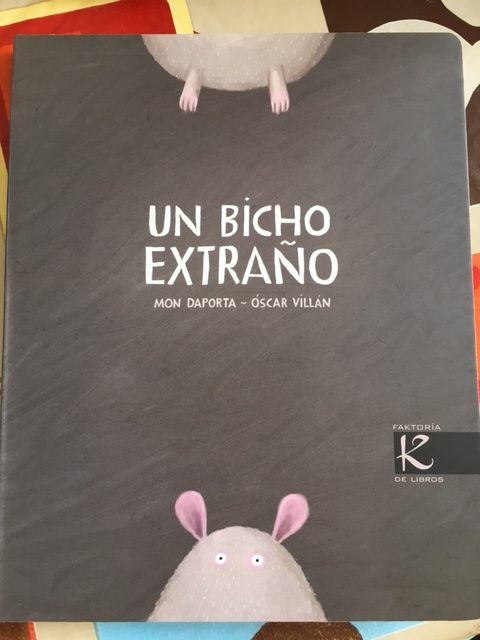
 

One of the books I bought in Bilbao was Un bicho extraño by Mon Daporta, a book which first came to my attention at Language World last year during the Show and Tell when Jesús from the Consejería shared it.

It’s a charming book that fits in well with the work we’re currently doing in Y4 about describing our faces and body parts. I love the video below of the story being told using a picture onto which body parts are stuck/removed as the story develops. And the wonderful thing is, the Consejería have produced a series of activities to use the book as well, including activities for pre and post reading. Some lovely ideas, and the instructions are bilingual too so no need to worry if you’re not fluent in Spanish!

I’ve also found this Slideshare that discusses ideas for using the story, and culminates with making your own version of the book using felt, buttons, ribbons etc.

On my trips to Spain I’m always in search of a bargain! I’ve recently not had much luck finding ‘Poundland’ type shops, nor the equivalent of a Swiss brocki but this time I came across a 1 euro shop down one of the Siete Calles in Bilbao. Disappointingly there were no books, and unfortunately I was down to my last few euros. However, I did find some bargains.
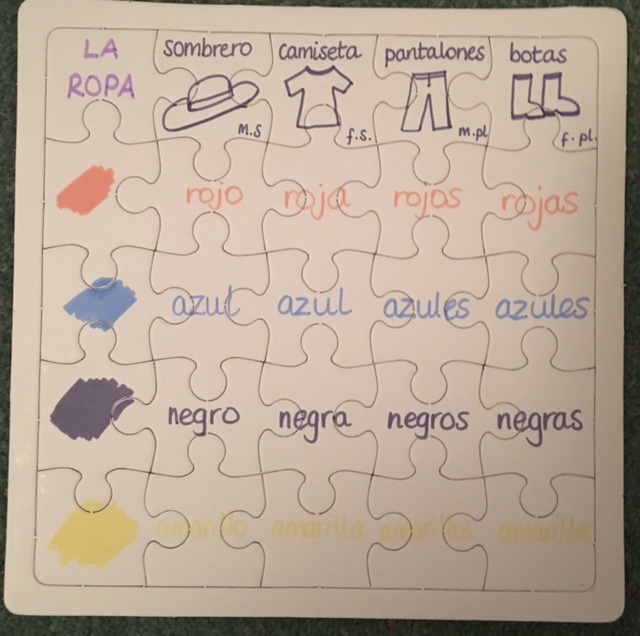
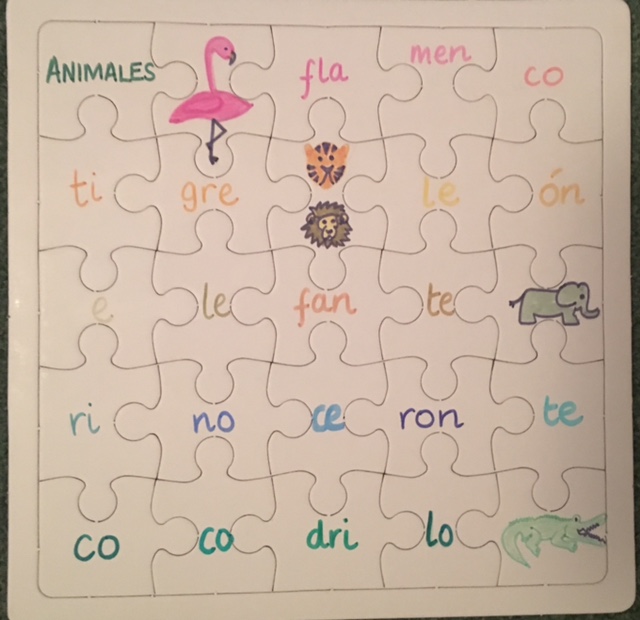
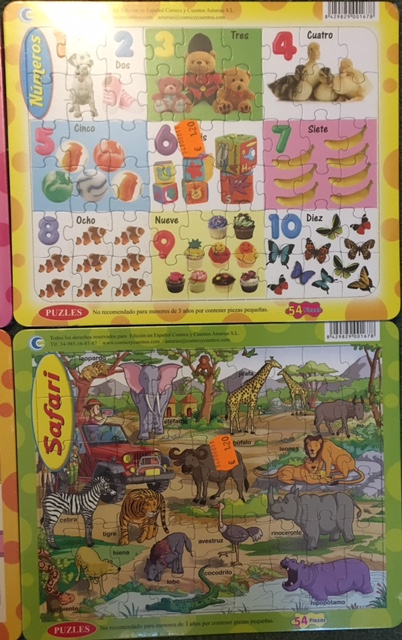
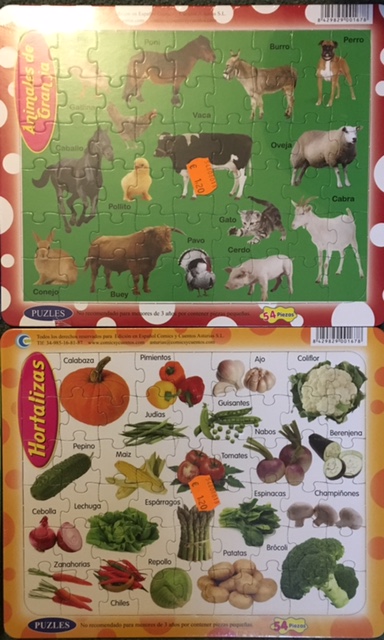
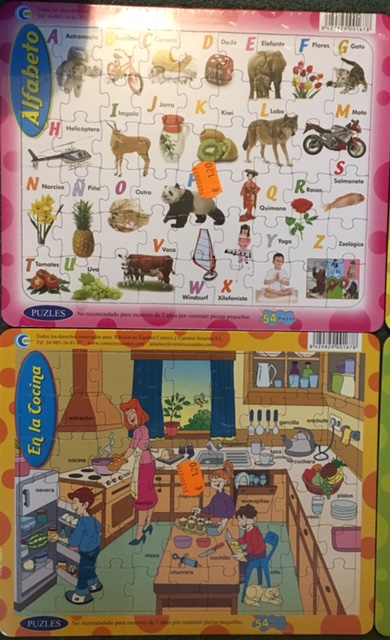
Firstly some vocabulary jigsaws. Following on from a tip from Eleanor Abrahams-Burrows at ILILC a few years back, I bought some blank ones from Wilko (also available from Flying Tiger) and made some bespoke vocabulary jigsaws for early finishers/take home Spanish bags/ to reinforce grammar points.
I was pleased to find these ‘rompecabezas’ in the shop and at 1 euro 20 I bought one of each. I’ll use them in much the same way as my homemade ones; let’s see which is the most popular. Additional activities that you could do once the jigsaws are complete:

  • put the vocabulary in alphabetical order
  • read and practice pronunciation
  • make a list of the words you find most interesting
  • make a puzzle for a friend with the words
  • classify the words – could be by colour, size, like/dislike, manmade/natural
  • find the word for… with a partner

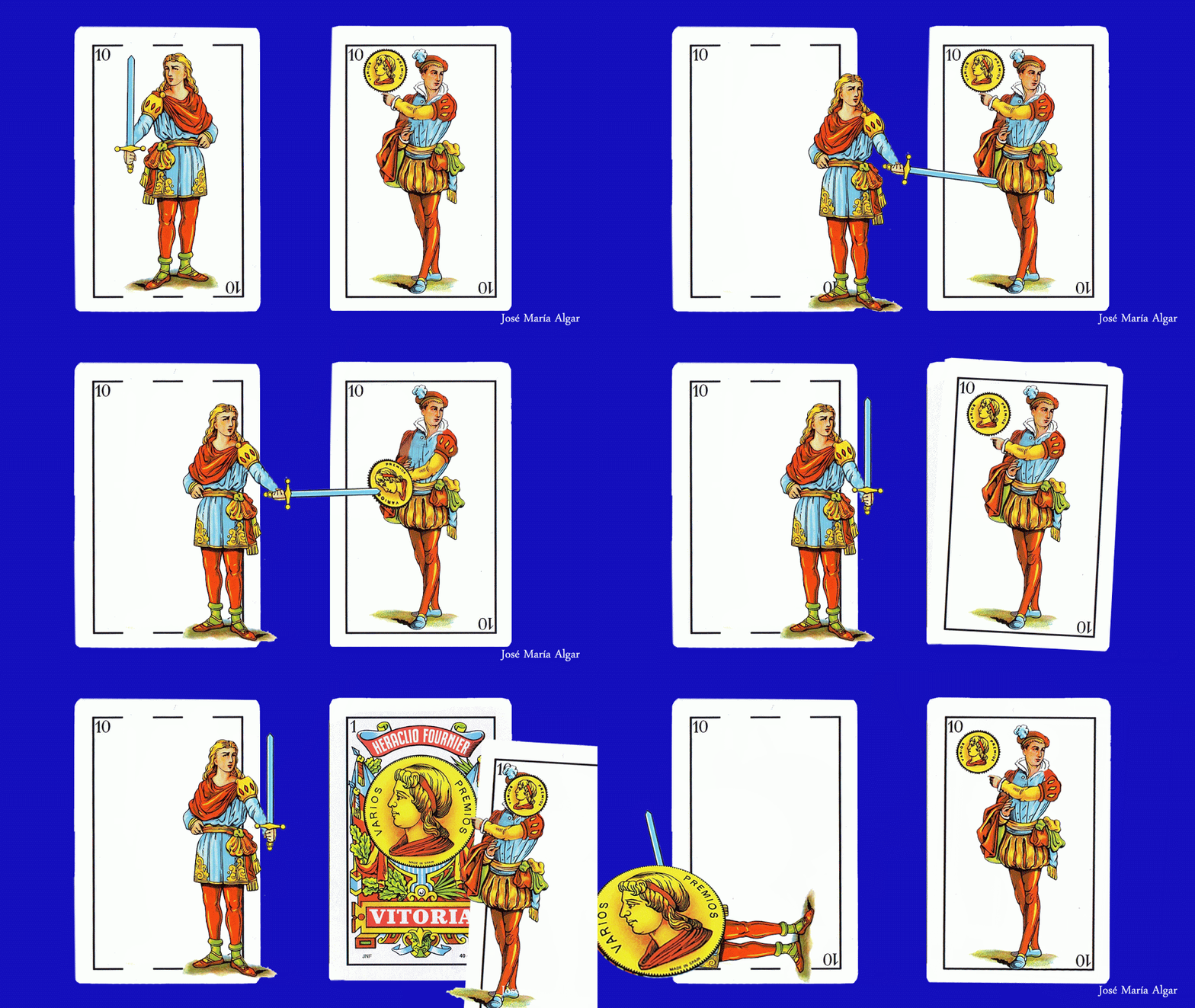
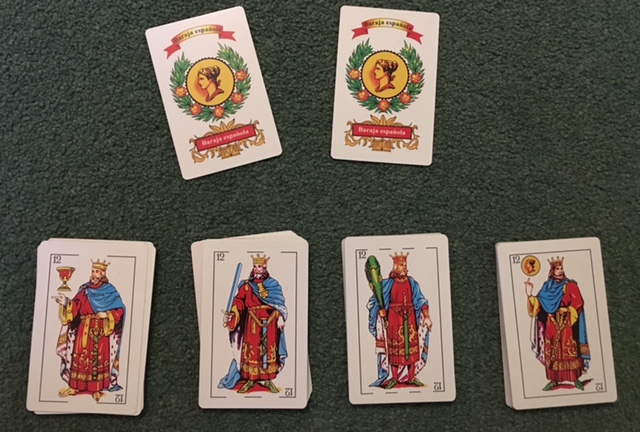
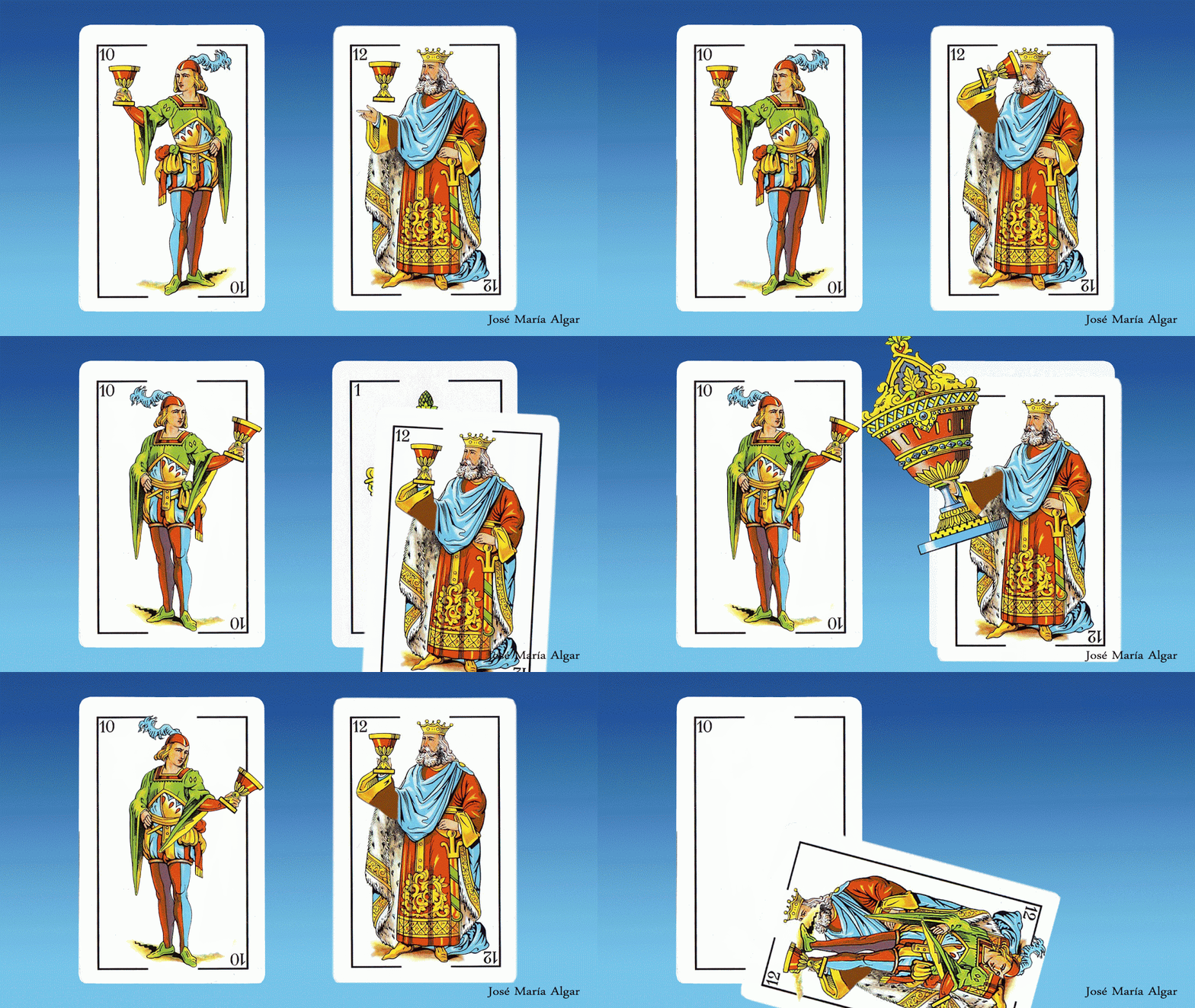
My second purchase was a pack of cards. I’ve got lots of decks of cards already, but this my first  ‘baraja española.’ As you can see, they are not the same as the ‘baraja francesa’ with which we may be more familiar. There are four ‘palos’ or suites – oros (coins), copas (cups), espadas (swords) y bastos (sticks) – of 12 cards each. The different ‘palos’ are also distinguished by the number of breaks in the line around the edge of the card: oros -0; colas – 1; espadas – 2; bastos -3. And, in contrast to the 52 card ‘baraja francesa’, there are only 48 cards in the ‘baraja española’ as, whilst there are three ‘figuras’ – rey (king), caballo  (horse) and sota  (jack) there is no card marked 10.

If you’re interested in the history of them, the Spanish wikipedia entry is very interesting.

I was pleased to purchase these from a  cultural point of view as well as to be used when we’re working on numbers/counting etc

Here’s a post with some ideas on how playing cards can be used in language learning.

And some traditional Spanish card games that are played with the ‘baraja española’ are explained in this post. Some are played with a 40 card deck (which omits the 8 and 9) One such game, and probably one of the simplest too is Siete y media which is explained in Spanish here (to change it to English, click on English in the left hand menu!) but is basically a game in which the aim is to get cards totally 7 ½ points and no more, with number cards being worth face value and ‘figuras’ are worth half. A simple game that could easily be played in class with basic language:

te toca a ti – it’s your go

otra carta por favor – another card please

me planto – I’m sticking here (no more cards)

me paso – I’ve gone bust (my total is over 7 ½)

gano – I win!

¿jugamos otra vez? – shall we play again?

You many not want to add an element of betting for counters or points, but if you do…

apuesto… puntos/fichas – I bet …. points/counters.

I usually use decks of cards for activities such as :

  • pick a card and say its value in Spanish
  • pick two cards and add their values
  • playing 21 (very like Siete y media but with higher numbers so harder to play when pupils can only say up to 10!)
  • pick a card and saying the number bond to make ten, fifteen or twenty
  • pick two cards; what’s the difference?
  • pick two cards and multiply the numbers
  • higher, lower (in the style of Play your cards right!)

Do you have any favourite card games that you think could be used in the language classroom?

PS Loving these ‘naipes’ GIFs!

I was privileged to be invited to speak at the recent SW London Primary Languages conference organised by the Merton and Kingston Primary MFL Network. I had attended and spoken at a previous conference three years ago and was eager to attend another as it had been such a positive experience (Tube and a stinking cold not withstanding!)

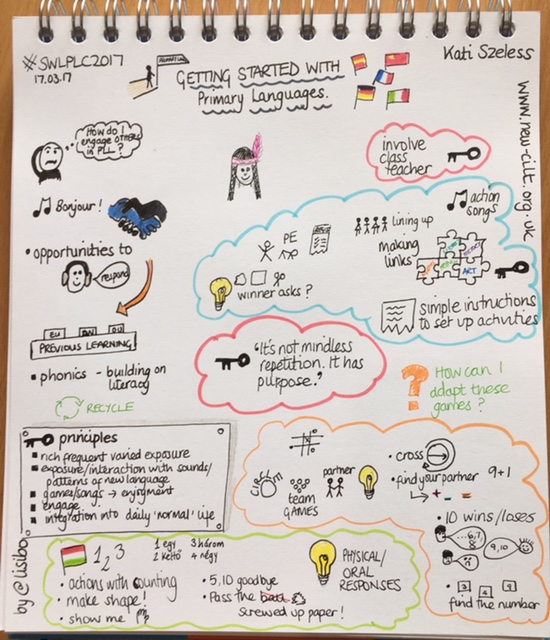
This year I was asked to speak on Sketchnoting and I began the conference by doing some! Here are my sketchnotes of the sessions prior to mine, delivered by the ever inspiring Sue Cave and Kati Szeless.

Sketchnote of Sue Cave‘s talk on “Grammar Moves” (actively learning grammar)  at SW London Primary Languages Conference.

Sketchnote of Kati Szeless‘ session at SW London Primary Language Conference on encouraging non specialist staff to support and get involved in language learning. I can now count to 10 in Hungarian!

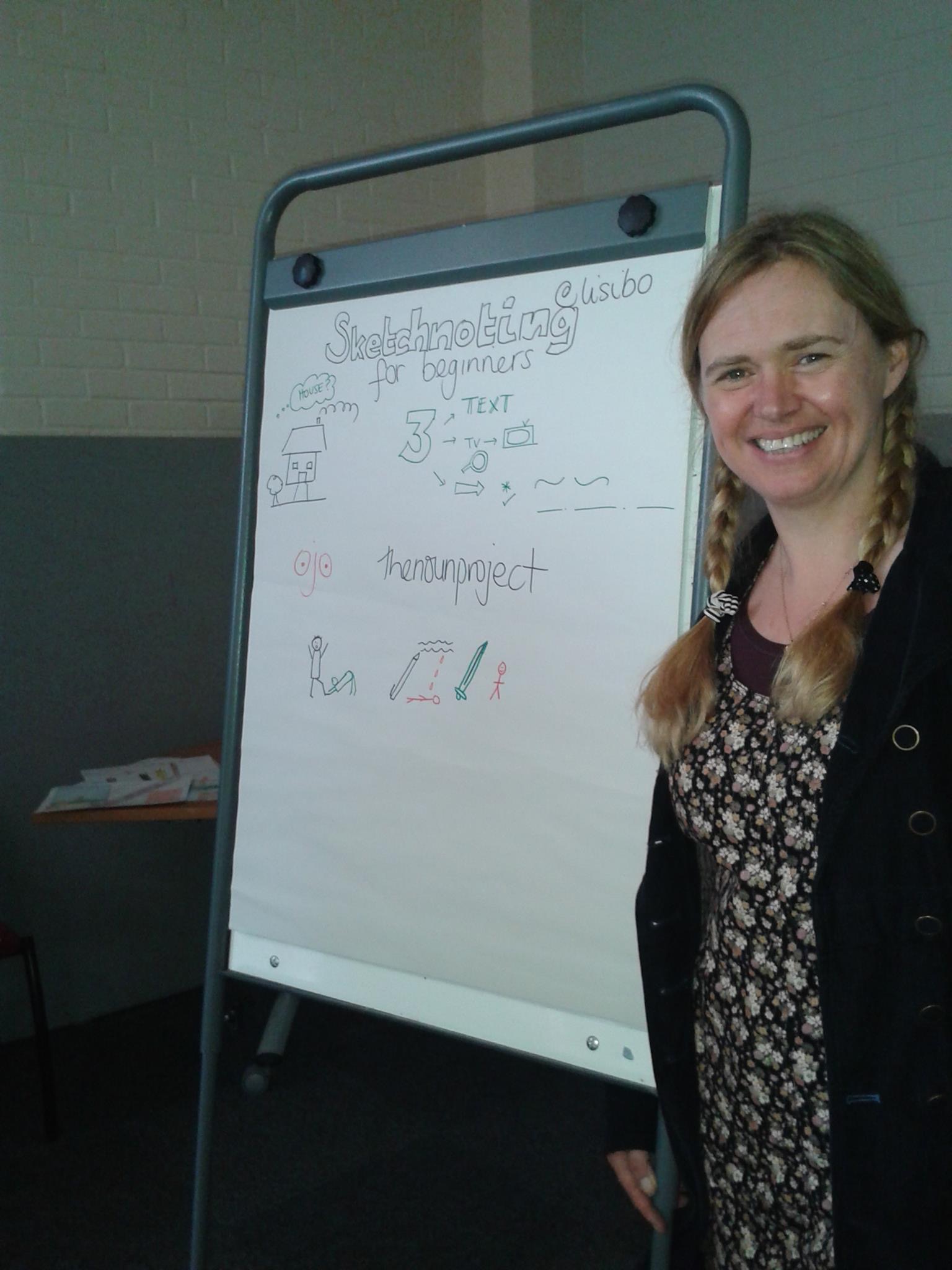
My presentation was very similar to the one on Slideshare below, but this time I had a go at a bit of live sketch noting and switched the order around a little to give people more of a feel of the HOW before I talked about the WHY. Thanks to Sue Cave for taking the photo at the top and the one below! I hope that people found it helpful; I certainly had some lovely initial feedback and quick chats immediately afterwards!


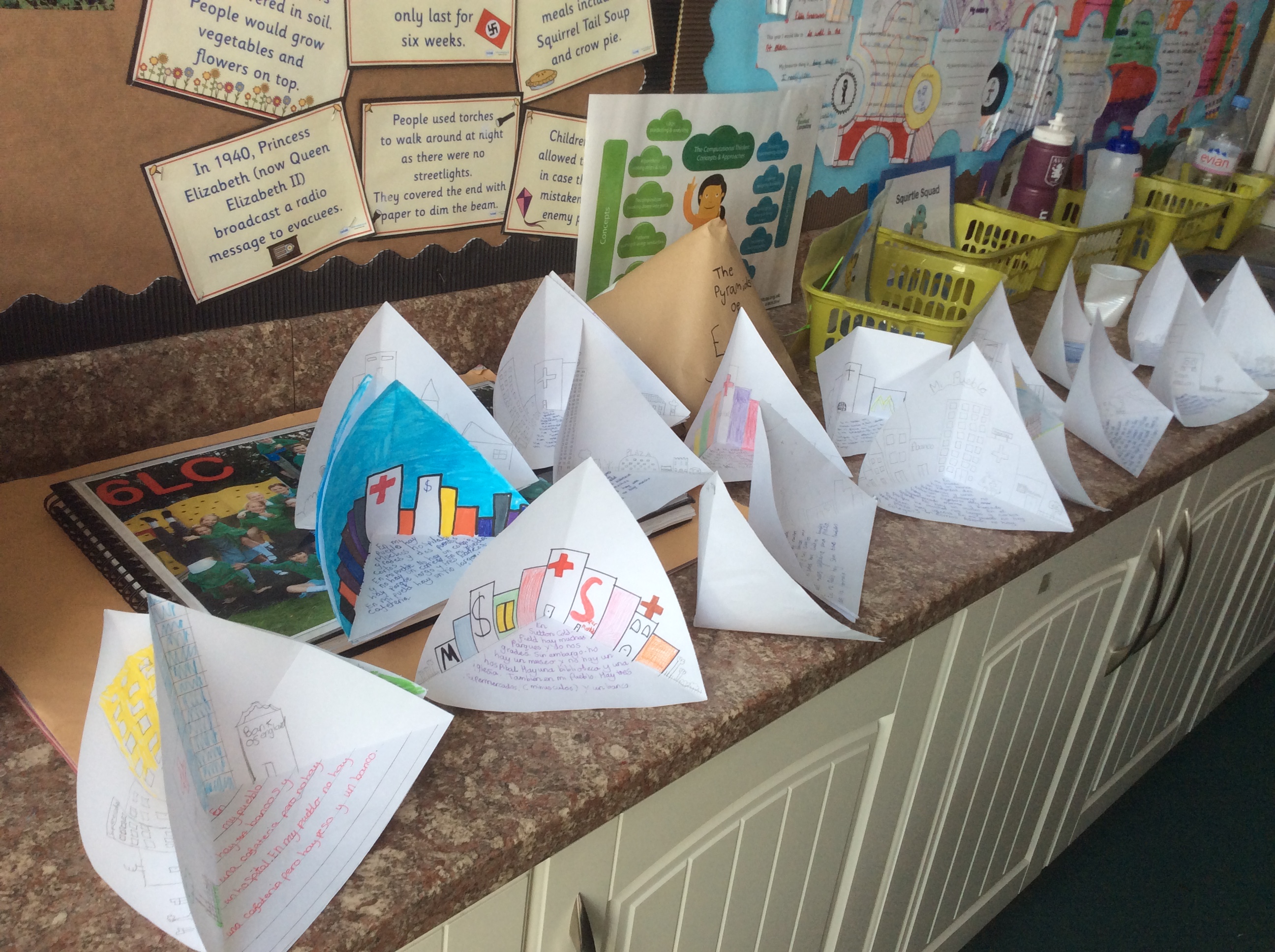
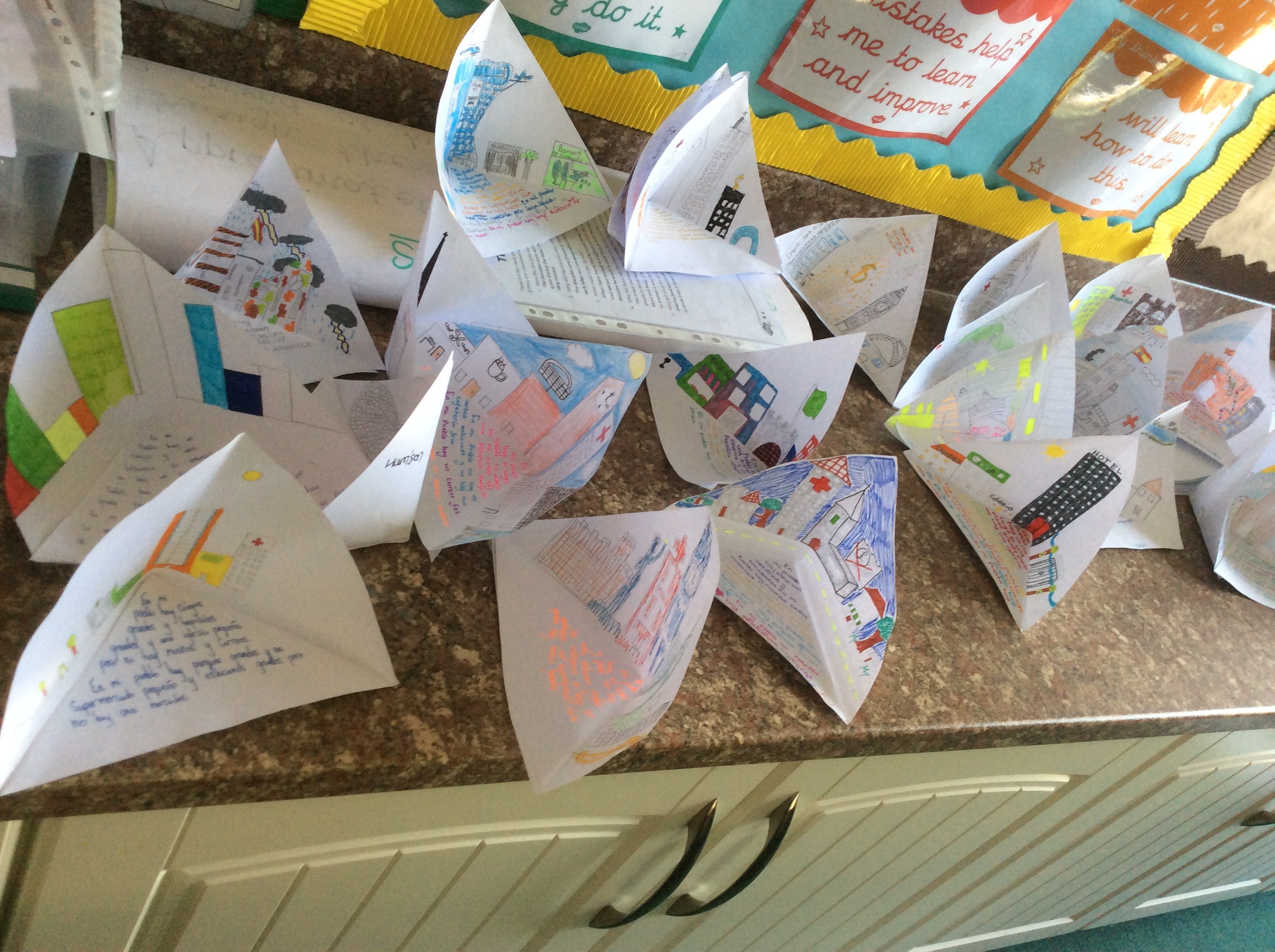
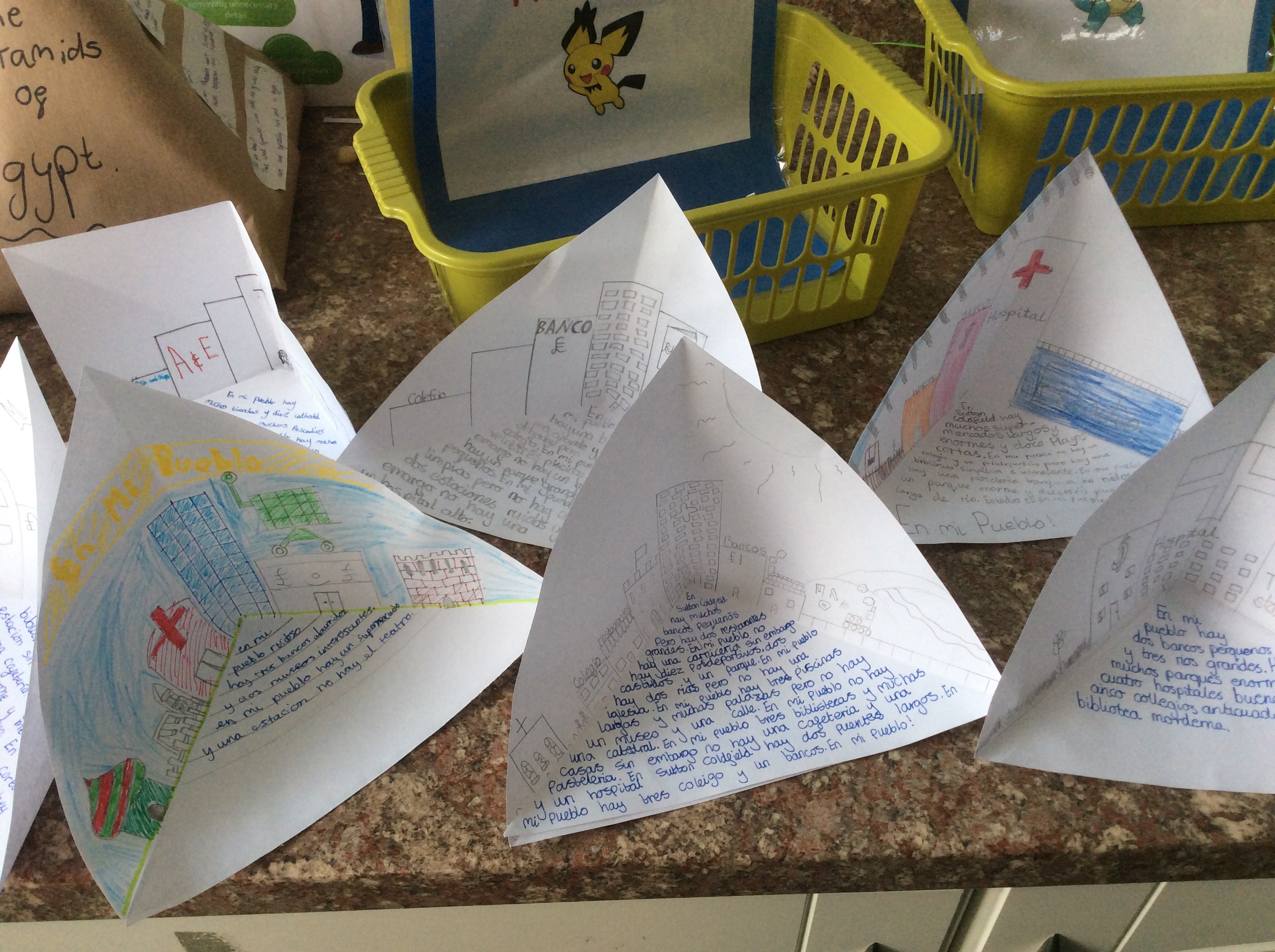
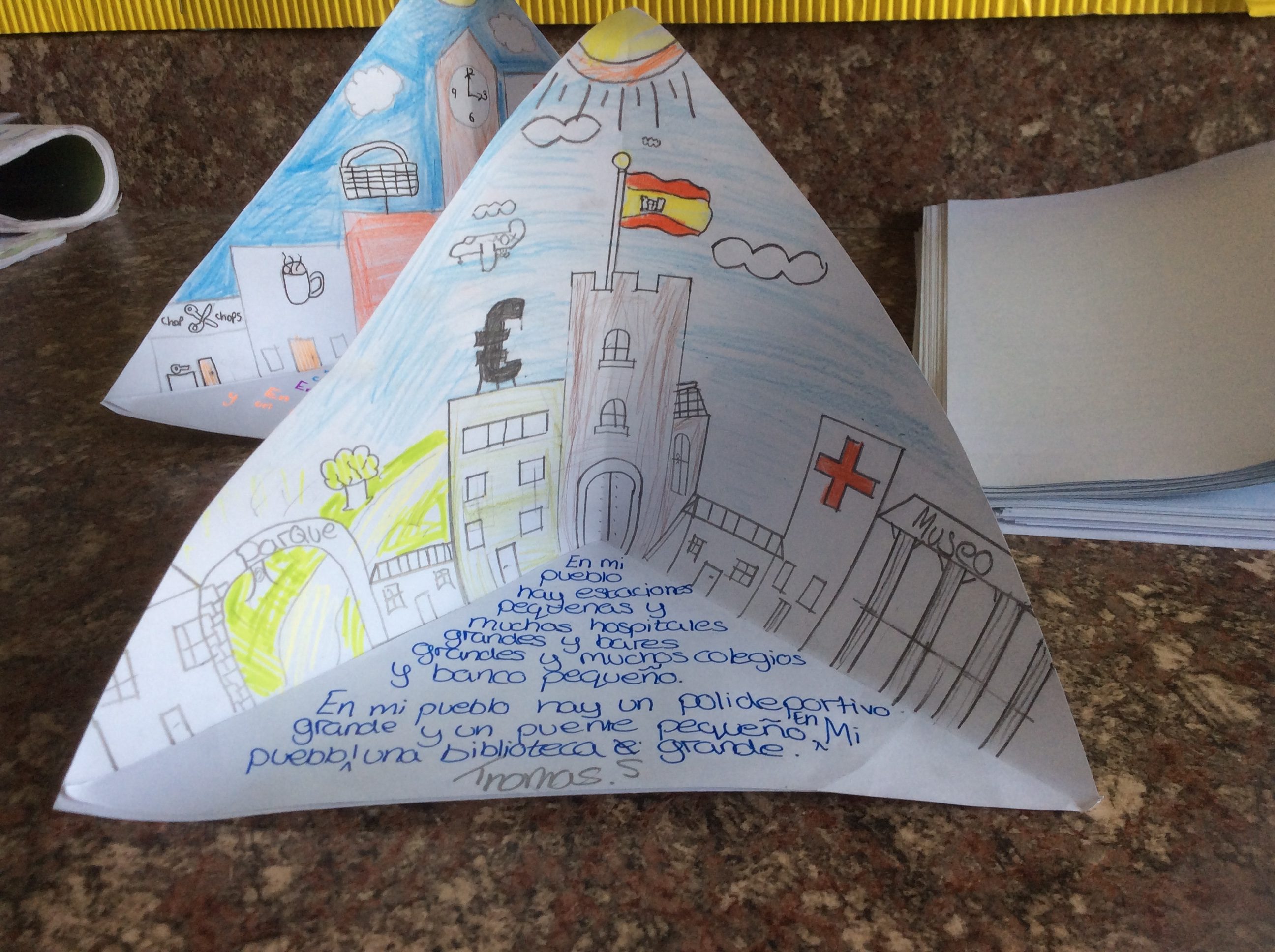
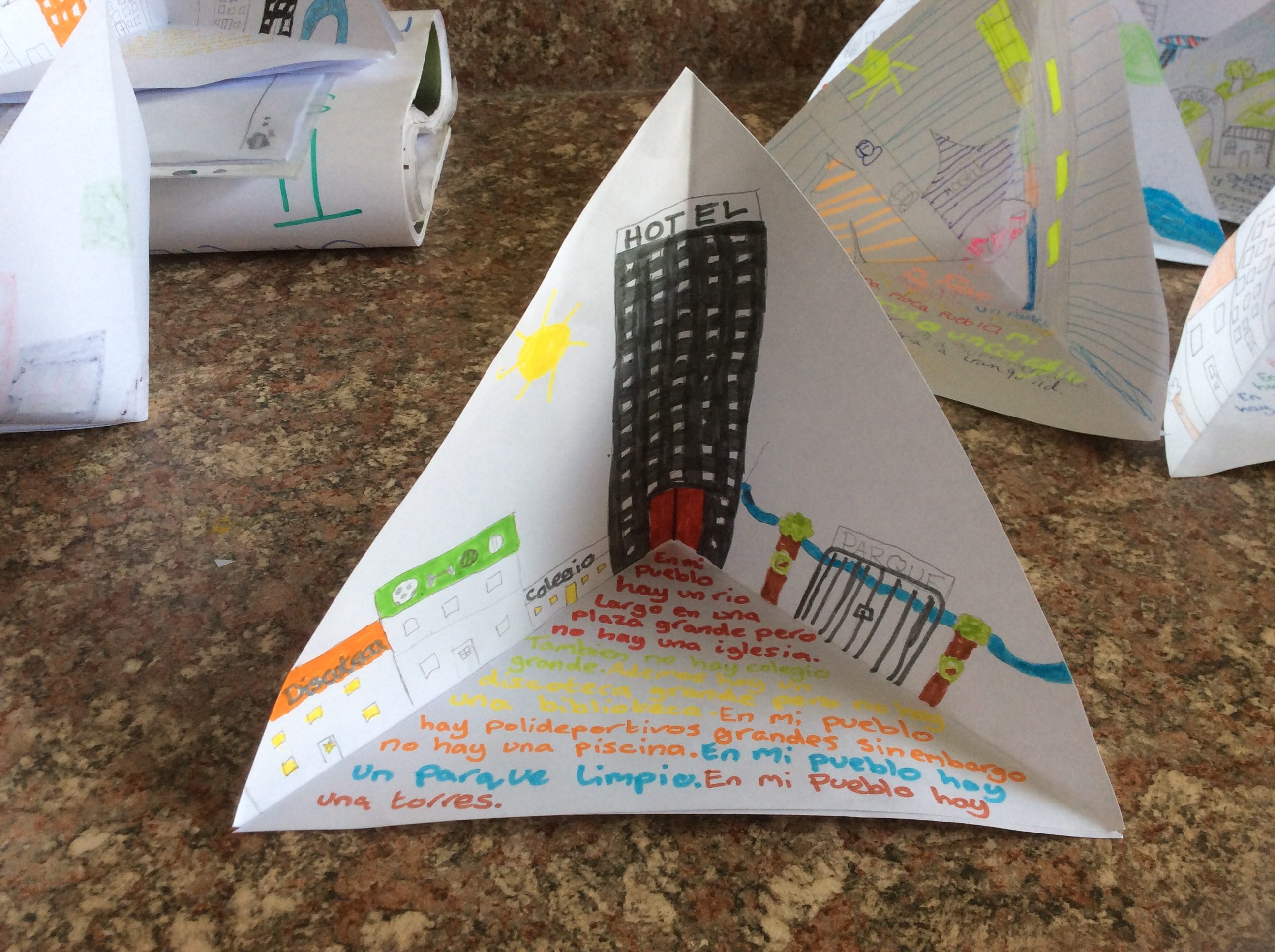
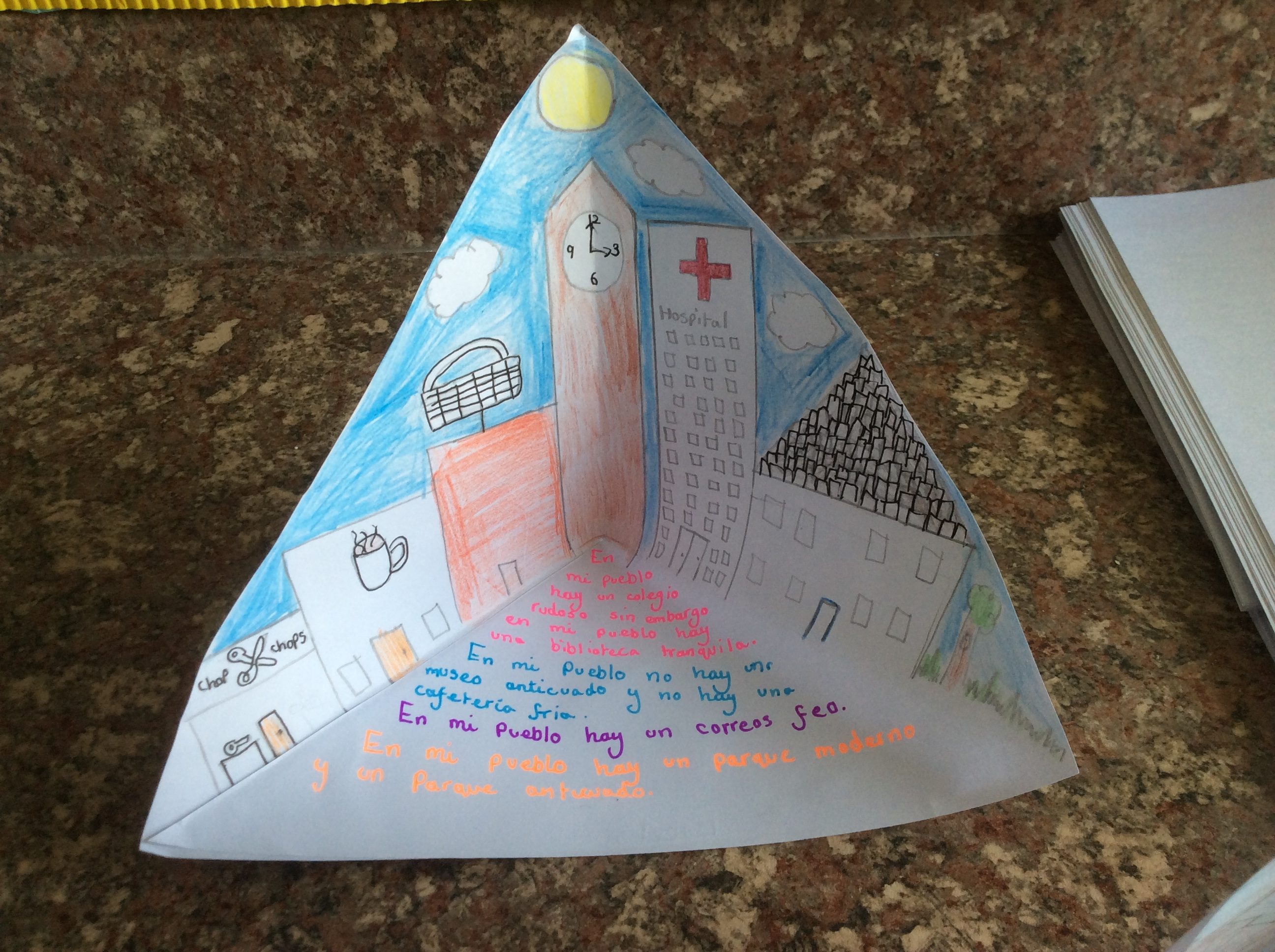
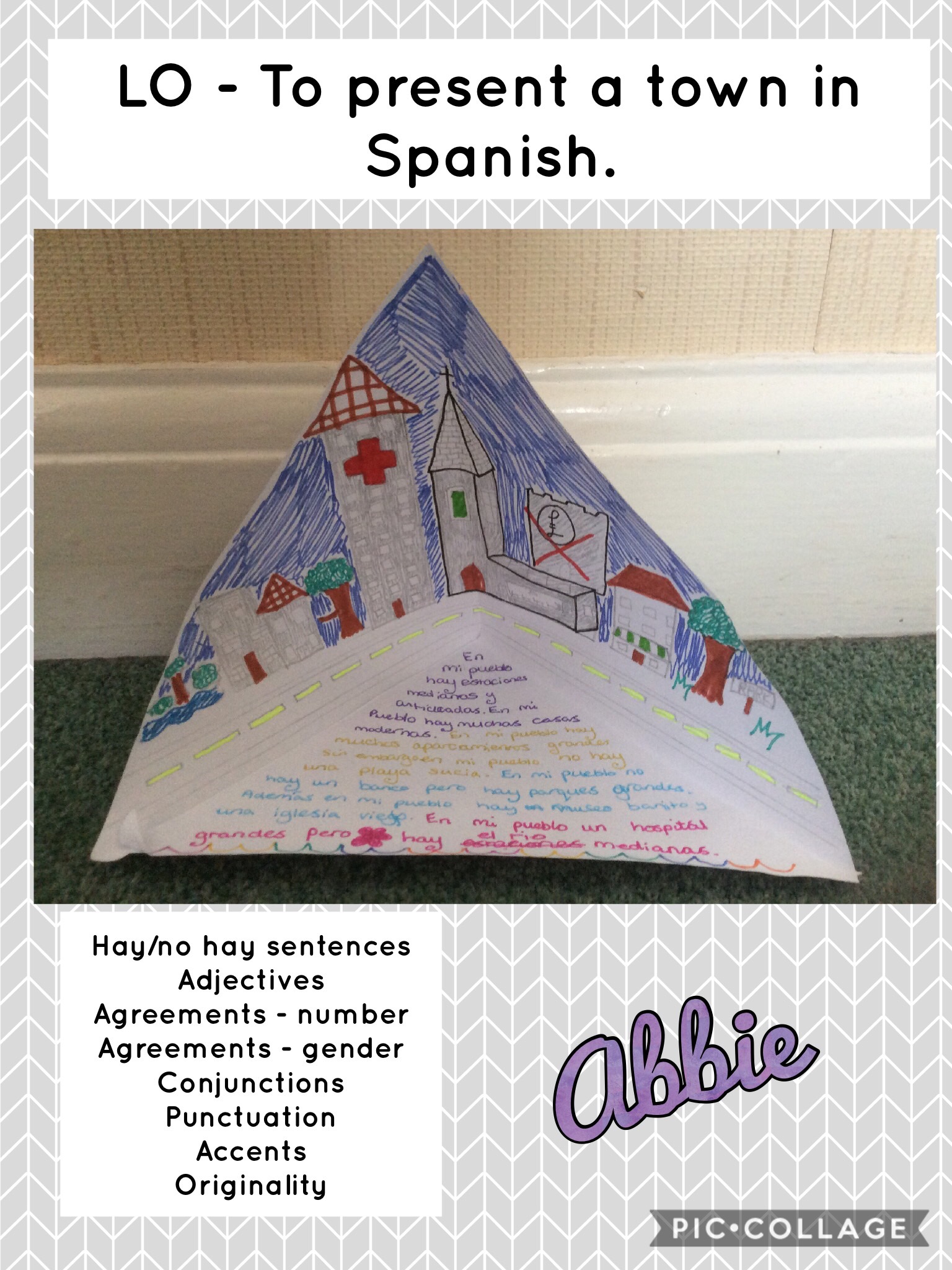
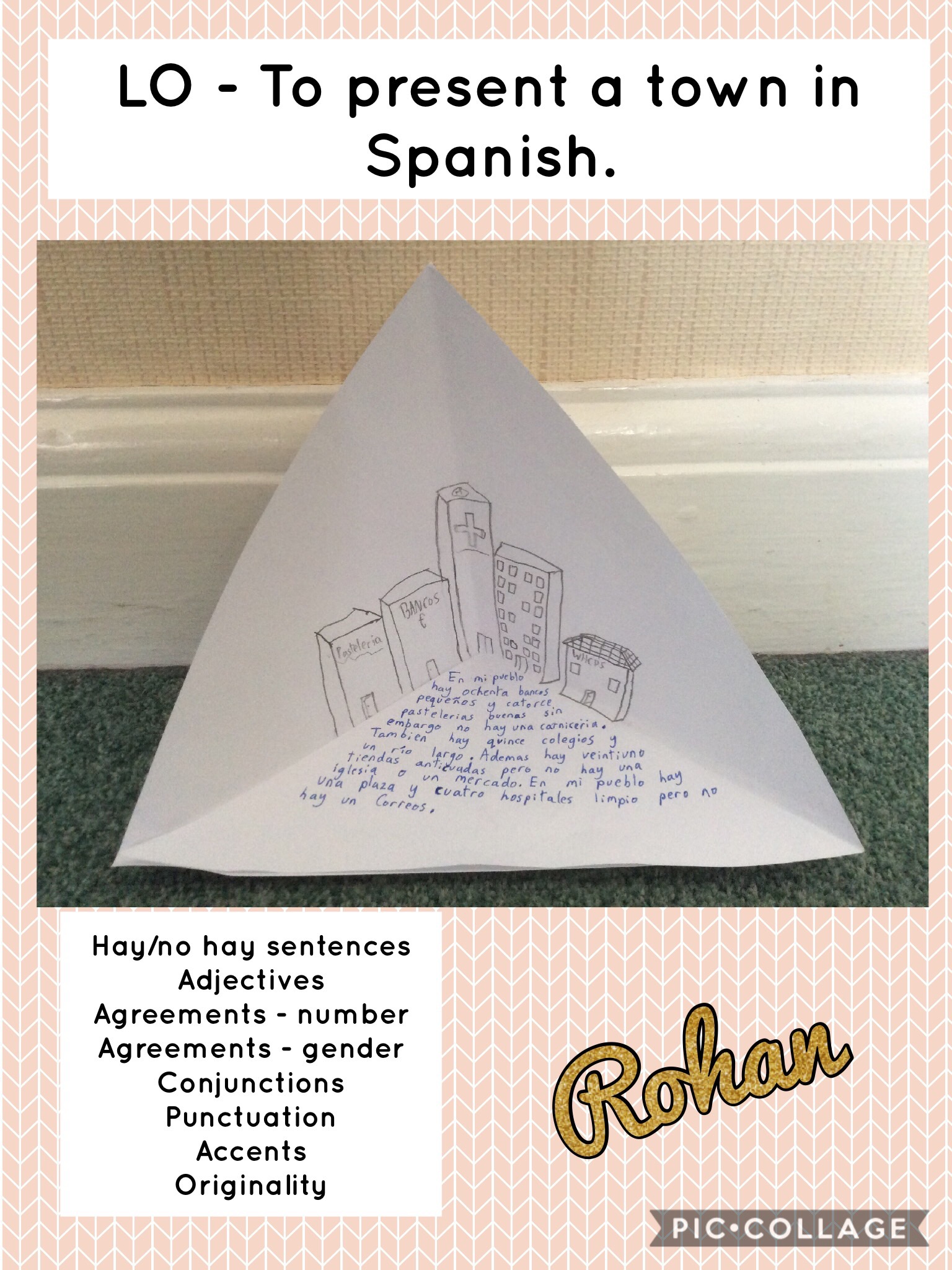
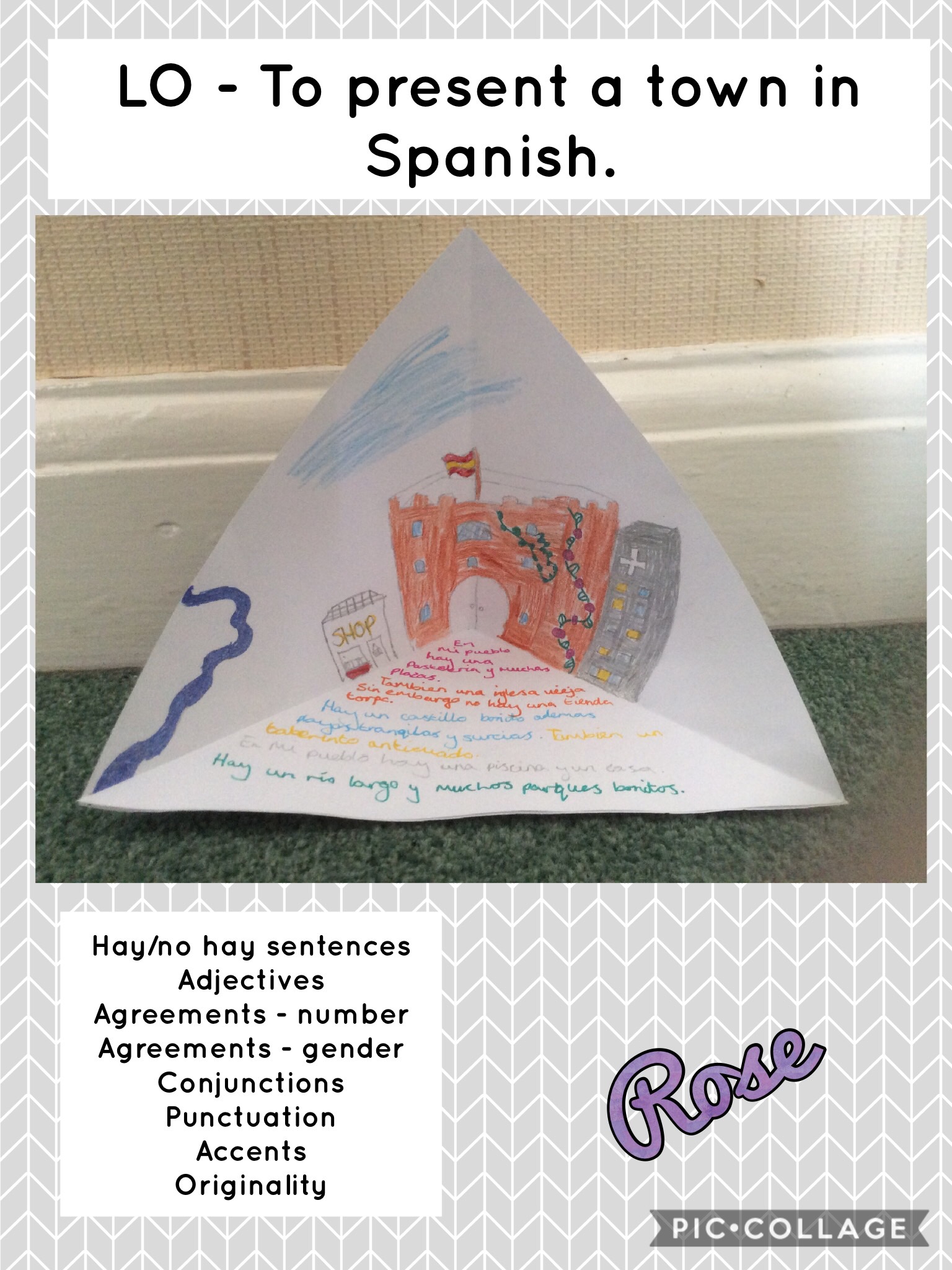
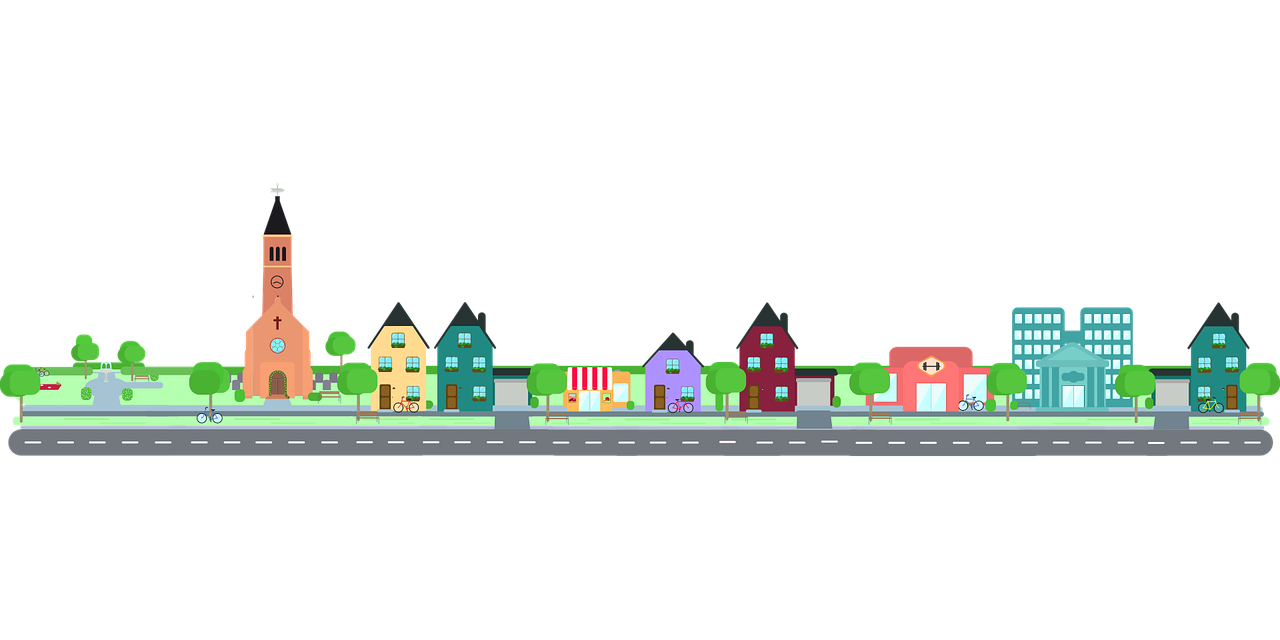
As promised, here are some of the trioramas made by Y6 at WCPS on the subject of Mi pueblo. The pupils were very excited about making them and whilst one class did a better job than the other, there were some excellent examples created. Each classroom has a (static) Spanish display and I’ve added some of the trioramas to the border of them. I was going to attach them like a row of houses but decided that it was batter with the writing flush to the wall and the townscape facing the floor so that they could be read!

Why spend the time making them?

  • Yr6 needed a bit of motivation!
  • It encouraged them to do their best work and take pride in presentation in a way that writing in their books doesn’t.
  • Their work is now on display, or has been taken home (I took photos of them all to stick in books.)
  • Others within school have commented on the work; again this would not to be true if it were in their books.
  • It celebrates all the work that they have put in over the previous few weeks.

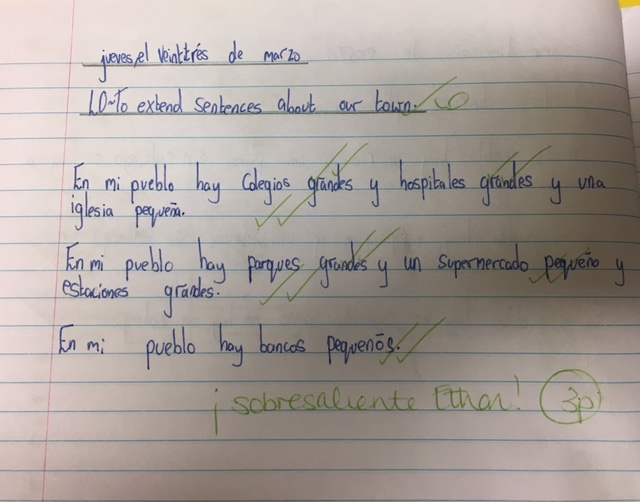
Year 6 at WCPS are currently working on the unit Mi pueblo and are working towards writing a paragraph about what there is and isn’t in their town/local area.

In the first lesson, they were given a set of pictures and words for places in the town and asked to match them up without any help. They used their knowledge of English (and French and Polish!) plus their skills of deduction to work out the majority and then the last was decided upon by process of elimination! We discussed their tactics and then recapped the definite and indefinite article that we’d covered before Christmas when talking about sport. In the same lesson, pupils were given a further sheet of images and words to match up.

In the second lesson we used hay and no hay to talk about what there is and isn’t in our town. We joined sentences with simple conjunctions such as y and pero before moving on to use sin embargo, también, tampoco and además.

Last week we moved on to extending our sentences by 1. using singular and plural nouns, 2. using muchos/muchas and 3. adding adjectives as well as using reference materials to find more places in the town. This meant that we reviewed the position and behaviour of adjectives in Spanish, something that we’ve ‘done’ lots of times.

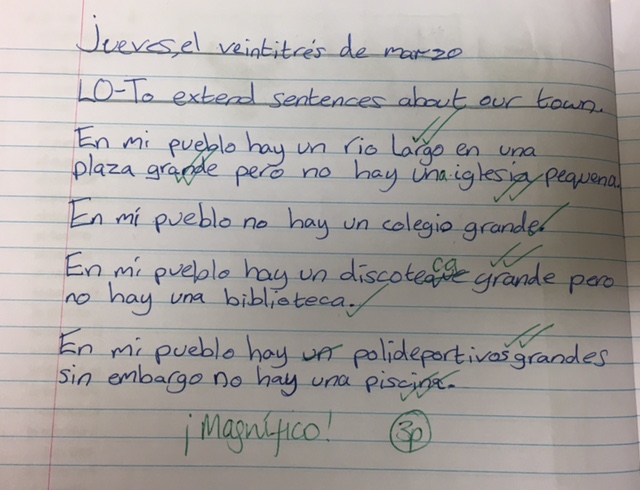
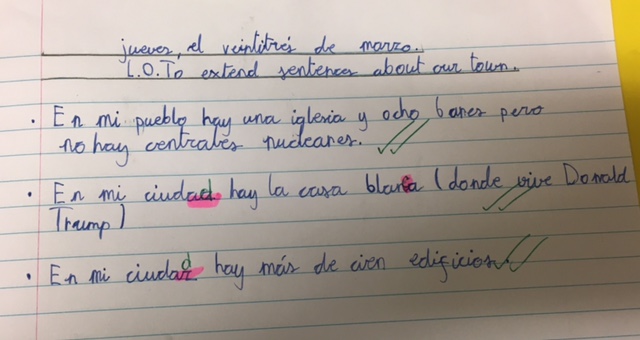
Some of the work is below:

These two boys really impressed me with their grasp of adjectival agreements.


This was written by a native Spanish speaker – imaginative but with some interesting spelling mistakes.

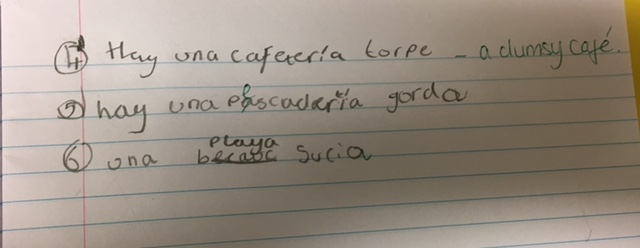
And these two young ladies amused me with their use of adjectives!

(Someone else suggested ‘en mi pueblo hay un castillo joven y una pastelería ocupada’)

This is in preparation for creating a town triarama over the next two lesson based on their paragraphs. I’ll post some examples when they’re finished. A bit of carrot and stick as well as a good way of producing work for display…


It’s one month to go until the annual Association for Language Learning conference, Language World. Have you signed up yet?

This year the theme is Progress for All (like the clever logo!) As the ALL website says:

Progression in the teaching and learning of languages is a priority for all teachers and ALL as a professional association as we respond to significant curriculum changes and developments at all levels. Progress for ALL is a deliberately broad title, as we aim to serve the needs of all conference delegates. For example, we are including sessions on promoting progress in all aspects of pupils’ learning of languages, ensuring progression in curriculum planning, sustaining progress in curriculum leadership and celebrating progress in building a culture of language learning in a school.

During the two days there will be a mixture of plenary sessions, major talks and workshops with something for everyone from primary to higher education, and this year there is a slot for poster presentations which looks really interesting too.

This year the conference takes place in Nottingham at the East Midlands Conference Centre which is very convenient for me living in the Midlands and once more in the ‘middle’ of the country.

There’s a special ‘call out’ to primary colleagues issued on the ALL page with testimonials from a range of primary colleagues. Have a look at the flyer: 

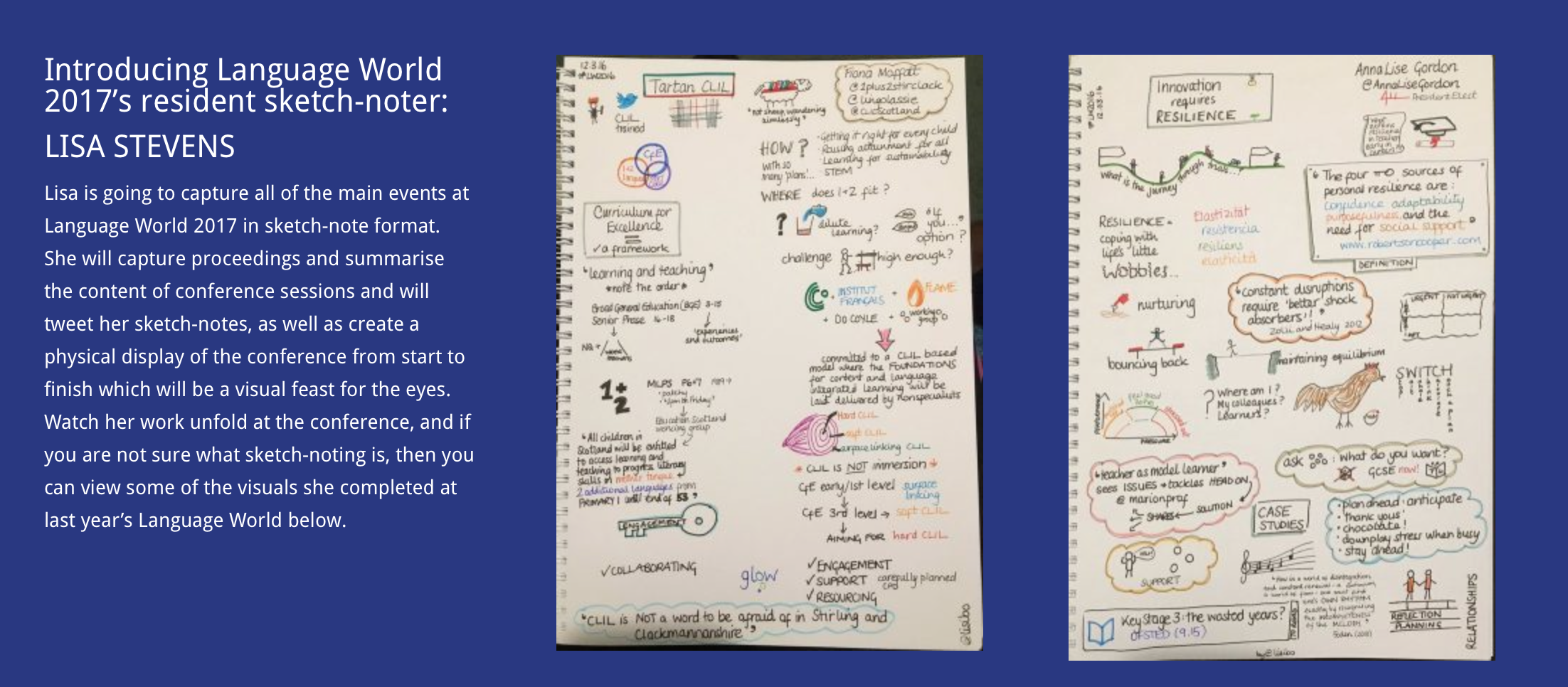
I’m not speaking this year (apart from a contribution to the Primary Spanish Show and Tell) but I have a special (albeit rather daunting) role to fulfil:

I’m looking forward to attending sessions and trying to capture them ‘live’ ready to post to the timeline in the exhibition area; a shame I can only be in one place at a time though as there are several slots where I’d like to attend two or even three sessions at the same time.

If you’re interested in attending, the programme is below, and booking details can be found here.

Hopefully see you there?


Teaching the time is a trying task in any language; I’ve been comparing notes with my Y3 colleagues who have been battling through the time with their classes in Maths lessons as I’ve been working on it with Y5 in Spanish. And back in the day when I taught KS3 and 4 it was also a challenge as I invariably had to ‘remind’ them of how to tell the time full stop! It seems that, for some, the time is viewed much as the gif above – wobbly wobbly and hard to pin down.

So this year I put on my thinking cap and considered what might make it easier. Active things like TimeBallet help with hour and half past, possibly quarter past/to, but tends to get too complicated/fall apart for many with minutes. Singing songs like Uno dos tres ¿Qué hora es? works for the question form and hour/half past. Using mini clocks works for some but I wanted something a bit more supportive. So I decided we’d all make a prop to help them.

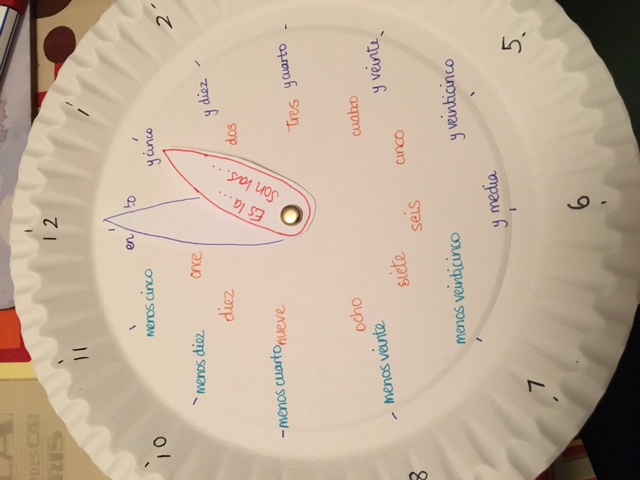
Cue the purchase of lots of paper plates and split pins, and the sharing of my gel pens, felt tips and fine liners. The idea – not very original perhaps but quite effective – was to make a personalised plate clock with key phrases on it to support learners as we rehearsed the time.

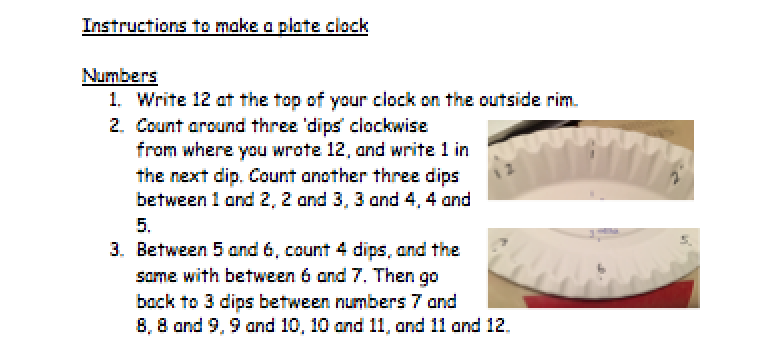
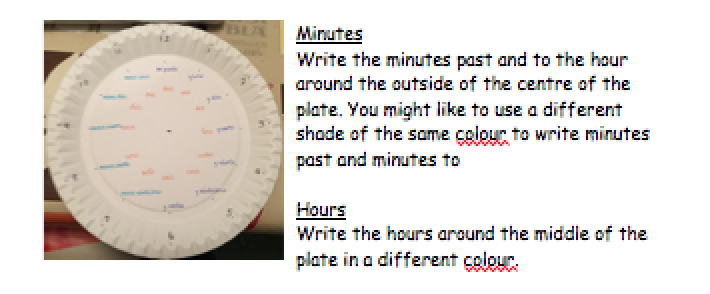
I demonstrated how to make it but also wrote a set of instructions (in 4 screenshots below and downloadable in one document from here) for the learners to follow after the demonstration, along with providing a larger image plate clock diagram between two so that the writing was clearer.

By putting the hours hand on top of the minute hand, I hoped to emphasise that the hour always comes first, and we wrote the verb Es la/Son las on it to remind learners how the sentence started. And by writing the hours and minutes in separate colours that corresponded to the colour of the hand was another attempt to make it clearer which phrase to use.


Everyone enjoyed making the clocks although some were a little wonky and needed a bit of ‘Sra Stevens magic’ before functioning correctly, and we’ve used them in two lessons now. On the whole, once we got over fiddling with the hands constantly and concentrated, it seemed to help some learners, and it was good to see them being used, much as they use the Maths equipment in numeracy lessons, to help children work out the answers to write in their books as well as in speaking work. Turn the hands to show the time then read the Spanish if the question is in English, or turn the hands so that they match the phrase in Spanish to work out where to draw the hands on a blank clock. Plus the children are all desperate to take them home which I’ve promised they can do once we’ve finished the unit.

There are some other good ideas on how to teach time here from Erzsi and Clare.

I’ve used the clock mini book idea in previous years with success as a self differentiating assessment activity:  pupils have to choose six times to demonstrate their understanding and confidence at telling the time so they need to choose carefully those that they know. Might yet do it this year…

If you have any ideas to add, feel free to leave a comment!


I’ve been working with Anamil Tech on Pacca Alpaca for a while now. The apps Pacca Alpaca and Pacca Alpaca Travel Playtime have proved very popular and are now available in English, Arabic, French, German, Spanish, Mandarin and Welsh.

Well, there is now a Youtube channel of free videos to accompany the app. You can subscribe to Pacca Alpaca for more kids learning videos in Spanish, English, French and Arabic here – http://bit.ly/paccayoutube

Here’s the first Spanish video, released today!


I choose joy

| 2 Comments

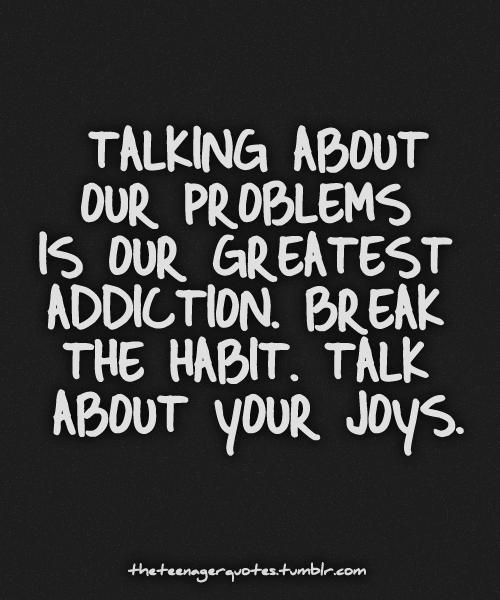
On Sunday I posted the following image on Twitter with the comment I choose joy.

I’ve  pondered this post all week and finally found time to write it. It’s provoked by an increasing trend to point out all that is bad in life, and more specifically, education.

Whilst I am quite aware that there are a myriad ways in which our world is broken, a multitude of things that drive me bananas about education and multiple aspects of my working life that I’d like to be different, I make a choice to not wallow like a hippo. I’m not ignoring the problems; they’re sometimes fairly important and need addressing. However, if I focus solely on them, my life is frankly miserable and unpleasant.

I make another choice, the choice to (try to) find solutions, and if not solutions, work arounds, compromises and ways to make difficulties less burdensome. I don’t have an answer to everything, in fact, I have answers to very few things but I do my best.

We follow a PSHE programme called SUMO at one of my schools, and one of the principles is not to be Doris Day (which is counterintuitive as I grew up wanting to be her so badly!) and claim “Que será, será.  Whatever will be, will be. The future’s not ours you see.” As a teacher I know that the near future is mine but the longer future belongs to my pupils (and to my children), and my role is to prepare and equip them for it. We teach our pupils to question and find solutions to their problems, to talk to one another, to celebrate successes and share and support one another in hard times. Surely if we model misery and moaning that sets the wrong example?

Don’t get me wrong, I have a whinge with the best of them from time to time, especially when I’m tired but all the time? I’ve written before about this in a post called Transformers and Reepsiepie added to my Optimist Prime/Negatron analogy by talking about Radiators and Drains; in every staffroom, workplace and social media site, there are those who drain all positivity and life. I want to sit next to the radiator! Increasingly I am choosing not to spend long periods of time on Twitter for just this reason, and likewise I have left groups on other social media platforms as their negativity was dragging me down.

I haven’t left Languages in Primary Schools though as, just like the marvellous Talkabout Primary MFL used to be, it is a place of celebrating all that is going well, sharing ideas, and helping out people with queries, worries and emergencies. The members are realistic about the task we face – and who couldn’t do with more time to teach their subject, less last minute changes of plan, decreased paperwork, 100% attention and more energy and time to do all we’d like to do – but it’s a place full of radiators who, when the going is tough, share their experience, and to continue the analogy, warmth with others. And isn’t that far better than pointing out all the things that the person did wrong, or adding to their woes with a list of your own?  I’d like to think that this website is a radiator too.

For me, life can sometimes be uphill struggle which may surprise some who only ever see a smiling bouncy Lisibo, but it’s true. Sometimes that bounce is an act of will and only happens because I’m working hard at it, like a swan madly swimming under the water. My decision to choose joy is a lifestyle, and lifesaving, choice.

I write a Grateful blog each day in which I write things for which I am grateful; last year it was things that made me smile. Sometimes I don’t get it written and published because I’m tired but the thought is still there. I’d encourage you to do the same.

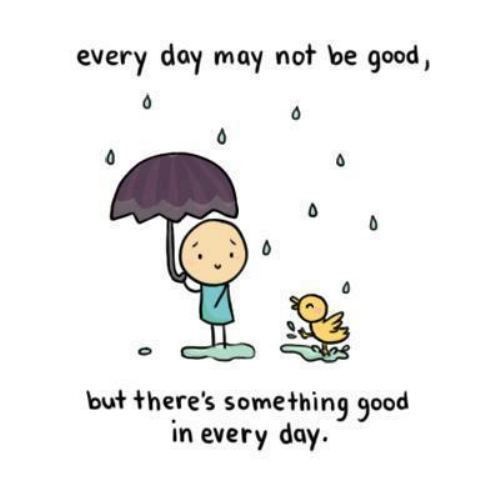
Yes, life is challenging and teaching is hard for a variety of reasons, but there are so many joys too. I could focus on the fact that yesterday I was on break duty, I didn’t get my lunch eaten and Y6 took advantage of my good nature, there was staff meeting, I didn’t get to teach the classes I was supposed to and I got an impatient email asking me to do something that I’d already said I’d do which isn’t due until next week anyway. I’d rather list my joys: I spent lunchtime yesterday dancing around the dining hall with pupils as they ate their Christmas lunch, singing at the top of my lungs and getting very hot. In the afternoon, we watched Y1 and 2 perform their play. We opened Christmas cards from partner schools in Finland, Spain and Poland, and borrowed a Polish pupil from his class to read us the latter. He glowed with pride! A whole stream of Reception children (who I have never taught) walked past me as I was photocopying and smiled, and quite a few responded to my ¡Buenos días! with a cheerful ¡Hola! A colleague helped me find my mislaid iPad case; a volunteer student stayed inside with a child at playtime so I could go to the toilet and get a cup of tea. At some point, a child stuck a sticker to my jumper – no idea who did it but it made me smile. A child saw two others about to have a fight and intervened before it escalated, sending someone to fetch me in case. I was met with groans of disappointment when I said there was no Spanish next week. I sang in the staff meeting.  We hatched a plan for the teachers to sing a song in the end of term concert.

And that’s just one day.

You may also like this post on a similar theme:

Ser optimista

¡Vámonos! ©2026. All Rights Reserved.
Powered by WordPress. Theme by Phoenix Web Solutions