Engaging Hearts and Mind – Collaboration in the Primary Languages Classroom #LW2026
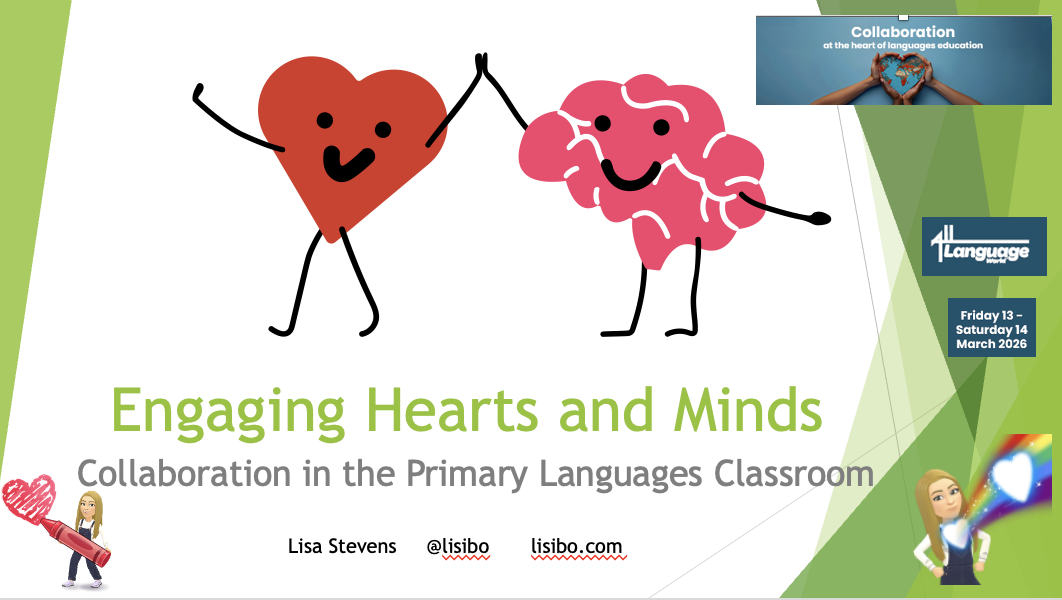
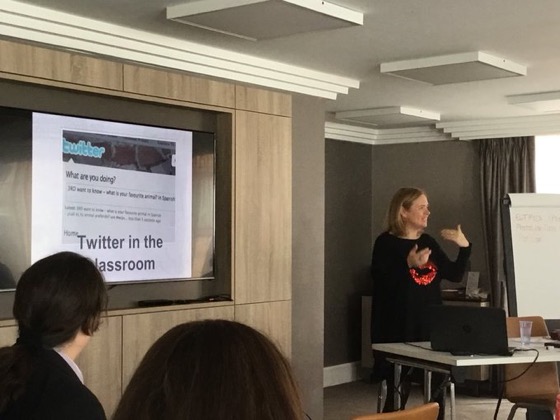
Last weekend I was privileged to present once more at ALL Language World, this year held at Hinckley island.
The theme of the conference was COLLABORATION and my session was entitled Engaging Hearts and Minds.
I’ve been playing with Google NotebookLM and asked it to summarise my presentation:
This presentation by Lisa Stevens advocates for a holistic approach to primary language education that focuses on connecting with students’ emotions and intellect. By fostering international partnerships and cultural exchanges, schools can broaden pupils’ worldviews, enhance their communication skills, and dismantle harmful stereotypes. The material highlights how cross-phase collaboration between primary and secondary teachers ensures a smoother academic transition for young linguists. Furthermore, the use of character-based learning, such as the “Language Superhero Squad,” helps students embody virtues like resilience, curiosity, and respect. Ultimately, these initiatives aim to elevate the status of languages within the curriculum while developing empathetic global citizens.
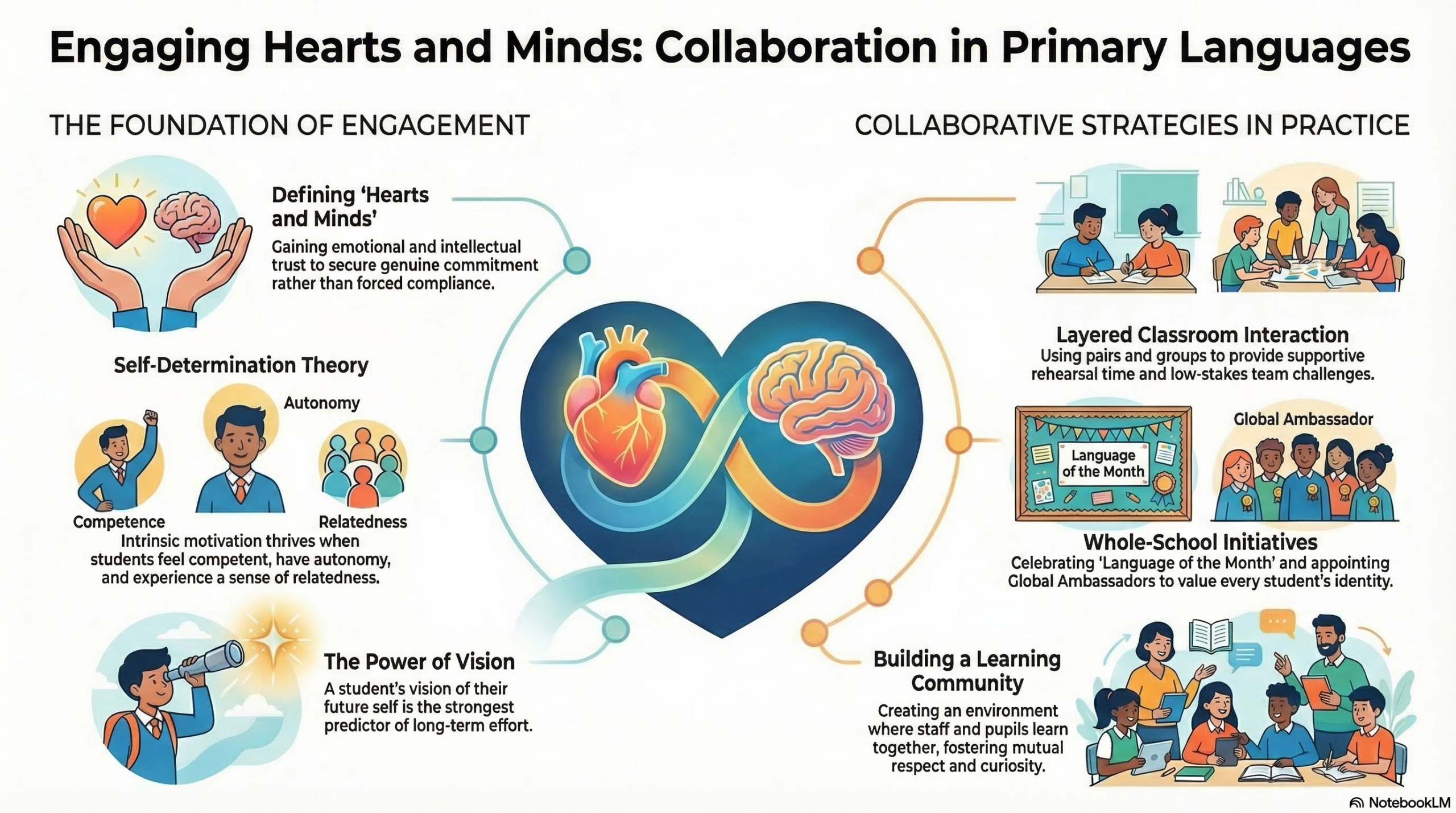
I admit that I was intrigued by the infographics that I’ve seen Jerome Nogues sharing on social media so i had a go, uploading my slides to see what I’d get. What do you think?
I was also intrigued to see if it could write my blog post for me. Didn’t do a bad job I have to say. Some minimal editing (removing American spelling mostly!!) here it is!
More Than Words: 5 Surprising Ways to Win “Hearts and Minds” in the Language Classroom
We’ve all been there: standing at the front of the room, pouring our passion into a lesson, only to be met with a sea of blank faces or, perhaps worse, the “polite compliance” of students who are doing the work simply because they have to. We don’t just want them to memorize verbs; we want them to find their voices. The relatable struggle for every language educator is bridging this engagement gap—moving students from “forced compliance” to a state where they are learning because they truly want to.
The secret lies in a philosophy often discussed by Lisa Stevens, a renowned language teacher [that made me smile] at Whitehouse Common Primary, Member of ALL, and British Council Ambassador. She champions the “Hearts and Minds” approach, a strategy that moves collaboration from the periphery to the very centre of the classroom. It is about fostering a community where emotional and intellectual support creates the trust necessary for deep, long-term learning.
——————————————————————————–
1. “Hearts and Minds” is a Strategy, Not Just a Feeling
Winning “hearts and minds” is often mistaken for a fuzzy, “soft” concept. In reality, it is a sophisticated pedagogical strategy. Dictionary and historical definitions describe it as gaining emotional and intellectual trust, specifically in contrast to “forced compliance,” where students accept a situation only because they have no alternative. In a primary language setting, we aren’t seeking to prevail through the superior force of grades or sanctions; we are making emotional appeals to sway our students toward a genuine love for communication.
“Mrs Thatcher said that economics is the means, and changing hearts and minds is the goal.”
Just as economics was the means for Thatcher, in our classrooms, the target language is the vehicle—but the true destination is a profound transformation in student mindset. We use the language to reach the heart, ensuring students feel safe enough to take the intellectual risks that fluency requires.
——————————————————————————–
2. The “Vision of Self” is Your Strongest Motivational Lever
To sustain effort over years rather than weeks, we must tap into how students perceive their future selves. Research by Dörnyei (2016) suggests that the “Vision of Self” as a second-language (L2) user is the highest-order motivational force. If a student can’t “see” themselves as a person who speaks Spanish or French, their long-term effort will stall.
We can understand this through the “Expectancy-Value Theory” formula: E×V=M.
- V (Value) represents the “Vision of Self.” If the vision is zero, the entire equation collapses, and motivation (M) disappears.
- E (Expectancy) is the student’s belief that they can actually succeed.
This expectancy is built through the “Competence” pillar of Self-Determination Theory (Ryan & Deci). When we cultivate a sense of mastery, we fuel the intrinsic motivation necessary for the journey. According to this theory, motivation is powered by three essential needs:
- Competence: The need to gain mastery and control over one’s learning environment (Essential for building “Expectancy”).
- Autonomy: The need to feel in control of one’s own life and goals; fundamentally, it is about having a choice.
- Relatedness: The need to experience a sense of belonging and a deep connection with other people.
“The vision of who students would like to become as L2 users seems to be one of the most reliable predictors of their long-term effort.” — Dörnyei (2016)
——————————————————————————–
3. Creativity Actually Needs Constraints
It sounds counter-intuitive, doesn’t it? We often think creativity requires a “blank canvas,” but the “Constraint Principle” (Boden, 1990) argues that total freedom can actually lead to cognitive paralysis. For language teachers, constraints are our best friends.
Think of the Sentence Builder—like the ¿Qué quieres? frameworks used at Whitehouse Common. By providing a limited “wall” of options (e.g., choosing between comer and beber, then selecting from a small list of foods), we aren’t stifling the child. Instead, we are giving them a safe structure that allows them to “play” with the language. Within these narrow bounds, students find the confidence to be linguistically creative without the fear of falling.
“Far from being the antithesis of creativity, constraints on thinking are what make it possible.” — Boden (1990)
——————————————————————————–
4. Collaboration is a “Team Sport” Within the Classroom
Collaboration should be a multi-levelled experience that turns the classroom into a “community of learning.” It begins with pair work (carpet partners) where rehearsal and “thinking time” provide the low-stakes support students need to build confidence. We then scale up to groups, using frameworks like “Voice21” to practice the “team sport” of turn-taking and building on others’ ideas.
The real magic happens during whole-class “Teacher vs. Class” or “Teacher + Class” dynamics:
- “Get into my head”: A high-impact game where students must predict linguistic patterns the teacher is thinking of, building a shared sense of community and pattern recognition.
- “Snowballing”: A primary process for building linguistic complexity where the whole class works together to grow a simple sentence into a masterpiece.
By aligning our lessons with school-wide virtues like Curiosity, Respect, and Resilience, we create a “family” atmosphere where mistakes are celebrated as a natural part of the team’s growth.
——————————————————————————–
5. International Links Break Barriers
Connecting with pen pals or global partners provides the “why” that makes the individual pieces of grammar and vocabulary fit together.
By looking beyond our walls, we achieve several high-impact outcomes:
- Mirrors and Windows: Children finally “see” themselves and their own culture more clearly while gaining a window into the wider world.
- A Tangible Purpose for Learning: Language moves from a “subject” to a tool for real communication, often leading to a sudden improvement in everything from speaking confidence to the neatness of their handwriting.
- Prestige and Ethos: Languages are no longer “forgotten” or curtailed; they gain status within the school, fostering a global outlook where every student feels valued.
- Challenged Stereotypes: Direct contact replaces preconceived notions with curiosity and awe-inspiring “WOW” moments.
One student at Whitehouse Common captured the human impact of this work perfectly:
“Everyone is different; if everyone was the same it would be boring. It will also prevent wars from happening so the world would be calm and peaceful.”
——————————————————————————–
Conclusion: Beyond the Classroom Walls
The “Hearts and Minds” philosophy is a call to move beyond rote instruction toward a pedagogy of connection. When we collaborate across borders and within our own classrooms, we aren’t just teaching grammar; we are transforming students into empathetic global citizens.
Are we just teaching our students how to speak a new language, or are we giving them a new vision of who they can become in a wider world?
If you are ready to move from compliance to connection and continue this journey of creative pedagogy, join the conversation by leaving a comment below. Let’s build those bridges together.