¡Vámonos! – Page 89 – "The decision to learn a language is an act of friendship. It is an outstretched hand." John le Carré
 

.flickr-photo { border: solid 2px #000000; }.flickr-yourcomment { }.flickr-frame { text-align: left; padding: 3px; }.flickr-caption { font-size: 0.8em; margin-top: 0px; }


El Toro, originally uploaded by sparky2000.

I’ve been (re)exploring Flickr this evening. I joined a while ago and uploaded some photos – but then forgot about it. As my husband was delayed by the Heathrow Terminal 5 fiasco, I had a spare few hours that i have spent browsing a multitude of photographs.

So here begins an (occasional) series of images of one of my first memories of Spain – the Osborne bull or Toro de Osborne.

More about Flickr and Osborne bull in future posts!


Hot on the heels of yesterday’s e-mail from CILT about Europe Day (see yesterday’s post), today I received a message from Pamela Powers at the European Parliament about Spring Day in Europe;

Spring Day in Europe was set up to promote learning and debate about the European Union in schools.

As 2008 is the European Year of Intercultural Dialogue, “Bridging cultures through dialogue” is the chosen theme for Spring Day 2008. It will be held from 25th March to 30th June, with a special focus on 9th May, which is Europe Day. Schools across Europe are invited to take part.

The Spring Day in Europe website provides teachers and students with ideas for events and activities in the classroom. For further information and to register your school, please look at the Spring Day website: http://www.springday2008.net

Once registered, you will have access to the full package of teaching and learning resources, activities, tools and services of the web portal.

The teacher adviser for the UK is Ian Levinson . He is a contact point between European Schoolnet and schools that register with Spring Day in Europe and is able to advise and answer questions.

Investigating the Spring Day website, it seems that there are various benefits to registering for the day – such as involvement with other classes and schools, taking part in competitions and receiving a certificate of participation for your involvement – always popular in schools with SMT :o)

Content is in 23 different languages, allowing for access to the site in the language studied as well as English, and the ability to compare text (and I assume activities) in different languages. At the same time, the whole day is based on the discovery of other cultures and traditions, thus covering ICU strand. There are online games, ecards to send and podcasts too which make my evolving techie side smile! You can find out more about activities, past events and how to register on the Spring Day for Europe 2008 site.

At the time of writing there are 1113 schools registered – I’m about to make it 1114.

What about you?

Europe Day 08

| Leave a comment


I’ve just received notification from Ruth Churchill at CILT of some FREE resources available. Never one to look a gift horse …, I immediately investigated!

Apparently May 9th is Europe Day (I’m afraid this was the first I’d heard of it!) and the European Commission has produced a booklet to promote the day as well as provide information promoting the EU.

Here’s the e-mail:

Representation of the European Commission in the United Kingdom – Passport to the European Union
What do we know about the member states of the European Union? Whereabouts is the statue with more clothes than one would find in any woman’s wardrobe. Did they really use eggs to built a bridge in Prague? Could there still be an island where no female either human or animal is allowed? This and a lot more information on the 27 member countries of the European Union e.g. their size and population, famous citizens etc. is answered in our little booklet “Passport to the European Union” which also includes stickers of coins, flags, buildings and even a map. Children can find places for the stickers in the passport and on the map.

In order to support Europe Day (9 May) activities for young people, the Representation of the European Commission in the United Kingdom is making 100,000 copies of the Passport to the European Union available to UK schools and similar organisations completely free of charge.

You can view the booklet online and then decide if you want to order up to 100 copies per school either from your Europe Direct centre or by filling in a form online. I’m planning on using them for SODA (start of the day activity) and also for incidental work. If every class focussed on a different country, we could share notes in assembly later in the week. Kids love finding things out and with stickers and things too, it’s sure to be a hit (they’ll prefer it to handwriting too!)

So don’t hang around- there are now 100 less copies as my order’s already in!

Here’s a montage of posters used in previous years to promote the day – perhaps it’ll inspire you!

To find out what’s going on in the UK, have a look at the events diary – I like the look of the Giant European Union Pub Quiz in Wrexham! And there’s also a whole page of ideas for how your school might be able to celebrate.

SMS en español

| Leave a comment


hla k tal? spro k b. k acs? kntm.

Sbs k digo? My typing skills haven’t deserted me – I’m texting! If you speak Spanish and/or are conversant with the language of texting, all that makes perfect sense.

I must admit that I sometimes get confused by all the abbreviations and double meanings in English – LOL is laughing out loud but also lots of love – and have to explain some abbreviations I use – I thought ROFL was universally understood as rolling on the floor laughing??

I was interested to read a recent post from Spanish.about.com entitled Spanish cell phone abbreviations – Shortcuts make text messages faster.
I wondered how the language of text would vary between English and Spanish. It was interesting to see how Spaniards use similar abbreviations to us:

  • letters and numbers just like us – gr8 = great / 100pre = siempre or salu2 = saludos
  • phonetic abbreviations as we do – cu = see you / aki = aquí
  • initial letters – brb = be right back / npn = no pasa nada

but also have borrowings like pls for por favor, and also sms for texting itself.

I wonder if we could justify texting as a suitable for Primary learning –
it’s definitely Modern, it’s Foreign to many and it’s a Language in its own right. How about it? ;o)

m1ml, b7s, a2

You may have noticed I’ve got a new widget on ¡Vámonos! labelled Where in the world…??
This follows someone (I’m afraid I can’t recall who!) Tweeting about placeSpotting.com, an online map game based on Google maps. There are numerous riddles showing a satellite picture of somewhere in the world in the top box, and in the bottom box is a Google map of the world. Your task is to find the exact satellite picture to ‘solve’ the riddle. Some people have left clues to help you – for example, I’ve just solved on with the clues

.…… Beach
Crockett and Tubbs

leading me to Miami.

Yesterday I was sent to Ullaru with the clue

Kangaroos

I’m now addicted to the site – given the cold and hail/snow, it’s a fine way to spend a Bank Holiday afternoon, improving my Geographical knowledge (not my strong point). Some of the puzzles are fiendishly hard, others are very easy – I had to find the border between France and Spain yesterday!

Here are a few puzzles I’ve made to bamboozle you – they’re not hard! Congratulations to @mrmackenzie and @josepicardo for solving the first one very quickly!

¡Suerte!


The ever innovative and very talented Leigh McClelland from Comberton Village College sent me a message on Facebook last week about a theatrical novelty taking place in the West End very soon.

Peter Pan El Musical: Spanish musical adaptation of JM Barrie‘s famous children’s story comes to the West End’s Garrick theatre from 28 March to 27 April. Peter Pan El Musical, which has enjoyed box office success in Spain, features all the familiar characters from this most English of stories – Wendy, Tinkerbell, Captain Hook and Peter Pan himself – who reveal a previously unknown aptitude for languages by performing the musical entirely in Spanish, with English subtitles. Adapted by Cristina Fargas, the show includes 14 original songs, performed by a cast of 25, led by Spanish musical theatre star Miguel Angel Gamero as Captain Hook and Mr Darling. Interesting? Lx

So I investigated further and discovered a website of excitement with photographs, music and news from the production. I particularly like all the photographs of the production.

The production is in London for a month before returning to complete the tour of Spain with Badajoz, Zaragoza and Valencia. A shame London isn’t nearer to Birmingham for a school trip but I might get there. If you want to find out more, go to the website, or here for tickets.

After my post earlier in the week about assessment I was interested to attend the session on Asset Languages at the Birmingham Primary Languages Conference. I knew a little of Asset from previous presentations but I was interested to hear if there had been any changes since I had last been updated.

John McNutt began his presentation with the statement –

‘Asset Languages is …a new way of assessing languages against the CAN DO statements of the DSCF’s Languages Ladder. It uses discrete assessment of the four skills of speaking listening reading and writing, allowing assessment to be done in as many or as few skills as wanted. It marks a move away from a content to skills based approach – not what you know but what can you do and work out with what you know; not just learning a language but learning how to learn languages.’

He gave us examples of how the first level descriptors look for Speaking and showed us by teaching us some Chinese that we all could attain this level quite easily.

  1. I can repeat a short phrase.
  2. I can ask a few questions.
  3. I can answer a few questions.

He pointed out that it’s easier to see your progress and your success if it’s in small steps like this.

Asset can be carried out through teacher assessment, external assessment or a mixture of both.
If you do teacher assessment, you can do it on your own at any time – can be done without telling pupils and you can issue your own certificates. John suggested that if the children don’t know they are being assessed, what’s the problem? Fair point I guess. He also highlighted that it is based on what pupils Can Do not Can’t Do.
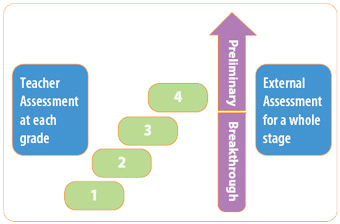
I liked John’s honesty on the subject of external assessment – If you do external assessment, there is stress! So why do it? He did suggest that it could be done at the end of Yr 6 for transition documents? this caused a sharp intake of breath from a number of people as they thought of SATs and already stressed out 10 and 11 year olds being faced with more exams.

The assessments are available in a range of many languages – and it is possible that a generic English pack will be produced so that any language can be assessed – good idea! The teacher assessments can be adapted as long as they fit the can do statements although external assessments are obviously set externally.

John wanted to demonstrate that assessment can be fun and asked for a volunteer. Having been met with silence, I took pity on him and volunteered, little knowing that i had to prepare the ‘class’ for an Asset Languaeg assessment in 5 minutes! I had to teach the ‘class’ a song in another language – guess what I chose? La Vaca Lola! Soon the whole class were waving their tails and mooing in Spanish – great fun!

Advantages of using Asset:

  • A way of providing baseline data (in the future!)
  • No need for QTS status.
  • Kudos of having a certificate to recognise their achievements in languages.

So what do you have to do and how much does it cost?

Primary Starter pack – Breakthrough £75 +VAT (covers all languages)

Certificate packs – 1st pack of 125 is free, after that, costs can be as low as 26.7p +VAT

For external assessments – £1 per skill per pupil.

I asked the question – Do you have to be accredited teacher?

If you want to issue certificates, you complete the self access DVD and it covers you for all languages. As a training exercise rather than pass/fail – and you can be an accredited teacher for any number of schools. This is a change from the previous system where you had to complete the course for each language and each level that you wished to test!

Registration is free – you pay as you go!

Centre coordinator training is free and organised regionally – one day to become an administrative expert on Asset – not compulsory but recommended.

Asset seems to have adapted to become much less of an administrative burden than it used to be. I like the idea of not having to externally assess to use the system, and also the ability to reward certificates as and when you see fit (obviously assuming pupils have met the standards!) Perhaps it’s something I should investigate further – although I’m still a little reluctant!


Sophie Bregent-Kight, Primary MFL AST at Moseley Language College led the second workshop on Tuesday entitled Adapting and using stories in PLL. Sophie is no stranger to many of those attending as has worked with a number of schools and also speaks at the ELLRSG almost as much as me!

She began by taking us through some reasons for using stories in PLL, linking it to the KS2 Framework for ALL year groups. There seems to be a concern that stories area great fro Year 3 but not for Year 5 and definitely not for Year 6. I agree with Sophie’s point that stories aren’t just for little kids – they can be used for all ages; it is what you do with them that matters.

Sophie recommended a number of places online where you might find some stories and activities, either in Powerpoint form or to purchase- there are many more including the various Grids for Learning, especially Northumberland which has whole units preplanned around fairytales such as Goldilocks, Red Riding Hood and the Three Billy Goats Gruff.
There’s also Herefordshire and Stoke .

www.storyplace.org – PPT stories – little stories

www.momes.net – French website

www.activedesigns.co.uk/french-educational-products.htm

www.ablekids.co.uk/merchantmanager

www.gallimard.fr/multimedia

Sophie then went on to show us an example of how a story can be adapted and used for a whole unit of work. Goma de verduras is a story that Sophie has adapted from Vegetable Glue by Susan Chandler illustrated by Elena Odriozola about a child whose body is falling apart because they don’t eat enough vegetables to make vegetable glue.

Sophie translated the story into Spanish – here’s the first page:

Cuando mi brazo derecha se cayó

Sabía lo que hacer

Lo pegué de nuevo con

Goma de verdura

We then discussed ways to use the story – obvious themes to pursue are food and body parts. Sophie talked about some of the activities that she had used in exploiting the story:

  • ¿Adónde va la mariquita? betting game – guess where the ladybird is going.
  • Made books as visual dictionaries using glossaries and research
  • Labeling Shrek / monsters – gave a choice of people to label according to interests
  • Making storyboards of the story
  • Human sentence to reorder text
  • Had models of little girl and practiced parts of body falling off with narration in Spanish
  • Teacher revisited during the week
  • Did similar activities with food stuffs
  • Took it on to like and dislike
  • Grammar plurals
  • Survey and graph
  • Report back reuses previously used vocabulary
  • Healthy / unhealthy = sano / malsano
  • Menu for a party – to keep in mind that it’s supposed to be healthy
  • Another idea – what do you put in your basket?
  • Recipe for vegetable glue – quantities included here
  • Girl with a stomach – feed food stuffs into the girl for their recipe
  • Moved on to talk about food groups ands healthy eating pyramid in English and Spanish – compared and contrasted – portion sizes
  • Used to discuss their eating plans for next day

Sophie then shared a
nother idea she had to use ICT to research food in Spanish supermakets by accessing their pages on the web. You need to have a Spanish postcode – use the white pages to choose a name you fancy and ‘borrow’ their postcode if necessary– or borrow one from a Spanish friend!

www.carrefour.es
www.eroski.es

www.alcampodirect.es
www.mercadona.es

Some suggested activities –

  • Compare prices
  • Compare food stuffs – do we eat the same or different? Different vegetables? What is traditional? Packaging?
  • Make own adverts for food – cut and paste

I really enjoyed Sophie’s ideas – I’ve never read Vegetable Glue, but it sounds like just the kind of book that is really versatile and useful for PLL. Makes a change from Hungry Caterpillars and Giant Turnips!!

Any further suggestions anyone?

¡Vámonos! ©2025. All Rights Reserved.
Powered by WordPress. Theme by Phoenix Web Solutions