It seems that only Portugal and France agreed with me, and, as it was pointed out by @frogphilp on Twitter this morning, I’m not a country – yet – but I quite liked the Spanish entry for Eurovision. At least she sang in her own language!
httpv://www.youtube.com/watch?v=D7CuPRMyd-c&feature=related
Next week three staff from my school – including me! – are off to Barcelona for our third visit as part of the Comenius Reggio project between Birmingham and Barcelona. We’ll be visiting our partner school, Els Pins, as well as collecting resources, ideas and experiences for Whitehouse Common.
Whilst we’re there, we’re looking forward to meeting lots of people, including Miquel who works for the Consorçi de Educacció and who visited school last year.
You may recall that about this time last year I came over all excited about Miquel’s hobby and had a little go at making “human castles” or castells myself. See photos below!
Here’s the post I wrote afterwards and another later in the year. Also on my school website here and here. It’s not something you should try at home as it takes lots of practice, but Miquel is an expert!
He has just sent us some information in English about Castellers. Fascinating – what an awesome sight it must be to see towers of people 10 levels high! I was awestruck by seeing 5 levels!

¡Soy fuerte!

En Miquel

How it should be done!

Not sure I'd trust a random person to hold my child on their shoulders...
On Saturday I attended the Purpos/ed Summit for Instigators in Sheffield, meeting with others to debate the purpose of education and discuss how we might ‘kickstart’ a wider debate on the subject.
Part of the time was given over to 3×3 presentations by attendees – 3 slides in 3 minutes on the question of the education. The random fruit machine from Classtools didn’t pick me so I decided to rcord what i might have said.
Without adrenaline and anyone to tell me to be quiet, it went on for a bit longer than 3 minutes, but here it is.
I challenge you – what do you think the purpose of education is?
Find out more and join the debate here.
#Purposedpsi 3×3 @lisibo
View more videos from Lisa Stevens
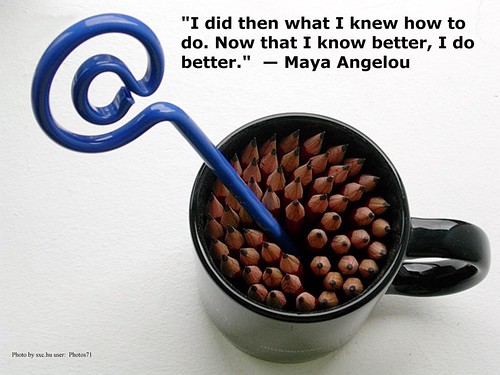
Image from Flickr By mikefisher821 Some rights reserved
I sometimes look back to when I first began teaching and can’t believe some of the things I recall. Like handwritten worksheets made on a banda machine, barely legible worksheets photocopied from Tricolore, not allowing pupils to see the words when you introduced them orally and naff songs! But, as this quote says, I do better now!
The last video has a footballer reading 2 non-fiction books about animals – always a popular subject in primary schools.
The first links into geography, culture and the environment; life cycles – who eats who – and habitats – who lives where.
Here’s a link to the West Sussex Grid where there are some resources linked to habitat. And some animal / habitat flashcards.
The second is about elks – venados – and how they live. Really interesting!
httpv://www.youtube.com/watch?v=cE_AtnV0Cjo
The third video is a non fiction book called Ser respetuoso. I think this would be a great way to start a PSHE session on respect – how do you recall eople showing respect in the story? The discussion doesn’t have to be in Spanish – but why not use the Spanish story as the stimulus? That’s a good way of integrating language into the curriculum.
httpv://www.youtube.com/watch?v=bSyODK6P1rs
The second video I’d like to share –
A story about a girl called Maria finding some lines on the ground at the base of a mountain in Peru opens up the possibility of looking at the history of a Spanish speaking country, the culture and heritage, and the art of that area. Here’s some background information that might help!
I think it’s be a brilliant way of integrating lots of different areas of the curriculum – what about making your own Nazca lines on the school field?
Nazca Lines and Cahuachi culture
httpv://www.youtube.com/watch?v=1PMPsqBAMfw]
Just discovered this ‘channel’ on Youtube – coloradolibraries. It’s the site of Colorado State Libraries and features several clips of people reading stories.
A Colorado Storytime includes read-alouds of childrens books along with literacy tips. It includes different types of short books, in English and Spanish, with colorful pictures, related in some way to Colorado through publisher, author, illustrator or theme, and read by Colorado personalities.
Over the next 4 posts I’ll be sharing some Spanish ones and making the odd suggestion about how they might be used.
The first is a story about Cucumber soup – Sopa de pepino – a great story about working together (think The enormous turnip) featuring minibeasts!
Linda Owen has some lovely ideas about using minbeasts in primary languages and here are some resources (in French I think but they could be adapted!) and there’s a wonderful song about a labybird on this page (scroll down the page)
httpv://www.youtube.com/watch?v=uRRWnRO7dm0
I was interested to see a FB post by Foreign Language House recommending some video clips for Earth Day.
When I investigated further I found that Earth Day is 22nd April.
Here are some clips to help you consider the environment with young learners on any day of the year!
La tierra está enferma
httpv://www.youtube.com/watch?v=zlugcpczjhQ
La carta de la Tierra
httpv://www.youtube.com/watch?v=1cCSD7n2rSc
Dia Mundial de la Tierra – some images to help you think about our effect on nature.
httpv://www.youtube.com/watch?v=on5MzLV2nPc
Medio ambiente – a short video by Arena and Pablo giving their take on the environment.
httpv://www.youtube.com/watch?v=_u6k8hKrD0U
And a little bit of help from Pocoyo!
httpv://www.youtube.com/watch?v=zb7rFETqdag
And then there are a few sites that could be of use too!
Ecopibes.com looks a wonderful site all about the environment – both on Earth and in space – offering explanations, activities and advice!
Peques.com also has advice on looking after our environment both at home, at school and in the wider world.
Just missed it but here’s an article about World Water Day!
Some advice here for parents / teachers on how to interest kids in the environment.
And some Cuentos para dormir about nature and the environment. Sadly no pictures, but you do get a transcript and the audio is well read!
Photo from Flickr by shareski Some rights reserved