lisibotalks – Page 4 – ¡Vámonos!
 

Tag: lisibotalks

Whilst I know that many schools do not celebrate Halloween (mine don’t!) I thought I’d share these ideas that I’ve used, made or seen over the years.

  1. A Halloween Storybird.
  2. Songs about ‘calabazas’
  3. Songs about ‘esqueletos’
  4. A story.

1. A Storybird for Halloween

In 2012 I made this Storybird at the request of the Reception teacher at my school. I say ‘my school’ but at the time I lived in Switzerland and they were missing me!

I happily created it and shared it with them, and then with you via my blog in this post.

Unfortunately in the intervening years, Storybird has changed the way you can share so the link was broken so I created a PPT of the pages and added some activities and extra slides today, then narrated it. The link to it is at the bottom of the post.


2. Songs about ‘calabazas’

I’ve shared the first of these songs before when I subtitled it (using a tool that doesn’t exist anymore so it’s lost 🙁
However, you can switch on the CC subtitles now and whilst, not perfect (the third ‘calabaza’ is ‘enojada’ and the subtitle read ‘que no y no’) they serve the purpose!

As you can see, each ‘calabaza’ is expresses a feeling using the phrase ‘se siente…’ and you could follow up this song with asking ¿Cómo te sientes? (How are you feeling?) with children responding “Me siento…”


Here are the lyrics:
Cinco calabazas sentadas en su casa
Una calabaza se siente muy cansada.
Cuatro calabazas sentadas en su casa
Una calabaza se siente asustada.
Tres calabazas sentadas en su casa
Una calabaza se siente enojada.
Dos calabazas sentadas en su casa
Una calabaza se siente muy frustrada.
Una calabaza sentada en su casa
Una calabaza se siente sorprendida
Cinco calabazas duermen en su casa
Cuando sale el sol, se sienten muy felices
.

Cinco calabazas sentadas en su casa.

I’ve just discovered this second video, also about ‘calabazas’ and emotions. This time the ‘calabazas’ are more animated, and express their feeling using the verb estar. Some interesting vocabulary used including gruñona, a great word meaning grumpy or cranky! Another opportunity to discuss feelings, asking ¿Cómo estás? with children replying Estoy… It also offers an opportunity to look at the present continuous Estoy+gerund.

Here are the lyrics:
Letra:
Una calabaza, sonriendo, sonriendo. x3
Una calabaza está feliz.

Dos calabazas, gruñendo, gruñendo. x3
Dos calabazas están gruñonas.

Tres calabazas, bostezando, bostezando. x3
Tres calabazas están con sueño.

Cuatro calabazas, llorando, llorando. x3
Cuatro calabazas están tristes.

Cinco calabazas, riendo, riendo. x3
Cinco calabazas están jugando.


3. Songs about ‘esqueletos’

I’ve long been familiar with the Babelzone song about ‘Los Esqueletos’ that has a skeleton coming out of the ‘tumba’ every hour of the night as the clock strikes, and have shared it many times! The version below has a bit more ‘movida’ and also uses ‘desde…. hasta’ to give a range of time (from … until) rather than ‘cuando el reloj marca…’ Certainly an earworm!

Tumbalakatumba – very catchy

I also like this version as it’s a rhyme rather than a song; great to work on rhythm and link language learning to music. You could find the percussion instruments and really get a beat going!
And then it becomes a song encouraging you to dance. First moving your ‘cintura’, then your ‘cabeza’, ‘rodillas’ and finally your ‘cuerpo’

If you prefer ‘calaveras’ to ‘esqueletos’ you could try this version or this one.

And linking ‘los esqueletos’ to parts of the body, you could try “El Baile del Esqueleto.” To the tune of Dem Bones, the song encourages you to move and dance whilst simply talking about how your bones are connected to one another. You could use it as part of a science lesson on the skeleton, or as an exercise in finding the word for or working out what the lyrics mean using scientific knowledge.

I’ve recently found this one too Tumbas por aquí, tumbas por allá that would be fun for a topical tidying up song!

And not entirely a song about ‘esqueletos’ but here’s a ‘Halloween’ version of 5 babies jumping on the bed with skeletons and a ghost Mummy telling them off!


4. A story about a broomstick

During lockdown I recorded a number of stories for my pupils and, like many people, had some online shopping sprees when I couldn’t get out. I combined these when a colleague discovered that I had bought a Julie Donaldson/Axel Scheffler book that is her favourite and asked me to record it for her so she could hear what it sounded like. I’ve uploaded it here for the next few weeks if you’d like to use it. After that, you can have a look at this version which is animated with pictures from the book (but also has some spelling mistakes!) or this one.
If you have a Twinkl subscription there is a set of vocabulary to accompany the story here and the bottom of this post has a couple of craft activities too. Obviously, activities for the English version Room on a Broom could also be used and/or adapted, especially craft activities as they have no text on them; here are some examples Kiddycharts Scholastic Teaching Ideas

And from the roomonthebroom.com, here are some downloadable activities:
Finger puppets
Pairs game
Can you find..?
colouring

So – there are my ideas for Halloween. As I said at the beginning, I don’t celebrate Halloween in my schools, but we do look at another festival at this time of year – Día de los Muertos.

But that’s for another post!

Must fly!

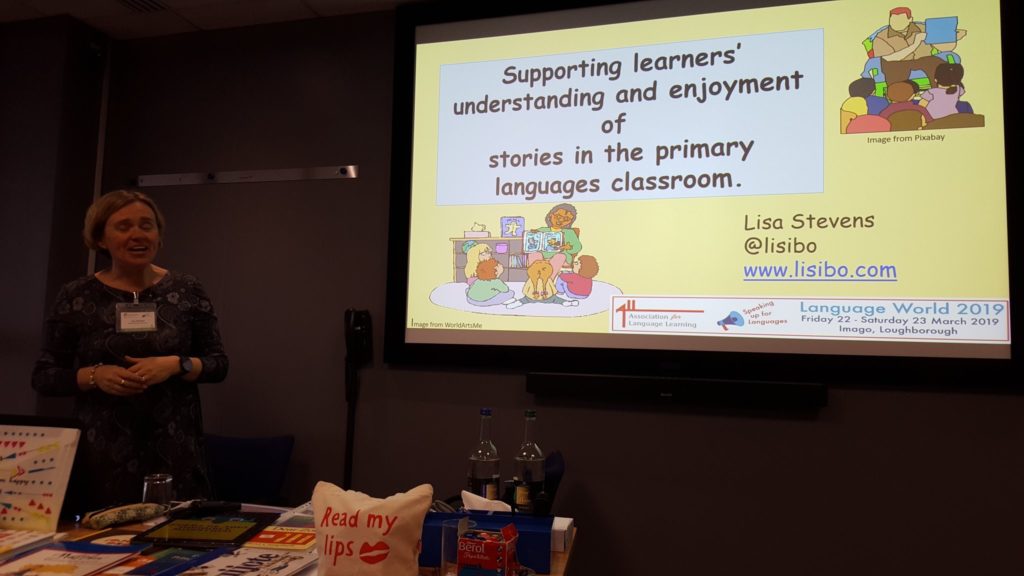
Thanks for the photo Nathalie!

It seems a long time since Language World 2019 (it is three weeks I guess) so I apologise for the delay in uploading my presentation here; I’ve had a few website issues.

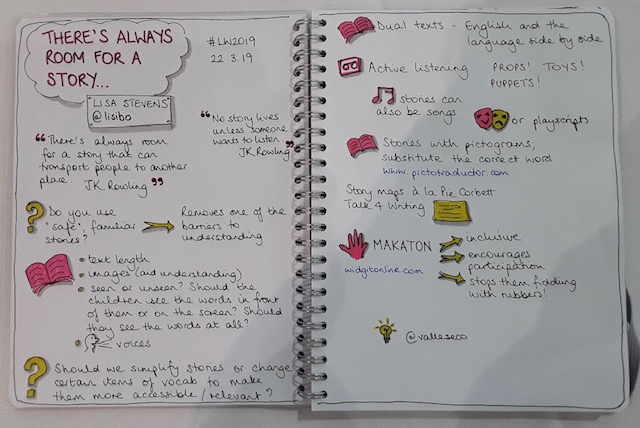
However, here it is, and below are some notes that you may find helpful in recalling what I said, or trying to decipher the slides! You’ll also find below Clare Seccombe’s lovely sketchnote of the session which summarises what I said as well!

Thanks Clare!

Links on Pinterest that accompany this presentation : https://www.pinterest.co.uk/lisibo/supporting-storytelling-lw2019/

La Belle au Bois Dormant resources from Bernadette Clinton

A post I wrote related to using Pictogramas – Leyendo con Pictogramas

Examples of stories and poems in pictograms – Coleccíon de Cuentos con Pictogramas and also Super colección de cuentos realizados con pictogramas Y ACTIVIDADES

Pictocuentos
Pictotraductor
Pictoaplicaciones
Unfortunately I haven’t managed to find an equivalent for French or German.
WidgetOnline is a subscription website that allows you to make visual stories similar to the Pictoaplicaciones suite but in English, or other languages with an add on pack.

I wanted to share more about using Makaton and to highlight that there are a number of free as well as reasonably priced resource packs that can be downloaded from Makaton.org
I got the materials to accompany my retelling of Dear Zoo/ Querido Zoo from there and then translated them/applied them to the Spanish story.
And there’s an article on Using Makaton in Storytelling that you might find interesting.

Ten in the Bed songs :
In Spanish – Diez en la cama
In French – Dix au lit
In German – Zehn im Bett
Download the Makaton signs here to accompany the story/song
And watch the story told in English and Makaton by Rob Delaney below:

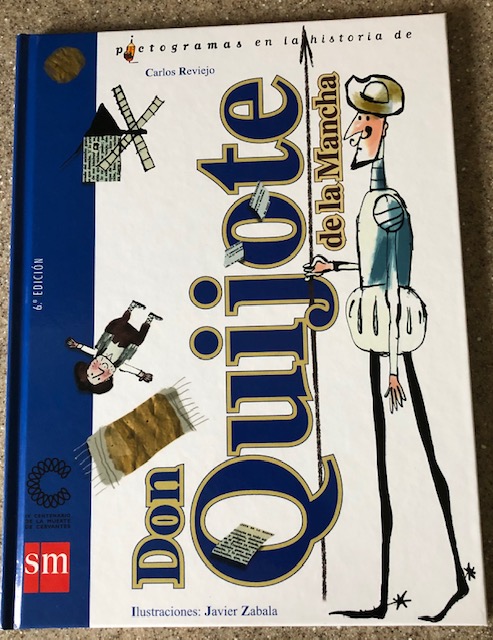
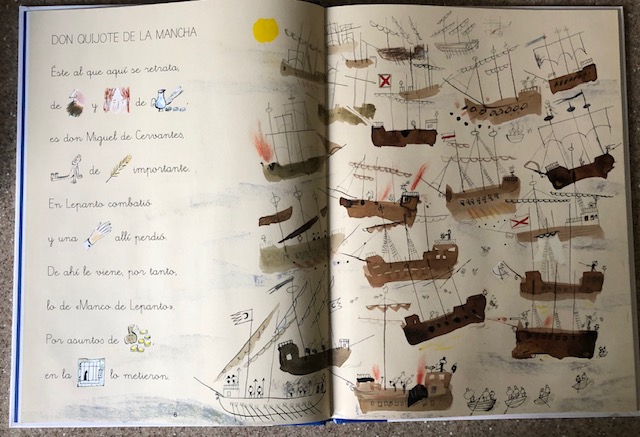
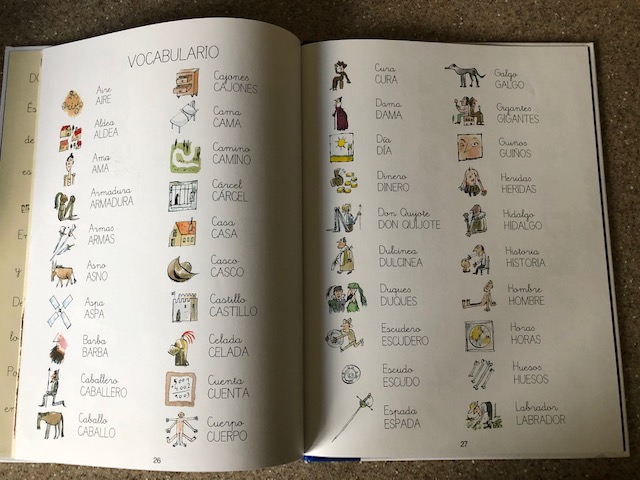
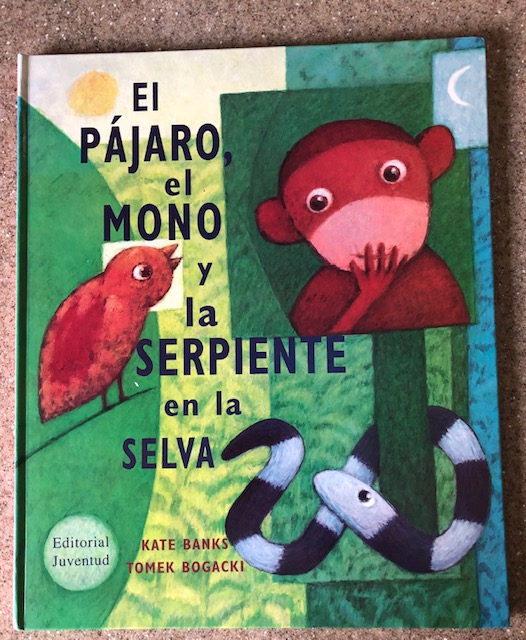
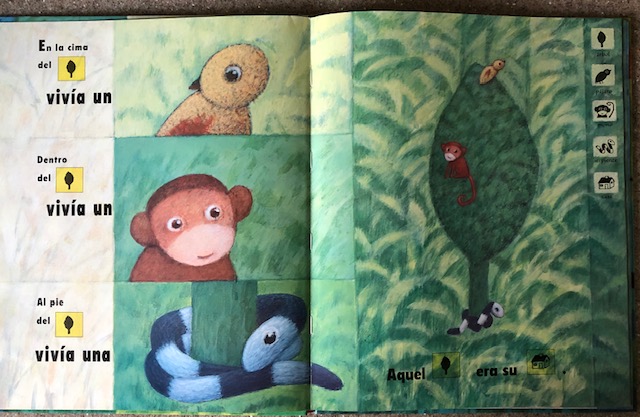
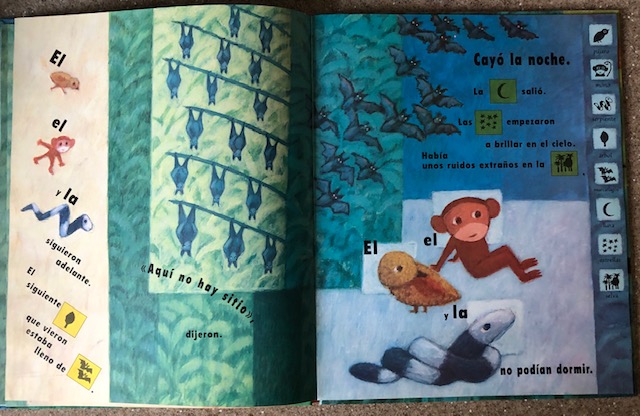
Finally, I had a pile of books to share but completely forgot with the pressure of time so here are screenshots from a couple. Firstly, Don Quijote de la Mancha which has the 2 USPs of being an authentic Spanish text, and also being written in Spanish ‘handwriting’, and El Pájaro, el Monoy la Serpiente en la Selva which is a charming story about living and working together.

If you have any comments or questions, please leave them below, or you can contact me via social media!

Sunny Bognor Regis!

I was happy to be asked to present at the annual University of Chichester MFL Conference last week, and as I noted in a previous post, thoroughly enjoyed the positive and inspiring sessions I attended.

I delivered two sessions. You can access the resources and ideas from the session entitled Using Technology for collaboration in a previous post  Sadly, TodaysMeet no longer exists but otherwise the ideas, recommendations and apps are the same!

The second session was entitled Tell me a story! and concerned the use of stories and books in the languages classroom.

The presentation is below to view. You’ll also find the links to some helpful posts and bookmarks below. I hope those that attended found the session helpful. Please feel free to leave a comment on the post if you have questions or comments!

Mi Madrid (including newly published videos of the songs!)

Link to resources for El artista que pintó un caballo azul as a text to discuss diversity.
The book I mentioned that was recommended and demonstrated by Nathalie Paris at Language World was called Poux by  Stephanie Blake – check out the sketchnote of her session here, and follow her book blog and podcast here for more great book ideas!

Storybird wiki   Watch this space for what happens to this when Wikispaces shuts later this year!

My Storybirds

ALL Literature Wiki

Pinterest links to research on Storytelling and stories in language learning

Pinterest board of online stories

Blogposts on books on ¡Vámonos!lots of posts!

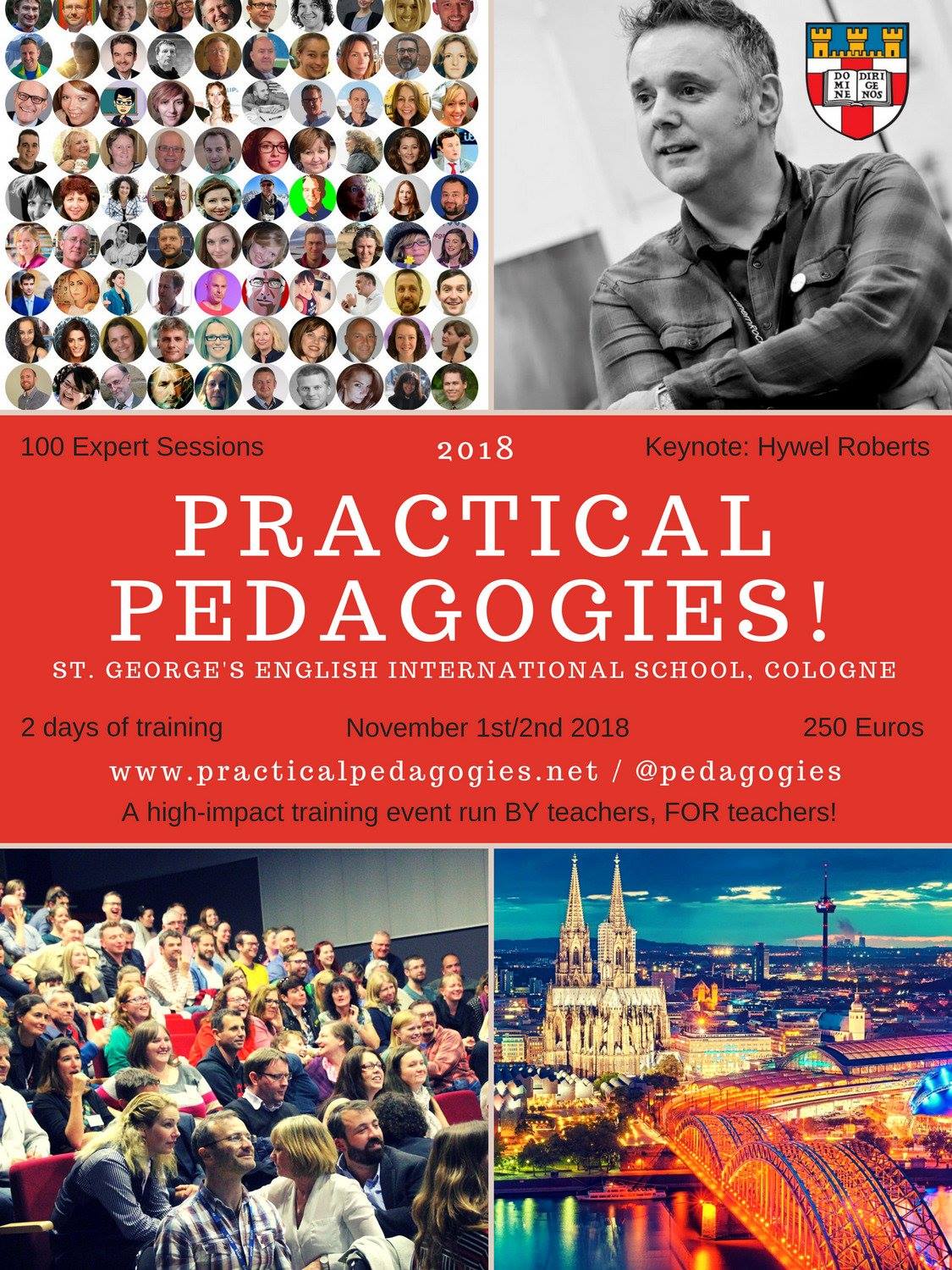
After two successful years at the International School of Toulouse in 2015 and 2016,  Practical Pedagogies is returning in 2018. This time it’s moved to Cologne and St Goerge’s English International School. Here’s what Russel Tarr, the conference organiser says:

Educational conferences can be prohibitively expensive for ordinary teachers, and often focus on abstract theory delivered by academics with little hands-on classroom experience. In contrast, “Practical Pedagogies” believes the best training conferences are delivered by practising teachers, for the benefit of each other and their students, at an affordable price.

Practical Pedagogies 2015 and 2016 took place at the International School of Toulouse, France. Teachers from all over the world delivered upwards of 100 sessions in a vibrant, friendly and enriching event lasting two days. Hot lunches, refreshments, an evening restaurant meal after day 1, and a bar tour after day 2 provided social opportunities for carrying on the conversations with old friends and new acquaintances.

The feedback was so enthusiastic that it’s been decided to take the show on the road, with St. George’s International School Cologne scheduled to host the next conference in November 2018. Session proposals will be invited as from January, a programme will be drawn up in February, and delegates will be encouraged to book their places from March onwards.

Russel Tarr, conference organiser (@russeltarr)

100 workshops have been confirmed, led by educators from all over the world – including me! – and delegates can pick 8 to attend over the two days.  And the good news is, you’ve got two more days to get the Early Bird discount.

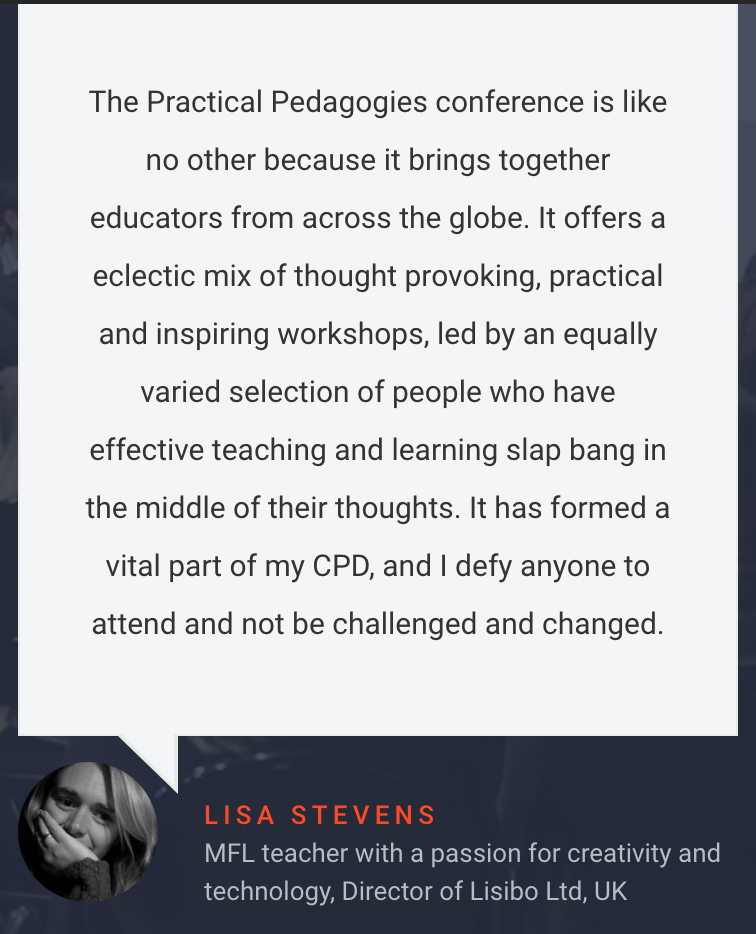
Still need convincing? Here’s what I think!  

Would be great to see you there. Lisa x


This year at Language World I was invited to present some ideas for using technology for collaboration in language learning. I teach primary so the focus was on that age group but there are many ideas and tools that are equally applicable for young and old! In spite of some technical hitches and running out of time as there was so much to share, the ideas were well received and I hope that this will serve as a reminder/update for those who attended, and a snapshot for those who didn’t.

Below is my presentation. Whilst all the links work, the videos don’t I’m afraid but you’ll find some below to give you a taster.

Link to BetsyBelle’s webinar Out of this World on using apps in the Primary Language Classroom. Highly recommended viewing especially if you’re interested in the how as much as the why.

A little later than planned, and with huge apologies, here are my presentations from the East Midlands Primary Languages Conference held on Nottingham on 5th December!
Más vale tarde que nunca.  Mieux vaut tard que jamais! Besser spät als gar nicht.

Firstly, my presentation on Crosscurricular links:

And here’s the presentation on Technology for collaboration:

It was a pleasure to speak, and I was also able to attend a few other sessions which are sketchnoted below.

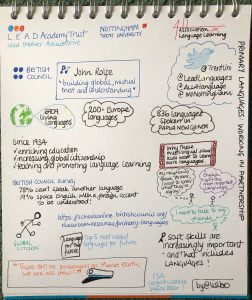
A marvellous keynote by the ever effervescent John Rolfe.
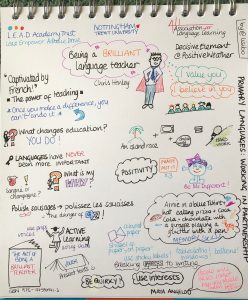
An inspiring session by Chris Henley about being BRILLIANT – finding my WHY? and being Ms Different.
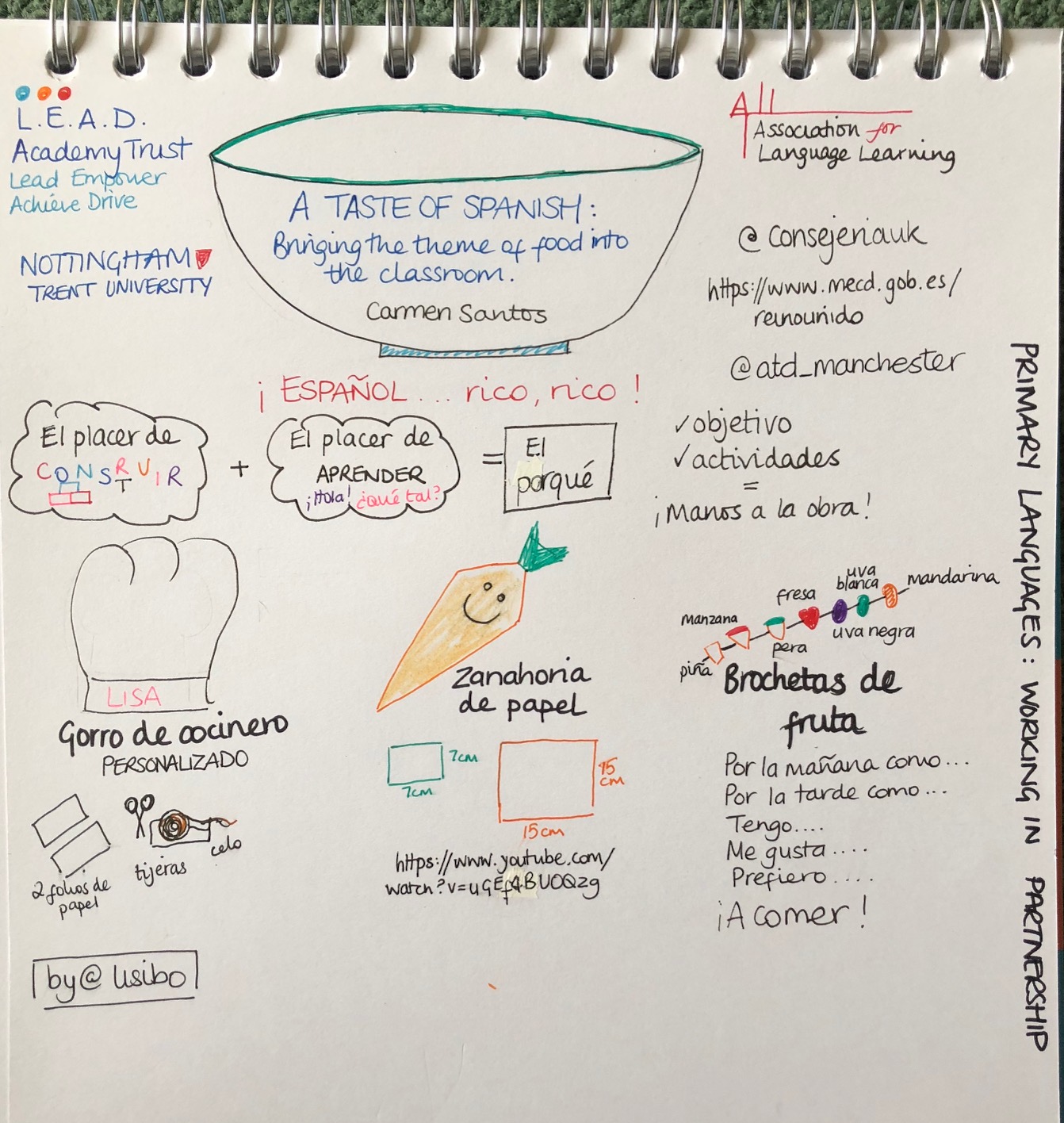
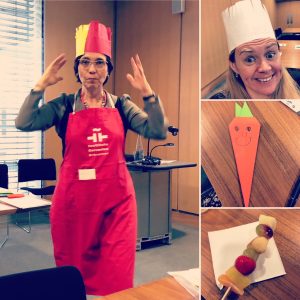
A Taste of Spain delivered by Carmen Santos from the Consejería de Educación in Manchester – loved making – and eating – my brocheta de fruta!

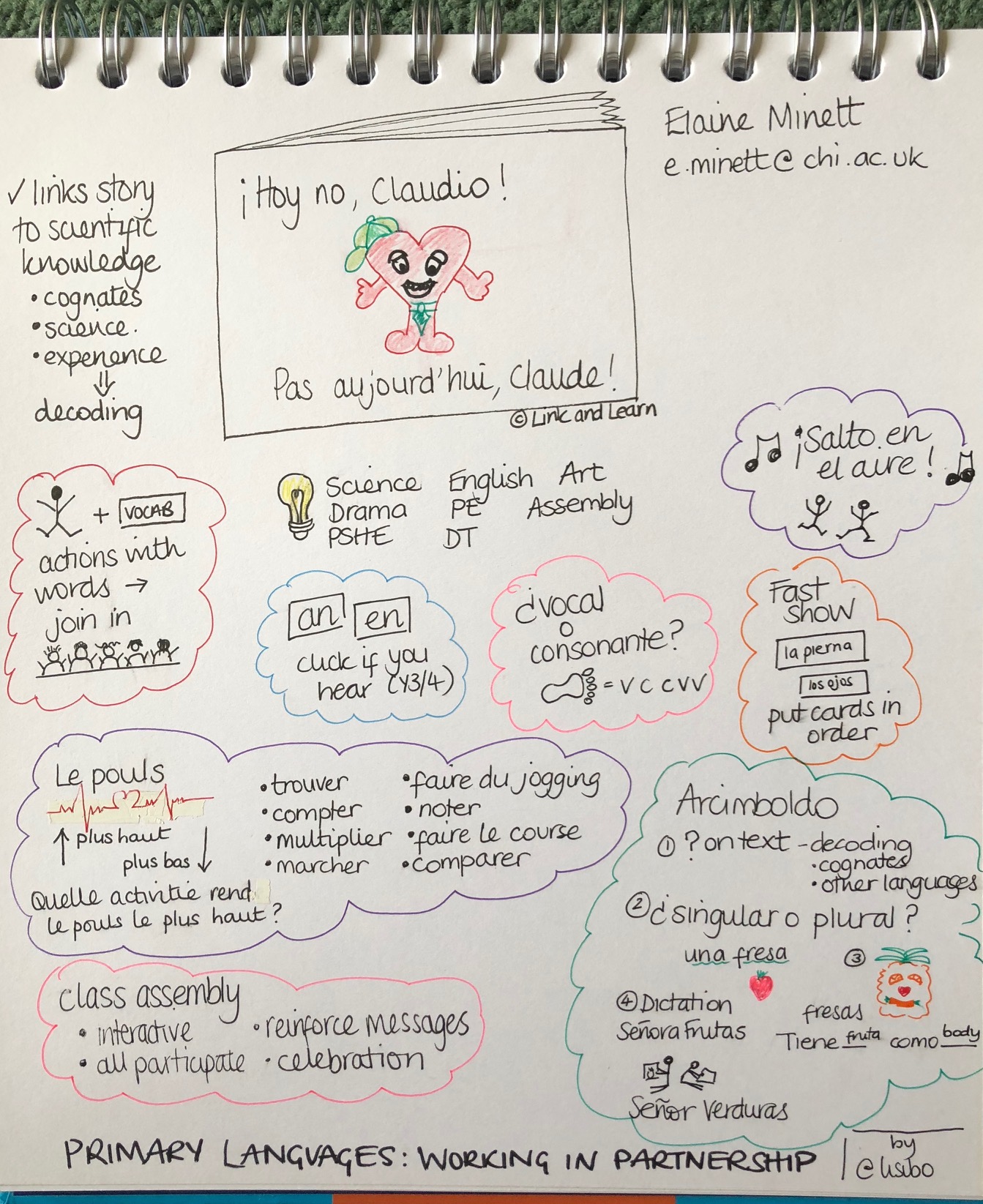
And Elaine Minett charing her Healthy Eating resources based around the story ¡Hoy no, Claudio!

ALL on Youtube

| Leave a comment

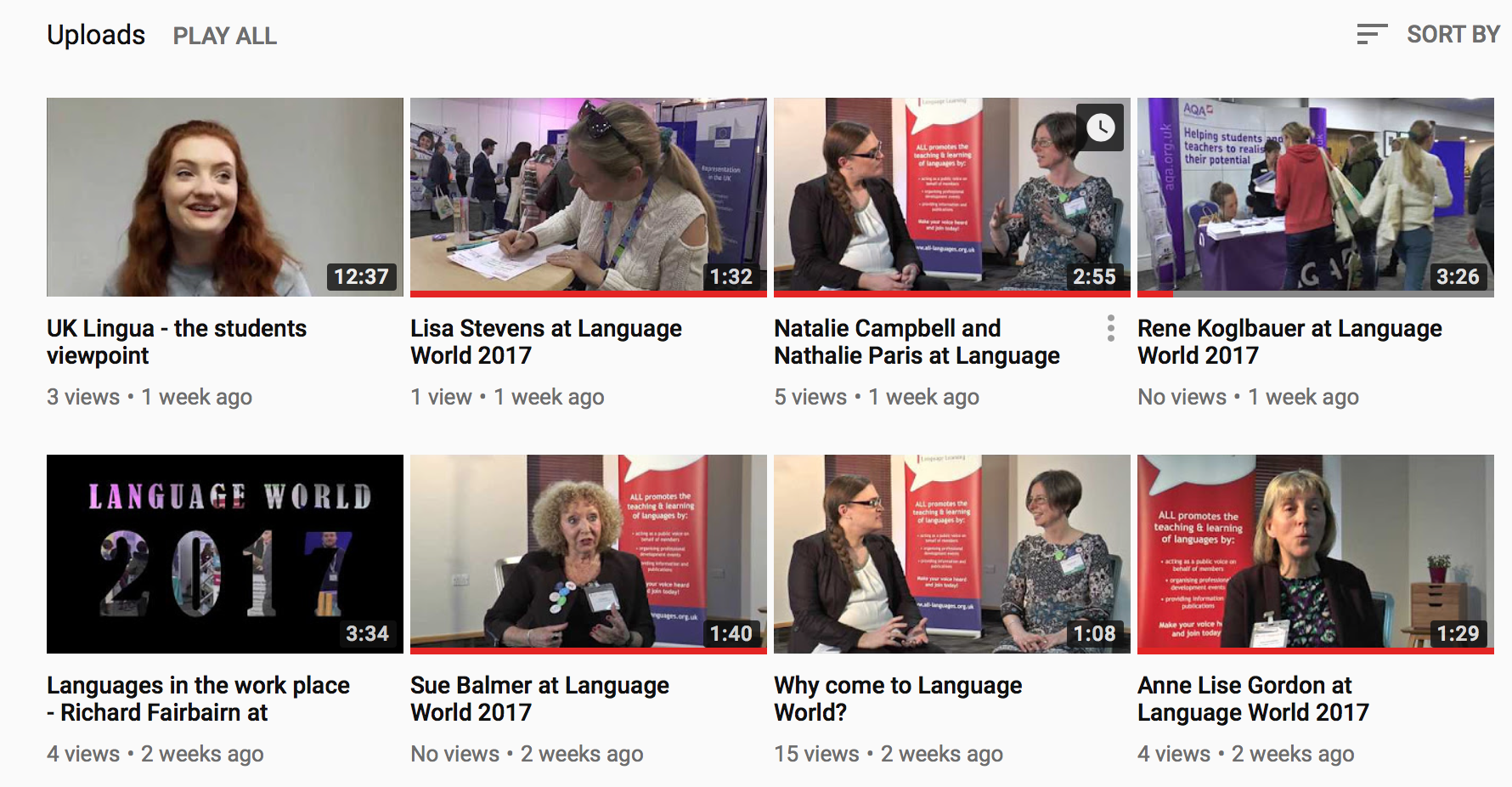
Did you know that the Association for Language Learning (ALL) has a Youtube channel? I didn’t until today when I attended the ALL Council meeting and discovered that not only did an ALL channel exist but that one of the first videos on it features me talking about sketchnoting!

There are currently a number of playlists and numerous really interesting videos. Most of them are really short, getting the message cross succinctly which is always a bonus. One of the playlists is full of videos recorded at Language World 2017 that cover things like what ALL does, how it supports language teachers and learners through networking and CPD, why you’d want to attend Language World and why languages are beneficial in the workplace.

One video I found particularly interesting – as a teacher and also as the parent of a child who’s just started studying German at university  – is entitled UK LINGUA – the students viewpoint in students discuss the transition from learning languages at school to learning languages at university. I’ve embedded it below.

I’d really encourage you to take a look at the channel, particularly if you’re not sure about what ALL does! You can find the channel here .

SaveSave

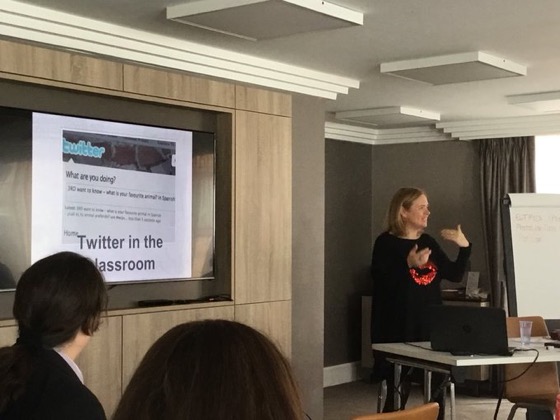
I am very pleased to have been asked to speak at the North West Primary Languages Conference in Warrington in June. This is the annual conference run by Janet Lloyd’s Primary Languages Network and this year the theme is Progress with Primary Languages.

The keynotes will focus on the identifying progress, phonics, using technology and the wonders of primary language learning, and there will also be sessions on singing and dancing, speaking and listening and reading and writing as well as an exhibition.

I’m excited to be sharing ‘keynote’ duties with Sue Cave, Daniel Alliot and Therese Comfort, and I’m looking forward to the ‘Spotlight’ sessions too which I believe will share some of excellent practice from the PLN teachers.

You can find out more and register for the event on the Primary Languages Network site  and there’s an online Flyer too. See you there!


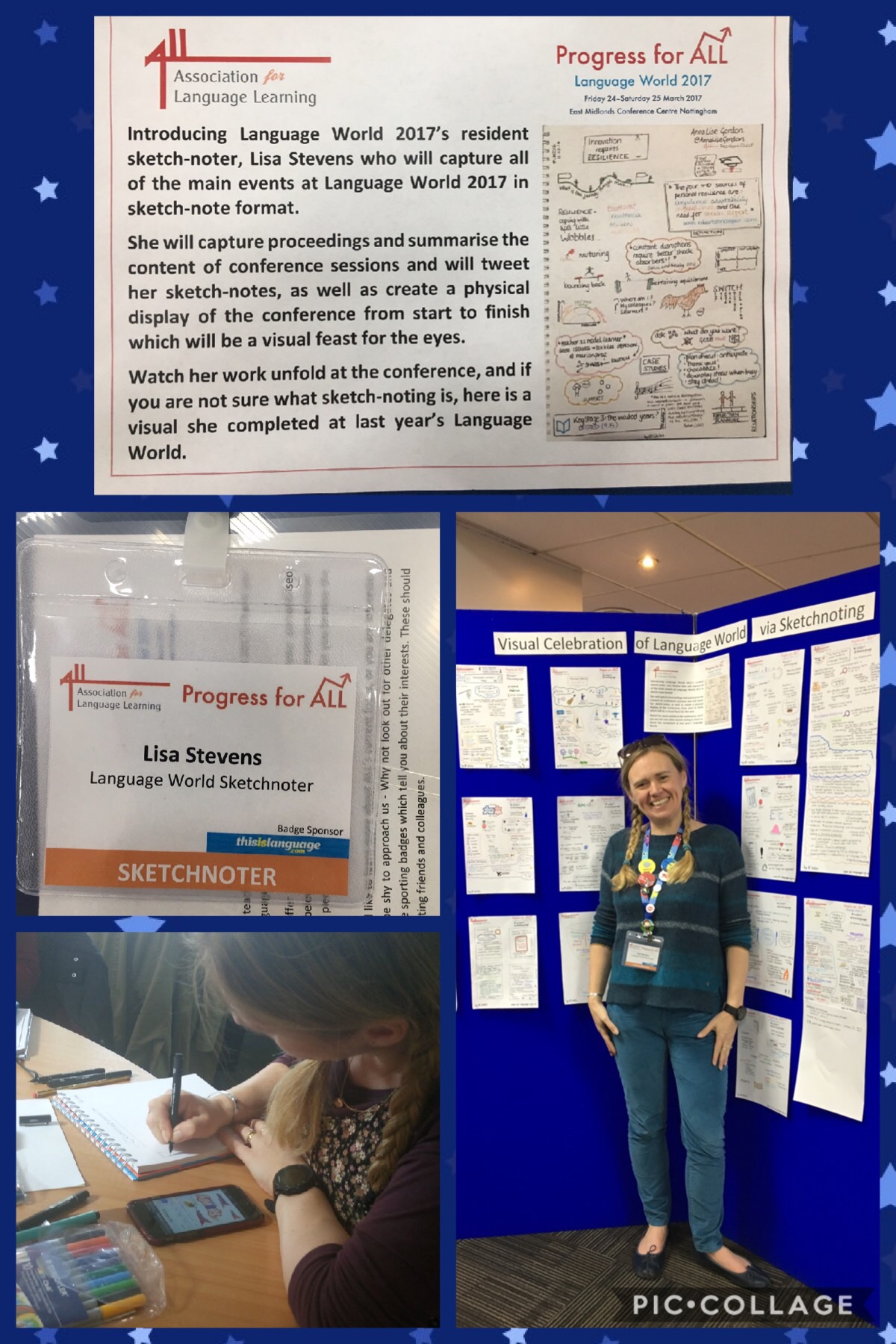
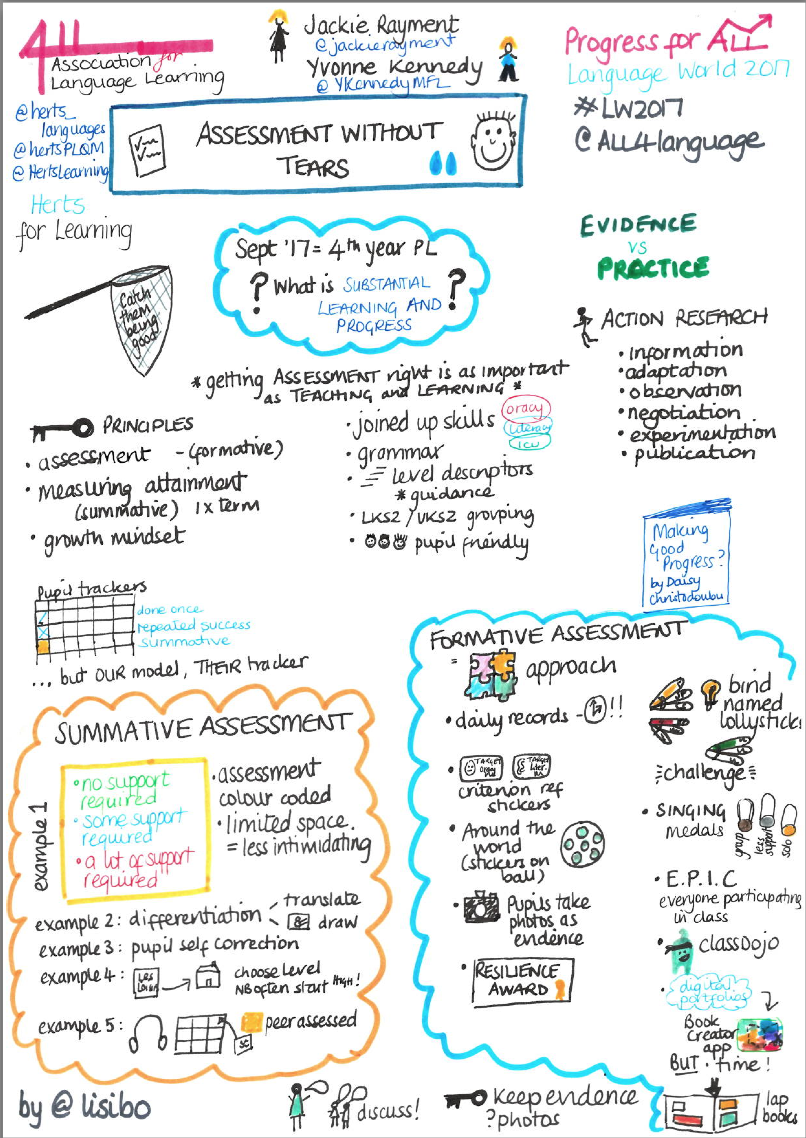
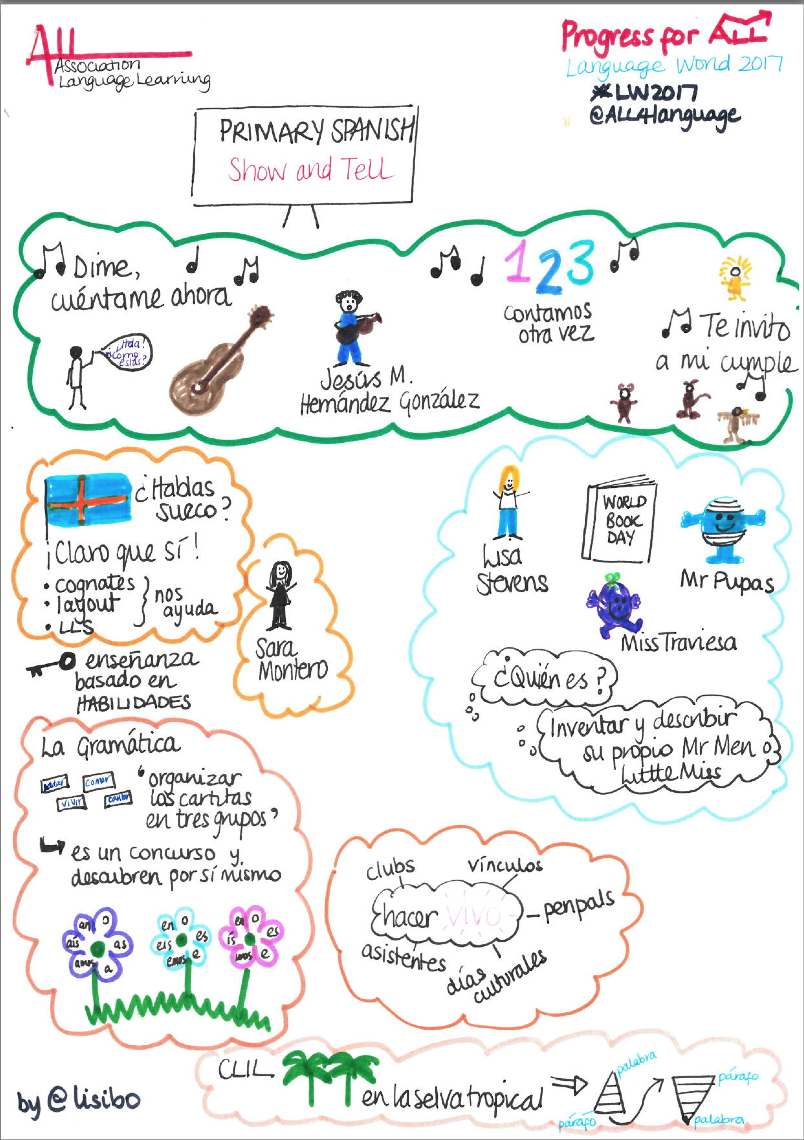
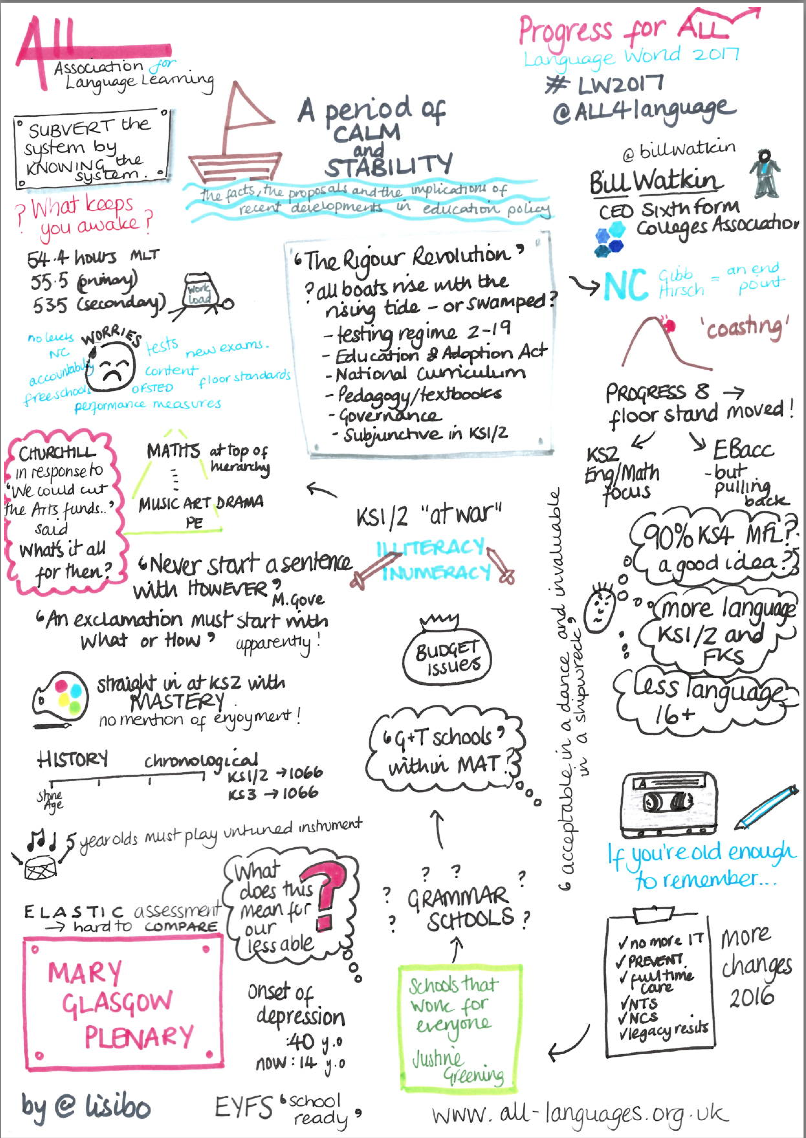
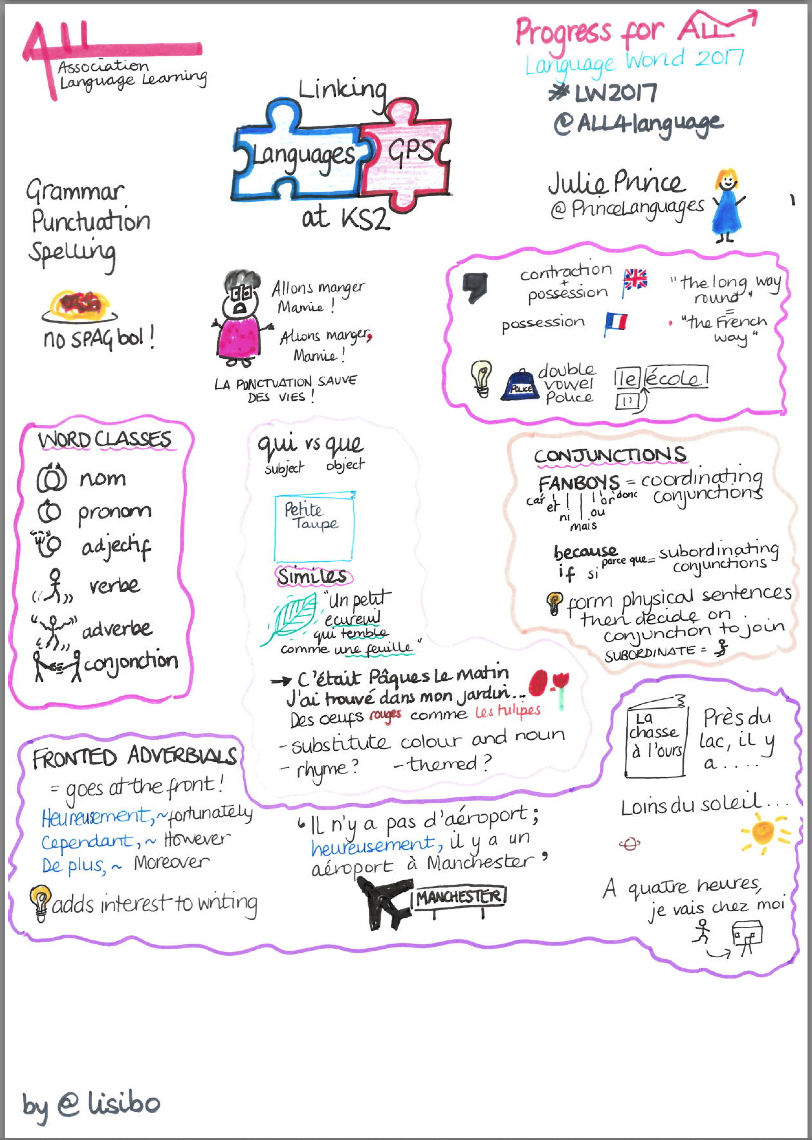
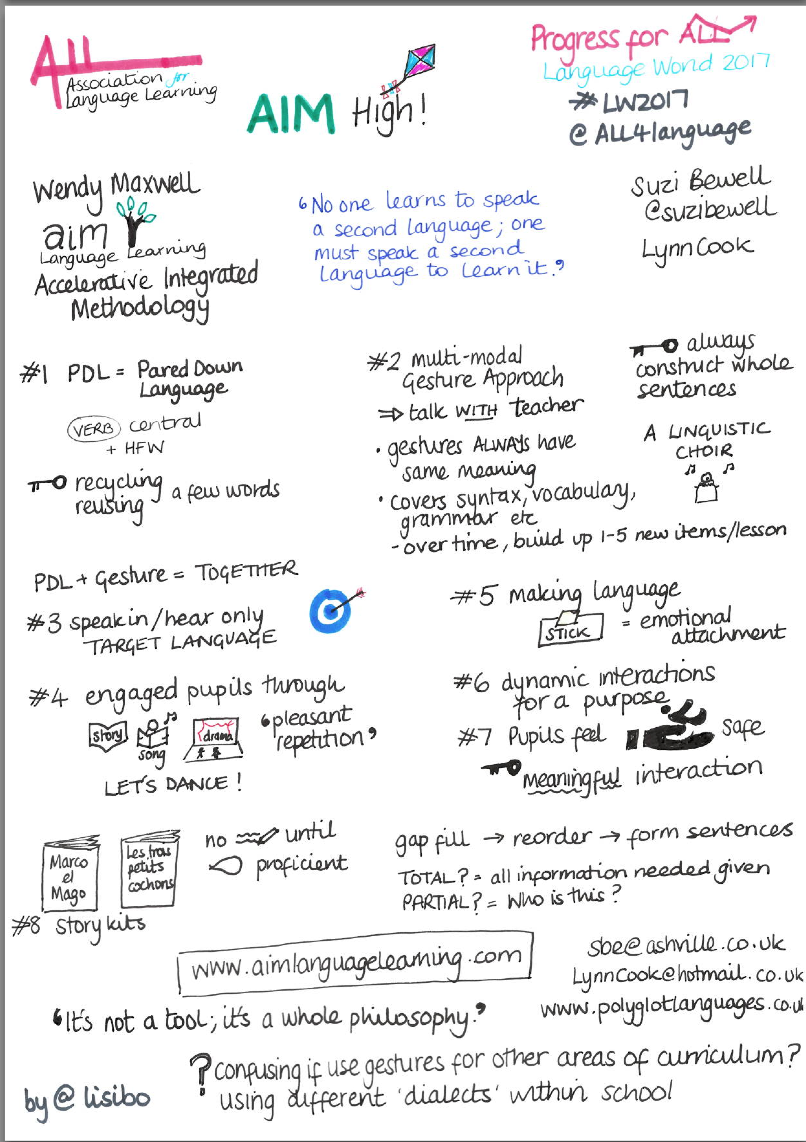
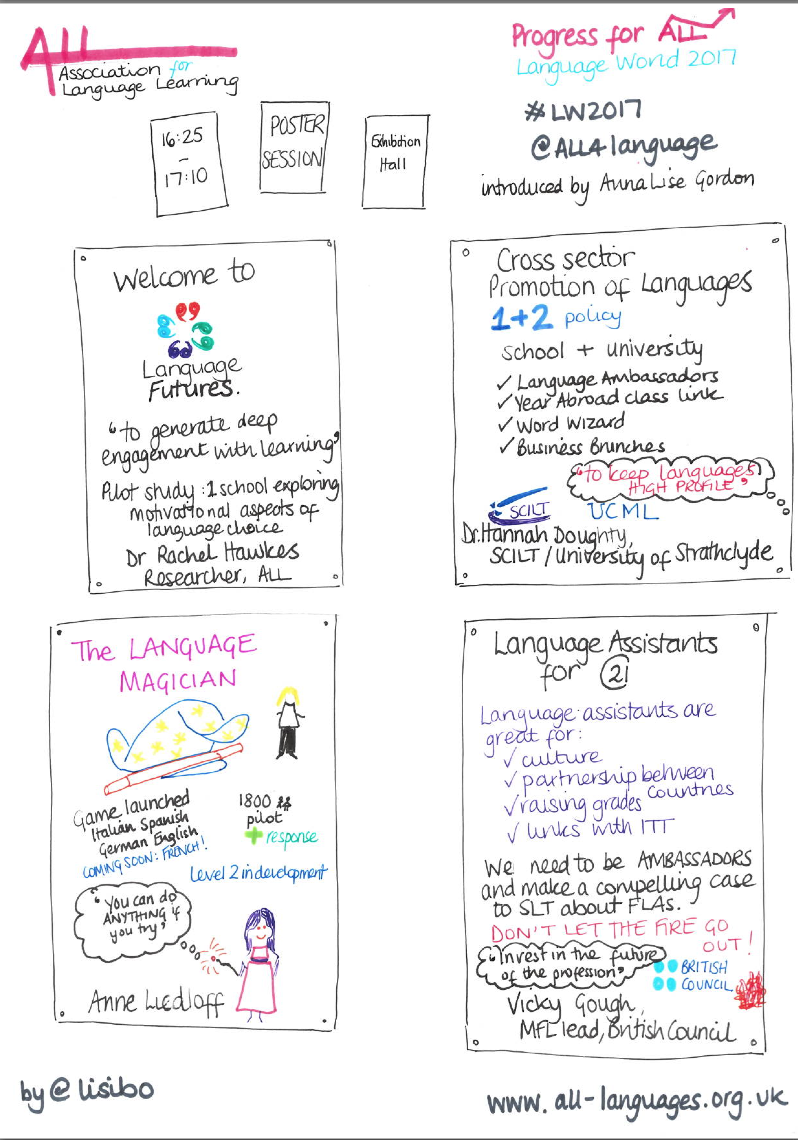
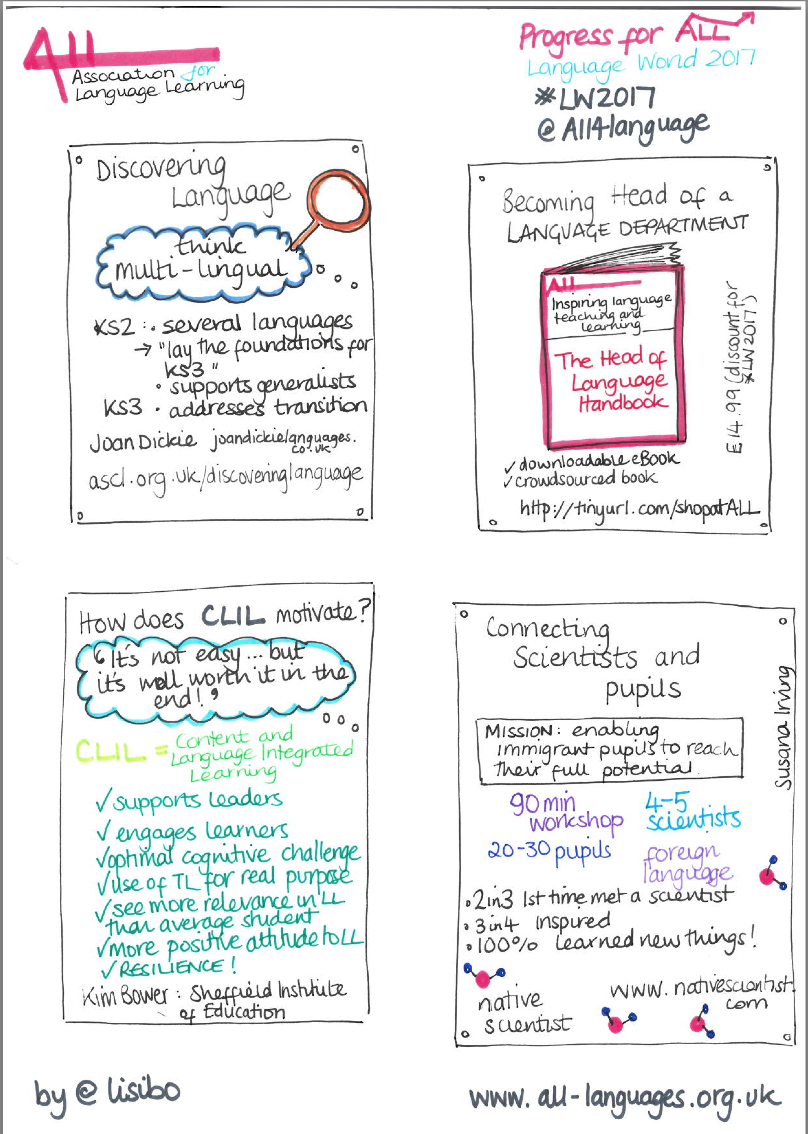
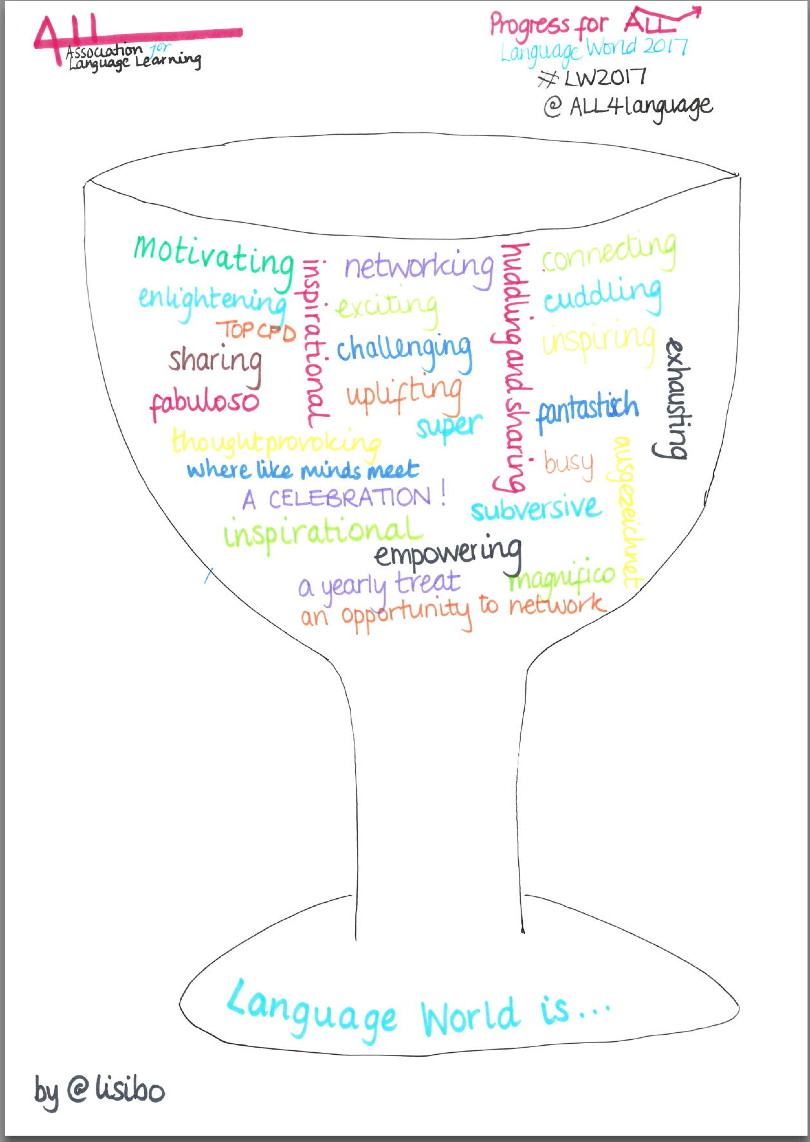
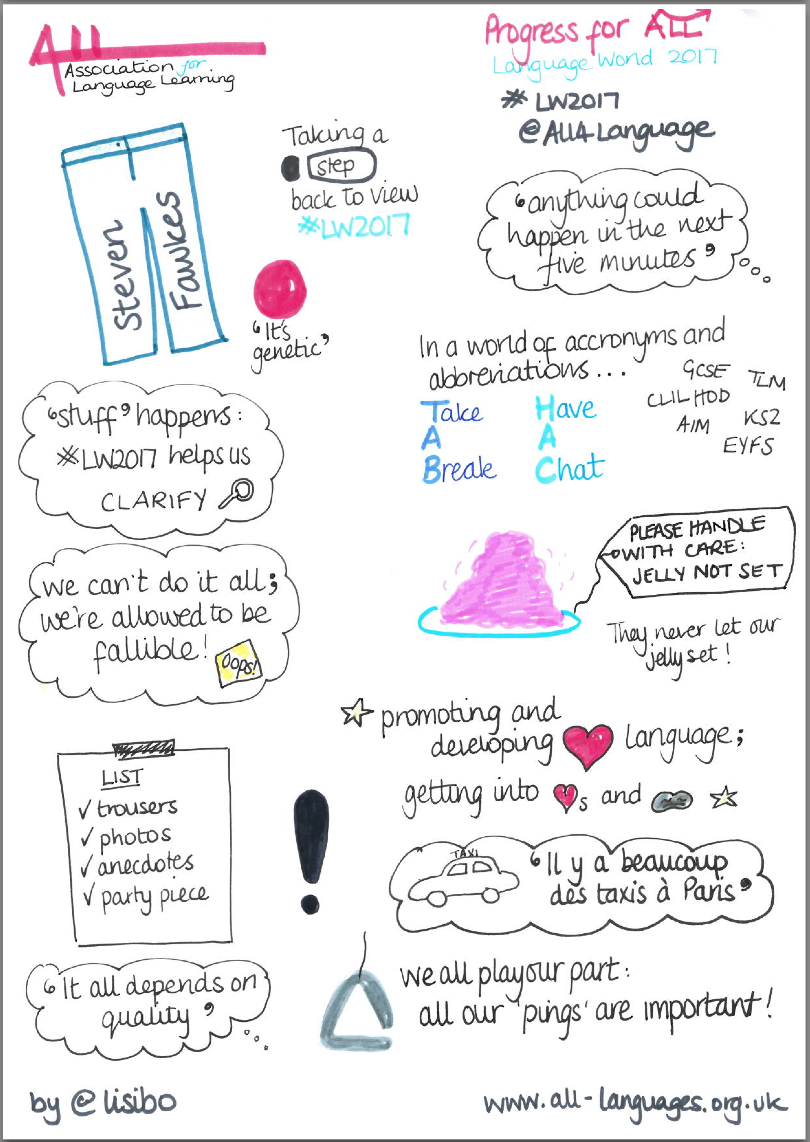
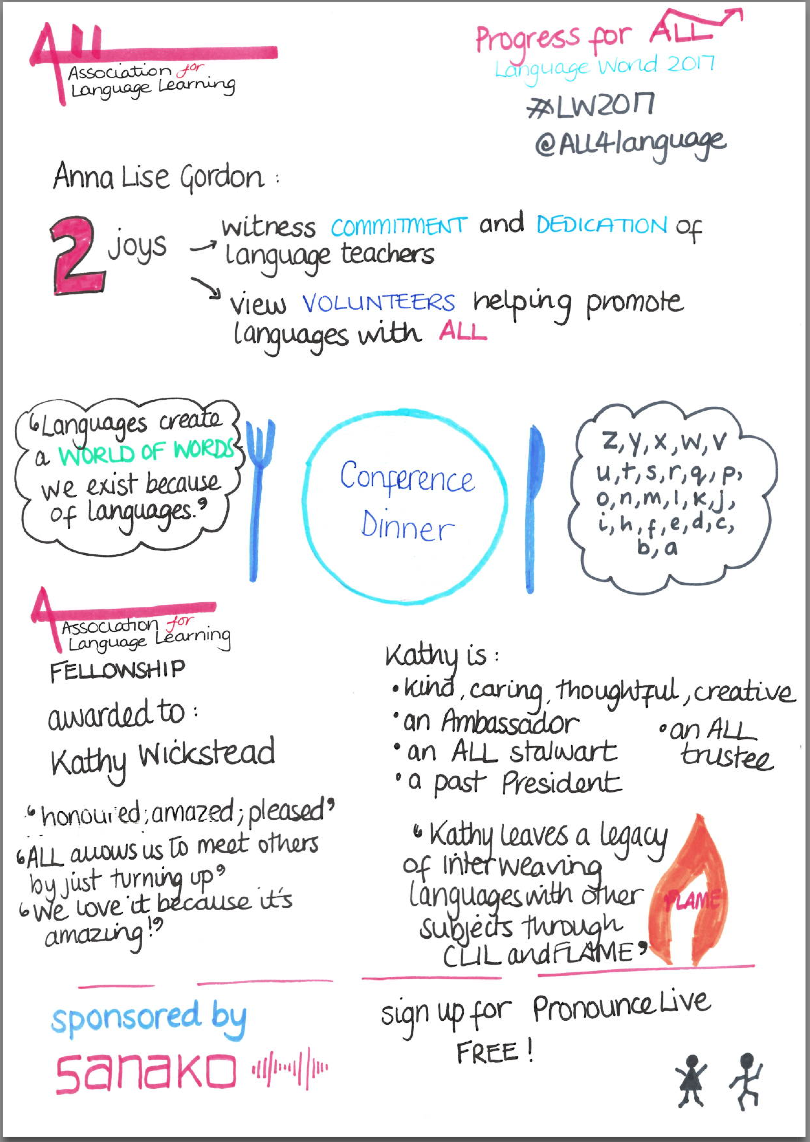
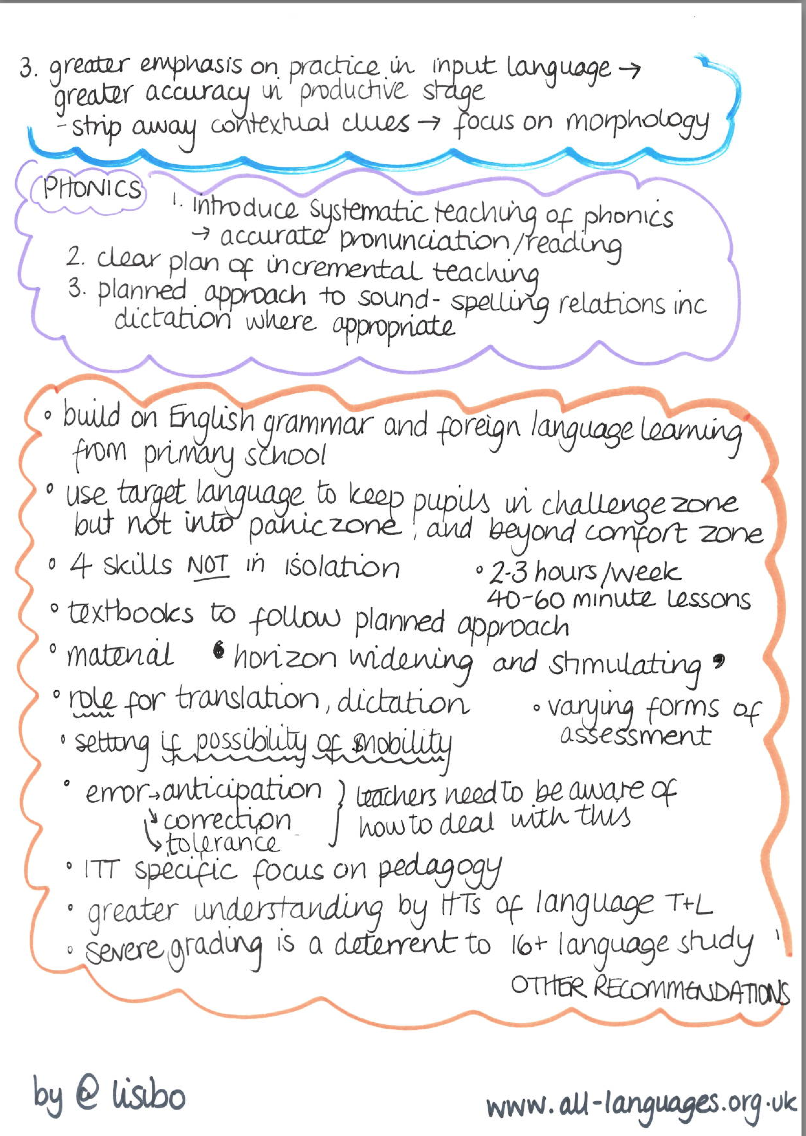
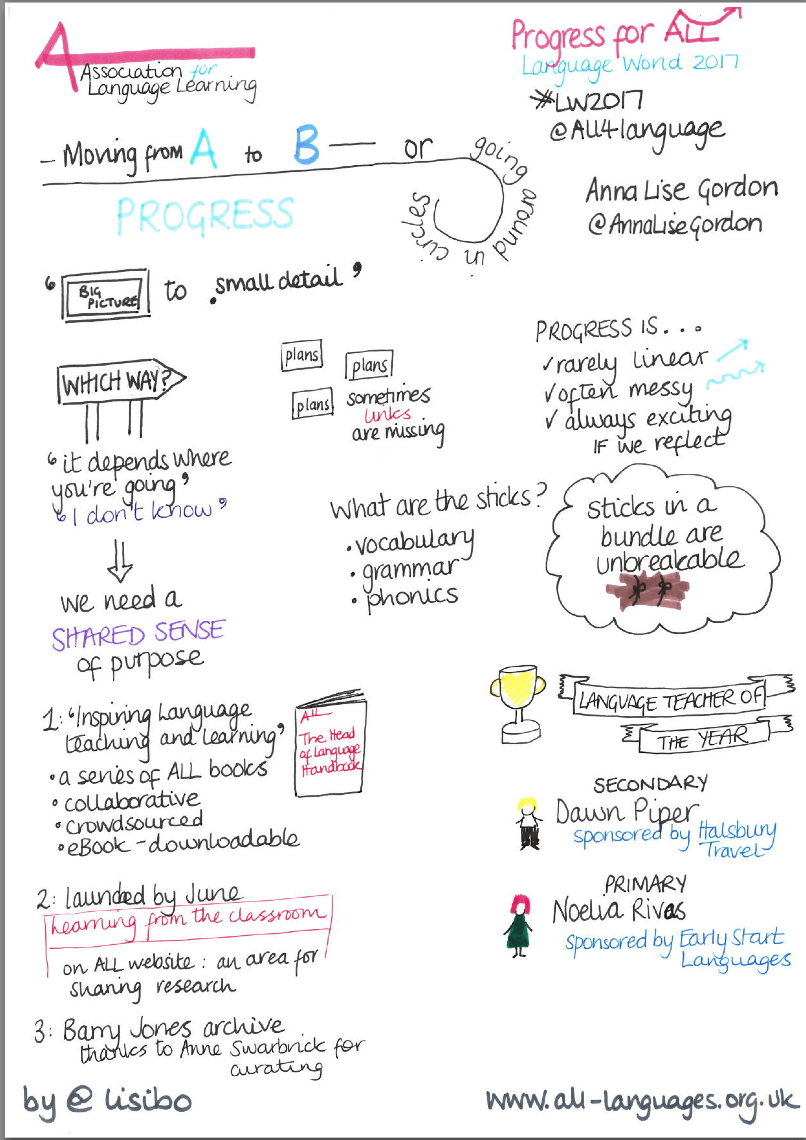
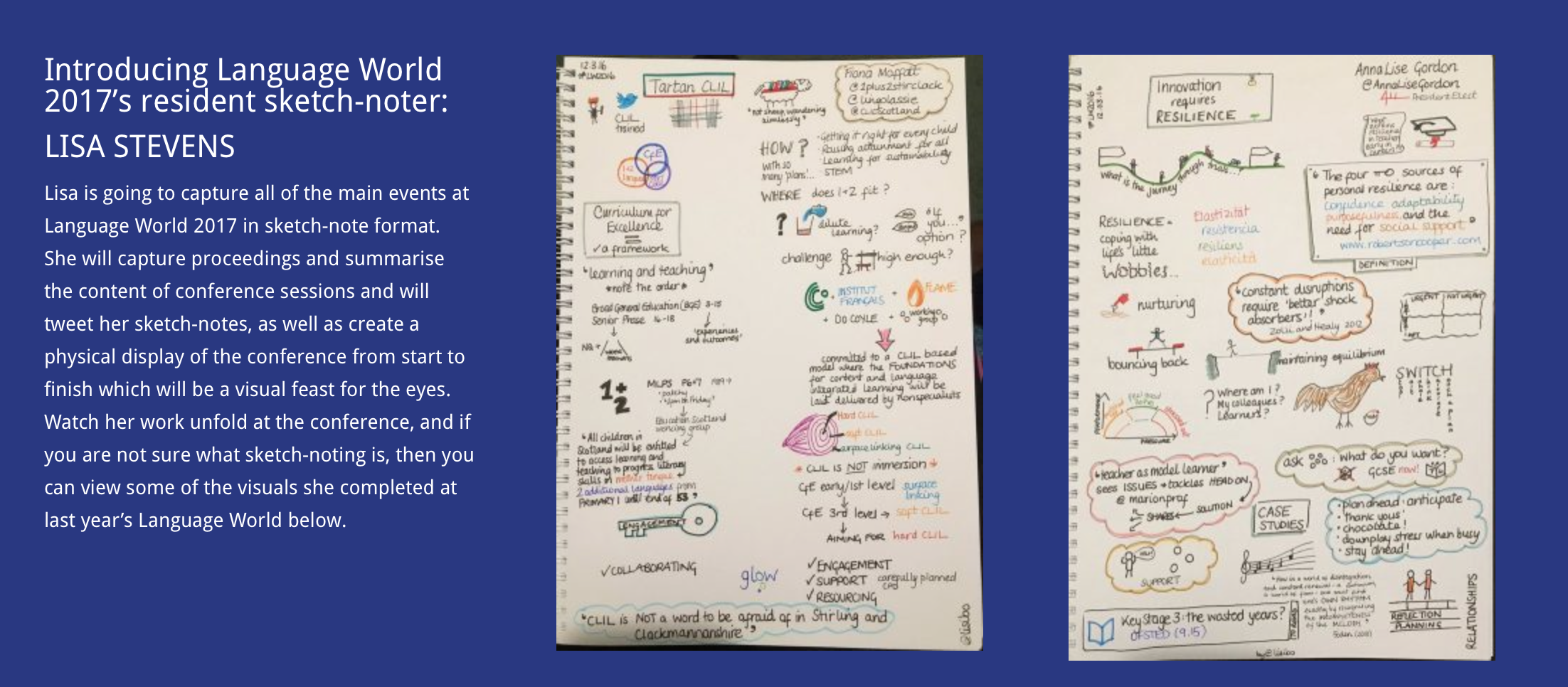
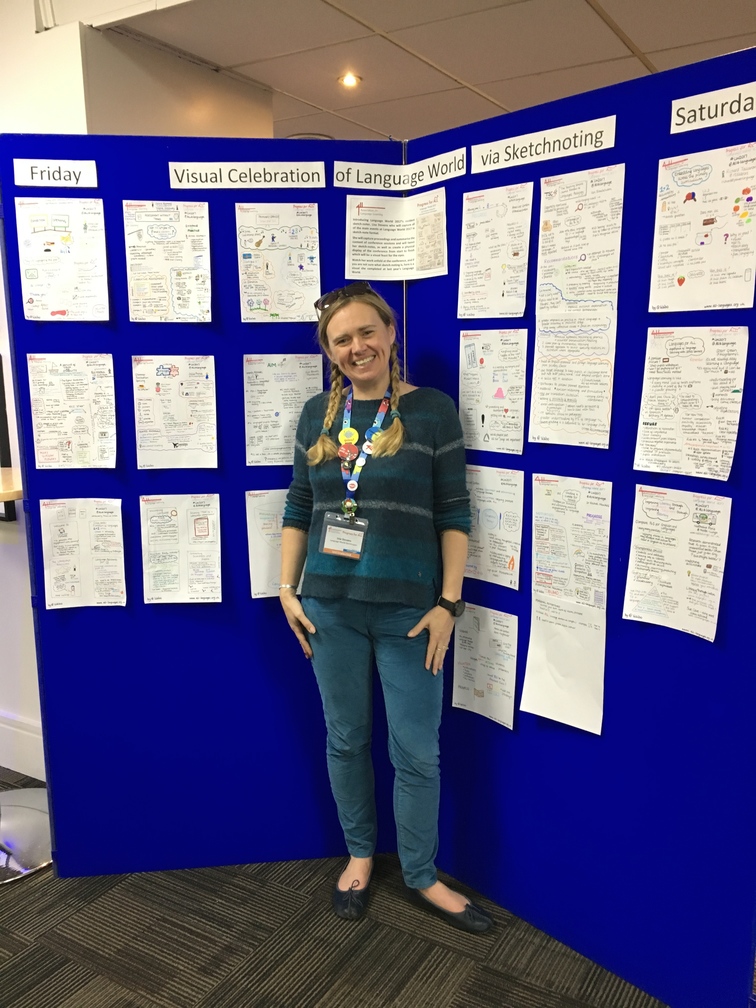
As I reported in February, at this year’s Language World conference in March I was asked to be Resident Sketchnoter and record all the fun and excitement as well as as many sessions as I could possibly attend. It was a challenge as I normally go back to my sketch notes later to ‘pretty them up’  but in this case the sketch was immediately posted on the display board so I had to just go for it! I was really pleased that people took time to look at the display and there was a buzz of discussion and excitement as people paused to discuss what they’d seen. My hand was really struggling by the end of Saturday but it was all worth it!

I’ve deliberately delayed posting them until ALL had done so (although they were all tweeted as I finished them!) and today I received notification that they are now uploaded and ready to view! And they’ve kindly made them into a PDF!

So, here’s the PDF of them all: http://www.all-languages.org.uk/wp-content/uploads/2017/05/Lisa-Stevens-LW-2017-Sketchnotes.pdf (too big to upload here!)

And here they are individually with comments and links to the presentations where available!

DAY 1

Tried to capture a few of the exhibitors before the conference started in the top section then AnnaLise’s opening words in the bottom section.


Assessment without tears – Jackie Rayment and Yvonne Kennedy


Now here was a challenge – sketch noting and presenting simultaneously! Also presenting with me, Jesús Hernández from the Consejería de Educación and Sara Montero, Primary Language Teacher of the Year 2016      Presentation


Mary Glasgow Plenary A period of calm and stability – Bill Watkin    Presentation


Julie Prince talking about primary language learning supporting Grammar Punctuation and Spelling (not navigation as the title might suggest!)   Presentation


Suzi and Lynn presented AIM methodology to us in this session.   presentation


The poster sessions – lots of exciting projects were highlighted here – I suggest you check out the ALL site to find out more! (scroll down to Poster sessions then click on the + for the abstracts)


How do you sketch note a wine reception? Thanks to Vicky Cooke for my inspiration, and to all my vox pops!


The national treasure that is Steven Fawkes had us all crying with laughter at his witty speech including references to jelly, taxis, triangles, and of course, his trousers!


The Conference Dinner – scribbled on a napkin then ‘done in neat’ later 😉

DAY 2

A summary of The Teaching Schools Council Review of Languages Pedagogy, delivered by Ian Bauckham. Very interesting! (Not often I have to use another sheet, and as you can see, a little hard to represent very visually!   Presentation


ALL President AnnaLise Gordon was up again to talk about Progress and present the awards for Language teacher of the Year.


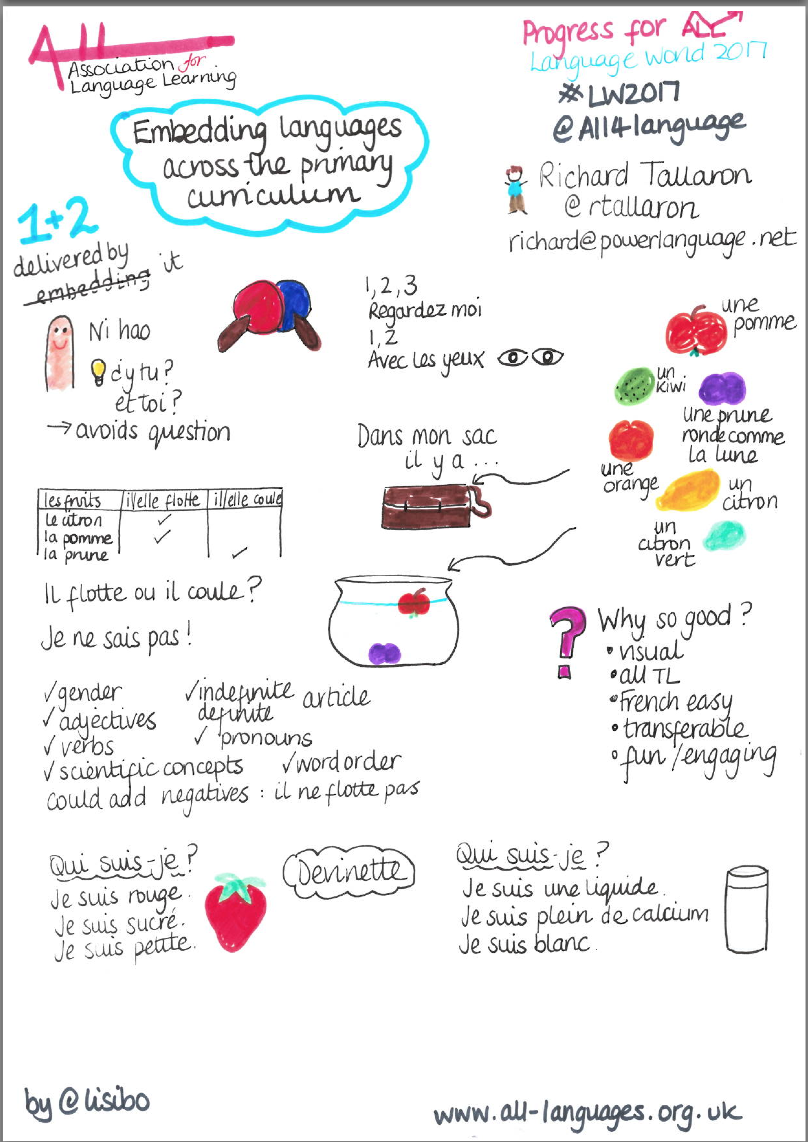
The super fantastique Richard Talleron went fruity in his session on embedding languages across the curriculum.  Presentation


Starr Green spoke about Languages for ALL and gave advice on teaching languages to pupils with SEND   Presentation


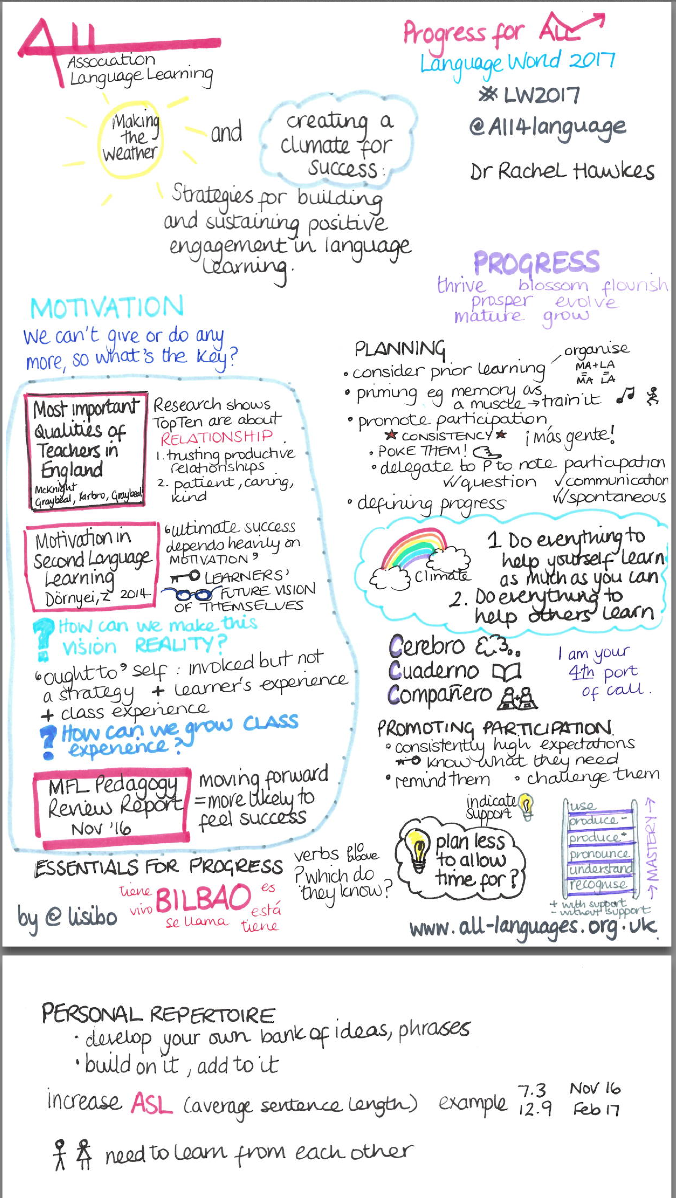
The always inspiring and incredibly clever Dr Rachel Hawkes helpfully talked about creating a positive learning environment, pointing out that sometimes staff can not give or do any more than they already are so something else has to change!    presentation


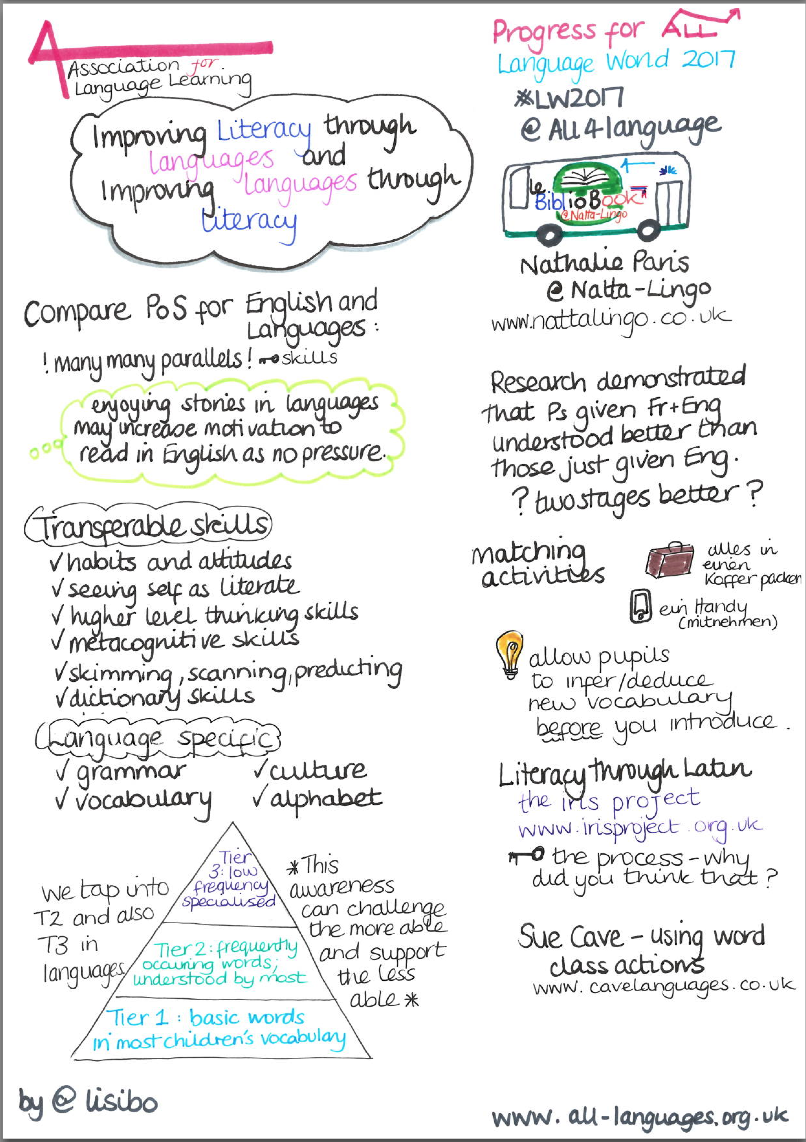
Lovely Nathalie Paris aka Nattalingo shared some ideas and research on the important two way relationship between literacy and languages.  Presentation

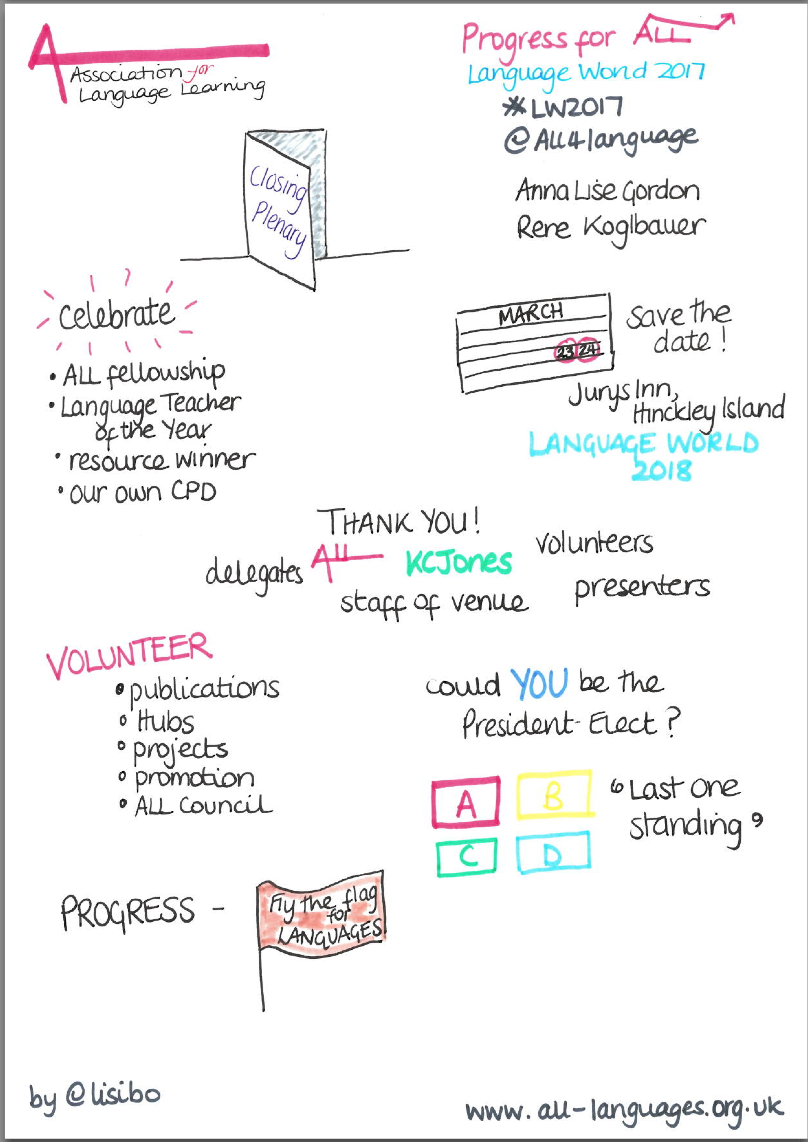
And finally it was time for thanks yous, AnnaLise’s quiz (foiled on the last question!) and the revelation of the date and venue for next year – March 23rd and 24th at Jury’s Inn Hinckley Island near Leicester. presentation

If you want to access any of the other sessions at the conference, many of the presentations have been uploaded to the ALL site Friday and Saturday, and you can read more about it here (also more sketch notes) and here. If you were there and have any reflections, please leave a comment and I can update the post!

And here’s a summary of the tweets!


It’s one month to go until the annual Association for Language Learning conference, Language World. Have you signed up yet?

This year the theme is Progress for All (like the clever logo!) As the ALL website says:

Progression in the teaching and learning of languages is a priority for all teachers and ALL as a professional association as we respond to significant curriculum changes and developments at all levels. Progress for ALL is a deliberately broad title, as we aim to serve the needs of all conference delegates. For example, we are including sessions on promoting progress in all aspects of pupils’ learning of languages, ensuring progression in curriculum planning, sustaining progress in curriculum leadership and celebrating progress in building a culture of language learning in a school.

During the two days there will be a mixture of plenary sessions, major talks and workshops with something for everyone from primary to higher education, and this year there is a slot for poster presentations which looks really interesting too.

This year the conference takes place in Nottingham at the East Midlands Conference Centre which is very convenient for me living in the Midlands and once more in the ‘middle’ of the country.

There’s a special ‘call out’ to primary colleagues issued on the ALL page with testimonials from a range of primary colleagues. Have a look at the flyer: 

I’m not speaking this year (apart from a contribution to the Primary Spanish Show and Tell) but I have a special (albeit rather daunting) role to fulfil:

I’m looking forward to attending sessions and trying to capture them ‘live’ ready to post to the timeline in the exhibition area; a shame I can only be in one place at a time though as there are several slots where I’d like to attend two or even three sessions at the same time.

If you’re interested in attending, the programme is below, and booking details can be found here.

Hopefully see you there?

¡Vámonos! ©2026. All Rights Reserved.
Powered by WordPress. Theme by Phoenix Web Solutions