primary languages – Page 30 – ¡Vámonos!
 

Category: primary languages

When considering Primary Language Learning (PLL), one of the thorniest issues seems to be the transition from KS2 to KS3 – how will it be managed? The KS2 Framework for MFL and the introduction of language learning for ALL pupils in KS2 by 2010 has massive implications for KS3. In the past, many children went into KS3 with little or no knowledge of languages – now pupils will arrive with, in some cases, more than four years of language study. Added to this, not all experiences will have been the same. Some pupils may arrive with four years of French, others with Spanish, still more with experience of two or more languages. How can it possibly work?

Comenius West Midlands today held a conference entitled ‘MFL – Planning for Transition’ to discuss just this issue.

Led by John Connor (Associate Consultant, MFL, Thurrock), and David Mee (former General Inspector, MFL, Wirral), the day began with an overview of the challenges and opportunities involved in transition before Carmel O’Hagan (CILT) offered some advice on welcoming pupils with diverse PLL backgrounds. The day then offered the opportunity to attend three workshops chosen from topics including

  • Investigating Languages-a skills based approach
  • Practical strategies to ease the challenge of transition
  • Asset languages
  • Welcoming children into the MFL classroom in their new school
  • Video conferencing to support transfer and progression
  • Language Bridge
  • Liaison –the issues and how to avoid (or cope!) with them
  • Using the ELP to support transition (delivered by me – see My Box of Goodies on the right for the notes!)

before Phase groups (one for Secondary and one for Primary) to discuss the issues of the day, concluding with a plenary to draw the two lists of issues together and culminating in a highly entertaining example of using song to engage in the Primary classroom.

Over the next few posts, I hope to share some of the things presented during the day and my repsonse to them.

I blogged last week about the ELL RSG meeting last Tuesday, and my contributions on the subject of parachute games and songs and rhymes that can be used for active learning. However, other people offered ideas too and I was reminded of one of them when I received an email via MFL resources Yahoo group.

One contributor was Sara Vallis from City Road School in Birmingham shared some ideas from a course she had attended in Besançon.
FlySwat and Lamb Darts – also known as Lamb Slam – where two people compete to be the first to swat or slam the appropriate item of vocabulary on the board. Perhaps not one for the IWB!
Chair OXO where you physically play Noughts and Crosses with vocabulary items to be named or questions to be answered on each chair before the square is ‘won’ and the team representative can occupy the chair. I liked this alternative to OXO on the board with pictures as I usually play it.
Hot/cold – Hide the teddy somewhere in the room whilst one person is outside, then the volunteer returns and has to find the teddy, guided by the rest of the class repeating a word or phrase loudly(for hot) or quietly(for cold) depending on how close the seeker is to finding the teddy. You could use any vocabulary or phrase; you could even use it to practise opposites with two words being used eg grande for hot and pequeño for cold.

Sara also suggested a song in French to practise body parts – as an alternative to Heads Shoulders Knees and Toes! Jean Petit qui danse is a sweet little song about a man who dances with various parts of his body. Sara used a downloadable track to show us how the song went, and yesterday I recieved an email in which MarieFrance Perkins mentioned the same song –

“When revising the body this is the song that I always with my students, they love it. I have now found it on Youtube. A good one to get out of breath and tire them out!!!”
Here’s the video –

I’ll blog about what Paul Nutt and Rona Heald said a little later!

Diez animales

| Leave a comment

Today, I had Year 2 for Spanish for the whole afternoon . I usually have them for between 45 and 60 minutes before swapping with the art teacher for Year 1. As Year 1 are doing a pottery module, I was asked if I would have Year 2 for a ‘double’ to give the littlies more time to get stuck into the clay (hopefully not literally!)

So we had the time to do all kinds of things! First of all we had a look at ¡Quiero mi plátano! (I want my banana) a Talking Big Book from Early Start and b small publishing. We read the story together with the pupils working out the meanings of words from the context and by looking for cognates. They even made the link between the colour ‘naranja‘ and the fruit ‘la naranja’. Once we had read the story, we had a go at some of the puzzles based on animals and fruit. The favourite was the ‘reveal’ game where a picture is hidden by seven numbered tiles and pupils have to choose a tile to uncover and then make a guess as to (in this case) the animal or fruit. This enabled the pupils to practice numbers as well as the new vocabulary, and was accessible to all as there were two options given for the answer thus allowing the less confident to make a 50/50 choice, whilst the more advanced guessed before the options were given.

We then went back to a favourite song we had learnt a couple of weeks ago – Diez animales en la pared. One afternoon I was inspired to rewrite Ten green bottles in Spanish as the class needed some number practice and bottles aren’t interesting – to 6 year old anyway ;-). Diez animales en la pared was the result. The original was created in five minutes (how long I had before the class arrived!) on the SMARTboard, but the beauty of that is that you can export the file as a Powerpoint and then use it on other IWBs (great as WCPS had Promethean!). In the original, the pupils took it in turns to make an animal fall off the wall; in the powerpoint version, I animated it so that the animals fell off the wall on cue so that I could ask the pupils to predict which animal will fall next. Today it was a popular move to revisit the song which was particularly surprising as at this point choir members had to go off to rehearse for the Christmas production, leaving six boys and me!

And we had a great time! Such a good time that I recorded them for posterity – and you can listen by going to my new Box of goodies! (you can also download the powerpoint if you want!) We didn’t stop there either – break came and I was inspired again – why not take the classroom outside – so we did. Outside went the box of puppets and we had another chorus of Diez animales this time using the puppets as the actors and the shelter as our stage. The boys weren’t happy with the outdoor picture so we moved to the cloakroom for some more!

Then we went back to the class and made our own walls with animals on. So
me walls were more successful than others (don‘t think we have any future bricklayers in the class!) but the animals were selected and named (mostly!) in Spanish. Comments at the end of the lesson included ‘That was fun, Señora, do I have to stop now?’, ‘I’ve just put it in my desk to finish tomorrow – is that OK?’ and ‘Oh! I missed it all cos I was at choir!’.


Next week we’ll go back to ¡Quiero mi plátano! as we’re moving on to talk about fruit, but I’m sure we’ll have to sing Diez animales again!

Having spent all weekend working hard (honest!) at the eTwinning conference in Nottingham, the last thing I fancied today was an Inset day. This was partly due to fatigue but also as I didn’t want to lose the thoughts that are still floating around my mind following the excellent CPD over the last few days. So many ideas, so little time! A further complicating factor was the need to produce evidence for our school ‘Curriculum for the 21st Century’ display that each Head had to put up for today’s proceedings. Flattered to be asked but lots of work – hence the Twittering about laminating.

Despite my misgivings, I have to say that I enjoyed today and found it quite exciting!

The theme of the day was ‘A curriculum for the 21st Century’ and the day was actually an Inset for our cluster of local schools based around the Creative Curriculum.

We started the day with a definition of creativity – ‘bringing into being something that did not exist before’ – before moving on to consider our aims for our pupils, deciding that it’s not content as much as attributes and skills that are at the heart of what we want. What really excited me was that the things being said fitted so well with what I had been hearing (and agreeing with!) in Nottingham, particularly in George Glass‘s presentation about collaborative communities, raising self esteem, nurturing empathetic youngsters who can work cooperatively in teams, becoming effective learners and local and global citizens.

The idea of working creatively was likened to building a house – the house won’t be built by leaving a pile of bricks on the plot – you need to put them all together. There was also the analogy of a tree with content as the leaves, and attributes as the roots (teamwork / reflective learners / self managers / creative participants / independent enquirers), held together by the trunk of learning experiences.
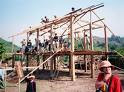
And the picture I liked best was about throwing things! If you throw a dead bird, there are laws etc that make it possible to calculate how far it will travel, but if the bird is alive, there is no way of knowing. The vision was of the creative curriculum as a way to launch live birds into the world, hoping that they will soar , becoming things of beauty rather than plummeting to the ground. Perhaps I’m just a sucker for a good analogy, but this made sense to me!

I can see that thinking creatively and given pupils more responsibility for their learning is desirable – we want children to remember things – what’s more memorable than finding out for yourself, and enjoying the process? I could have downloaded Oscar Stringer’s notes on animation and learned that way, and without the opportunity to experience the workshop, that would have taken me through the necessary steps. However, being there, hearing the instructions first hand whilst watching what to do and then working with a group of people to create and animate our own ideas was so much more memorable.
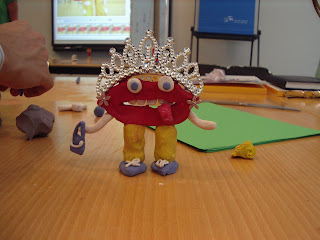
We were allowed to play around with the plasticine (and we did!) without being told off – how often do we give kids something that they’re dying to play with (as a language teacher, I’m thinking of dictionaries), only to tell them that they’ve got to do it our way? Wouldn’t it be better to let the pupils ‘play’ first and discover for themselves with guidance where necessary?

As a Primary Languages teacher, I think I’ve become increasingly creative in my teaching, looking for ways to embed the subject across the curriculum, and I believe that’s one of the reasons why I was asked to present some ideas and evidence for the display. It was good to talk to teachers from other schools about eTwinning, International School Award, Voices of the World, EDL, links with Canada and USA as well as Spanish from 3-11, and to share some ideas that they could use in their schools. And, in the end, it wasn’t too onerous to miss lunch and stand by our display talking to colleagues, because I wholeheartedly believe that being creative is the way to go.

Visit Talkabout Primary MFL

A few months I became a member of Talkabout Primary MFL – and what a good decision that has proved to be!

Set up by Jo Rhys-Jones ‘This is an interactive network for those teaching (or considering teaching) a foreign language in a Primary school; a place to share your worries/successes with supportive colleagues. Please let us know what works (or doesn’t) for you.’

I have contentedly made myself at home on the site, joining in discussions, discovering new resources, making friends and blogging about a number of things including European Day of Languages, the Rugby World Cup and teaching Primary Languages without a voice (my first ever blog post!!) And I will continue to do so.

I’m starting my own blog because I’ve always wanted to have a blog, and also due to the fact that NING is blocked at school. As one of the intentions of doing this is to support my colleagues as they begin to teach Spanish at WCPS, it’s important that they can gain access to the support when they need it.

However, I would thoroughly recommend joining Talkabout Primary MFL as you will discover a supportive network of people with a mixture of experience in relation to PLL , offering and discussing lots of ideas and resources to support and inspire.

So why not click on the badge in the sidebar and find out for yourself!

¡Vámonos!

| Leave a comment

I can delay no longer! After months of thinking about it and finding reasons to delay for a bit, I have finally stopped procrastinating and jumped into the blogosphere! So, may I present to you –

¡Vámonos!

Why Vámonos?

It means Let’s go! in Spanish and that seemed appropriate as I hope to encourage my colleagues (and the wider world!) to join the PLL train (as I heard it described at a CILT meeting earlier this year).
It’s one of my favourite phrases and one of the first I recall learning as a child.
And of course, it’s well known to most pupils courtesy of a certain bilingual young lady who has taught so many children how to count, shout ‘watch out’ and name colours in Spanish. Yes, Dora the Explorer has a lot to answer for – and I for one owe her a debt of gratitude as it means pupils start with at least some idea of what I’m saying!!

So – ‘Come on! ¡ Vámonos! Everybody, let’s go. Come on! Let’s get to it! I know that you can do it!’

¡Vámonos! ©2026. All Rights Reserved.
Powered by WordPress. Theme by Phoenix Web Solutions