primary languages – Page 23 – ¡Vámonos!
 

Category: primary languages


Today I took part in a Primary Language workshop at Plantsbrook School.

My contribution to the day was called You and Youtube and addressed the use of video and slideshows to facilitate and enhance primary language learning. Below is my presentation. If you click on the videos or the titles, they are all hyperlinked to their source. I’ve added a few of the clips I used as well.

[youtube http://www.youtube.com/watch?v=UkQCtzdQFto&hl=en&fs=1&border=1]

Additionally, to address some of the questions posed:

I was asked a few questions about ANIMATION – can I direct you to Oscar Stringer’s wonderful site for guidance ideas and resources – particularly his useful PDF that gives directions on how to animate.

Putting SOUND in POWERPOINT – check out this post from the ubiquitous Joe Dale.

Good places to find RESOURCES – ready made – are Talkabout Primary MFL and TES Staffroom.

All my bookmarks are available to access here – http://delicious.com/lisibo so if you need some ideas on festivals, click on the link, then click on ‘festivals’ on the right hand side and you’ll find all the sites I’ve bookmarked.

Having never been to Stoke on Trent previously, I was there twice in three days! This time I’d been invited to speak at a ‘Creative Spanish’ afternoon for Primary Language teachers, organised jointly by Lorna Harvey from Staffordshire and Helen Thomas from Stoke on Trent. I really enjoyed the presentation on using Art by Shirley Kliment-Temple and was sorry to miss the salsa and skipping!

My presentation was a repeat of the one I did at the Primary Language Show in Liverpool about the QCA unit based on SaintSaens Carnival of the Animals, and I have posted the slidecast from that event below so that you can listen and watch the slides! If yu want any of the resources, they are in this post.

If you have any questions, please feel free to contact me.

PhotobucketI had the pleasure of delivering the Next steps in ICT for the Primary Language Classroom at University of Cumbria in Lancaster on Tuesday. I had delivered the same in Cambridge last month, and whilst the presentations were identical, the days were quite different with the delegates taking a greater lead this time in guiding where we went. That always keeps you on your toes!

Below are my presentations from the day – you can also find these on the event wiki which was set up for us to ‘play around’.

Thank you to my 6 ‘victims’ as I referred to them on Twitter; to my Tweetmates who responded to my request to say hello; and to CILT for giving me this opportunity to share my enthusiasm for ICT and Primary Languages with others.


Friday was a busy day, starting off in London with an animation course run by Oscar Stringer at Institute of Education.

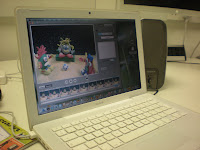
Working in two groups, we spent the day developing our animation skills, producing two short animations from initial idea to finished film complete with transitions, titles, sound and music. We used ICanAnimate to capture the animation then exported the film to iMovie to ‘finish’ it. My group used my Macbook and a Hue webcam – and it was lovely to meet the man behind Hue in the UK during the day as well (mine’s on order from Amazon – went for the blue one in the end!) whilst the other group used an iMac and a driverless webcam.

James, Carolyn and I took our inspiration from the Mr Men. Firstly, our models followed the principles of Mr Men (which are also important principles for plasticine animation – big features, bold shapes and simple designs) and secondly, we made an animation with a message – suitable for PSHE and based on friendship in the playground – a lonely girl on a bench wanting to join in with a game of ball.

The day reinforced all that I already knew about animating – the importance of keeping things simple, of planning well before you start, of working in collaboration and of how much fun it is!
We laughed so much making the animations – my group’s is posted below. This is the English version. We recorded three different ending – with the bench saying THE END in English, French and Spanish – so that we can use it in our classrooms and dub it in different languages.

If you want to find out more about animating, I can’t recommend Oscar’s courses enough. He has a real gift for making it all seem very simple (and it is) and conveys the great potential that animation has as a tool for creativity, collaboration, innovation and progression. Check out his website and his blog to find out more.

Amazing what you can do with a carpet tile, some plasticine and an idea!

Photobucket
Language teacher? Fancy finding meeting up with other language teachers for an hour or so without leaving your own home? Why not join in the Bank Holiday MFL Flashmeeting at 9pm GMT tomorrow (Monday). All you need to join in is a computer with speakers although a microphone and a webcam will allow you to get more involved.

The brainchild of Joe Dale, you can read all about it on his blog here including instructions on how to join in by signing the wiki, and how to make sure you’re prepared.

The suggested agenda is –

  • what is your favourite technology at the moment and how is it enhancing language learning?
  • the Rose Review and the proposals that technology be at the core of the primary curriculum
  • the value of creating your personal learning network and does the microblogging tool have a place in the classroom?
  • Web 2.0 CPD opportunities for next academic year – anyone like to organise a conference for language teachers interested in using ICT?

NB – the wiki is looking very full so if you find you can’t get in, please don’t despair. Master of technology Mr Dale will make sure that you can see the replay as soon as the meeting is over and will no doubt blog it too – unless I get there first ;o)

Photobucket
On Tuesday I made my way to Cambridge for the second time in four days to deliver a day’s training on behalf of CILT at Anglia Ruskin University.

The course was entitled NEXT STEPS IN ICT FOR THE PRIMARY LANGUAGE CLASSROOM and promised to address collaborative working, whole class ICT, digital voicerecording and assessment amongst other things.

I had a lovely day with the delegates and hope that they all went away with one or to things to try out in their classrooms – there was great enthusiasm for wikis and Voki, and TTS should expect a few orders for their sound recording products in the near future – especially as I need a new Easispeak as I seem to have left mine behind :O(

I made a wiki for the event on which I’ve put all my presentations and also as a place for the delegates to ‘play around’ with using wikis. I did record the sessions – mostly!- but in the afternoon we went off at a tangent and the audio won’t fit my presentations so i won’t be making slidecasts of everything. However, I have put the presentations below as they are full of hyperlinks to useful resources.

Hope you find it useful!

And if you want to go on the course, it is repeated in Lancaster on 19th May. Contact CILT for more details!

NB the first slideshow actually starts on slide 18 as slide 22 was triggered to the first 20 slides as examples!


Received an e-mail from CILT today with the latest copy of the Primary Languages e-Zine.

This online magazine contains news of QCA units, CILT publications and more, and also takes a topic for consideration.

The focus for this edition is STORYTELLING with ideas of how to get started, how to move on and how it fits into the Primary Curriculum and some ideas for resources as CILT staff choose their favourite books.

There’s also a section called ‘What you’re doing‘ which contains reports on how various people have used storytelling in the Primary language classroom – including Handa’s Surprise, Jules Verne and Go away Big Green Monster – written by someone you might know ;o) – as well as ideas for where to obtain *free* resources for storytelling and what research says about the use of stories.

Well worth a read!

When I met up with Oscar Stringer at the Primary Languages Show in Liverpool, he told me about his recent experience of using Fuzzy Felts when animating with younger pupils, so I was really excited to see some of the work he did last week on his blog.

In Animation with Reception (Early Years), Oscar shares how he used the farmyard Fuzzy Felts with small groups of pupils for 20 or so minutes, making up simple stories involving the animals and the farmer, taking the required shots before using iMovie to create the finished product with sound.

Several things excited me about this!

Firstly, it’s so simple – no models to make- just take the pieces out of the box and off you go!
Secondly, it worked with young pupils – I made plasticine monster models with Yr2 but wasn’t brave enough to animate them – yet!
And possibly the most exciting thing for me as Oscar told me, and I can see the evidence in the clip, is that it makes for very simple stories of the kind that are so useful in language learning.

Do cows eat apples? No!
Do ducks eat apples? No!
Do dogs eat apples? NO!
Do horses eat apples? YES!

¿Eres mi mamá? ( the chick asks the cow.) ¡No! etc

Une vache habite un étang? Non!
Une poule habite un étang? Non!
Le fermier habite un étang? Non!

And anyone could make up such a story, young or old, using simple language to create their own version.

So pop by Oscar’s blog and see if it inspires you too!

I’m off to ELC to get myself some fuzzy felts – the house set is on offer as are ballerinas and pirates!


I was lucky enough to be asked to present this year at Language World, the annual conference of the Association for Language Learning (ALL), which took place at University of Leicester on 3rd and 4th April.

My presentation was entitled Absorbing Language Learning and offered ideas to engage enthuse and stimulate language learners, particularly focusing on the Primary Language Learning context although the ideas are all transferable.

I was really glad to be on the programme near the beginning of the conference as I was then able to relax and enjoy the rest of it. And I was also really chuffed that my session was so full – we only just had enough chairs!

As promised, here is the presentation with links to all the resources. The battery on my iRiver sadly gave up midway through the session, but the lovely Joe Dale had given the equally lovely Alex Blagona an iRiver to record me too so I will shortly add the audio to the Slideshare and then you’ll be able to hear me too!

Links to sites and resources can also be found in my delicious bookmarks under lw09

photos – http://www.?ickr.com/photos/emerging/

¡Vámonos! ©2026. All Rights Reserved.
Powered by WordPress. Theme by Phoenix Web Solutions