languages – Page 24 – ¡Vámonos!
 

Category: languages


Photo by zen
Attribution-NonCommercial-ShareAlike License

Posts have been a bit sparse recently as the frantic end of term rush took over! Sports days, Year 6 leaving plays, Performance Management meetings and generally tying up loose ends got in the way of blogging. However, the holidays are here, and I’m hoping to make up for my failings over the next few weeks.

I noticed a couple of articles last week about schools in the news – Halesowen school wins award for languages and Loving languages on which I wanted to comment.

The first report is congratulating Earls High School in Halesowen (not too far from here!) on winning a European Award for Languages for their project , Project Croissant where older pupils from the High School mentor younger (primary) children through a weekly afterschool club.


I think this is a brilliant way of making links between local schools and of raising the profile of languages. I also think it’s great that the older pupils are given responsibility for activities etc and, through the project, are gaining life skills. And the activities are very appealing too! Now onder they won an award!

The second article also highlights links between phases, this time in Portishead in Somerset. Pupils at Gordano School visited St Joseph’s Primary School and taught them songs in french, Spanish and German as part of a project called Raise the Roof with Languages. Again, an activity that shows how older pupils can ‘teach’ younger pupils, making links and promoting languages. And the older pupils volunteered to help!

This kind of project is a brilliant model for encouraging language learning – not just for primary but for secondary. It’s really important to make and maintain links between phases, particularly as the Primary Languages Framework increasingly impacts on Key Stage 3 and 4.

So well done Earls High and Gordano Schools!


Whilst checking my Google alerts for MFL a couple of weeks ago, I noticed a news article about Young Enterprise in the NorthEast. And as I read, I was excited to see that I knew the school whose virtues were being extolled.

Lesley Welsh, AST and SSAT LP, is the Madame Welsh referred to in the article, and it is pupils at her school, English Martyrs Schol and Sixth form College in Hartlepool, who have won not only Company of the Year but also Most Creative Company of the Year in the awards sponsored by the Arts Council North East to reward an innovative and creative way of running business.

Here the group from English Martyrs explain –

Our company, LanguAges, provides educational resources to aid the teaching and learning of French in primary schools at Key Stage 2. We have created a compilation of three different games, The Clothes Game, The Class Card Game and The Shopping Game, and an Interactive CD, which form the LanguAges Pack.

All of our games are tailored to be fun, yet educational, comprehensively covering the Key Stage 2 curriculum, and helping to improve vital comprehension and speaking skills.

The initial idea around which our product is based sprung from a discussion with our business adviser in which we discovered that, as of next year, it will become compulsory for all primary schools to teach a modern foreign language at Key Stage 2. This meant that there would definitely be a market for teaching and learning tools.

We then sold more than £100 worth of shares in our company to get us up and running, which allowed us to design and develop our own prototype games. We tested these in several classes across Key Stages 2 and 3, and realised the LanguAges Pack was bound to be a great success.

Indeed the team has gone from strength to strength, selling several packs, and scooping up the ‘Best Sales and Marketing’ award at the MetroCentre Trade Fair, then going on to gain an order for 12 packs from Stockton Schools and ultimately securing a contract for 34 packs via the Hartlepool Local Authority.

This means that at the start of the next academic year, every Primary School in Hartlepool will have a full LanguAges pack – a true achievement for any company!

Furthermore, we have impressed pupils, parents and teachers alike. In fact the representative from the Hartlepool local authority, Tom Argument, said about us: “Their materials are creative, fun, very practical, and of a high quality. The group present themselves in a business-like manner and have real entrepreneurial potential.”

Our sales revenue is nearly £2,000 which has generated a healthy profit. Shareholders will receive at least a 100% return on their investment, and LanguAges will make a donation to charity from the net profit. However, we, as the directors, will be receiving a well-earned director’s bonus!

Young Enterprise has opened our eyes to the world of business. We learnt about the different departments of a company and the importance of each. Since our product was very time consuming and labour intensive it was essential that we learnt time and resource management. This was the first time many of us worked in a large group, therefore this experience enabled us to gain valuable team working skills. We learnt that communication and problem solving are two of the most vital components for the success of a business.

Of the many highs involved in the running of LanguAges, the development of our sense of team camaraderie has certainly been one of the most enjoyable. The shared responsibilities and experiences have led to solid professional relationships and firm friendships. These particularly flourished during the creative process of developing our product, which we all found both testing and fascinating.

Of course, one of the biggest thrills of business is the pursuit and accomplishment of sales, and this we enjoyed thoroughly with some of the team finding their niche in enthusiastic and mostly successful sales pitches. However, the extensive manual labour involved in the production of our product has at times been difficult to manage, but with close and effective teamwork, this challenge has been overcome.

Our hard work and determination has been recognised with a number of awards. As well as winning ‘Best Sales and Marketing’ at the MetroCentre Trade Fair, we also won Best Company Report at the Tees Valley Area Finals.

We have furthermore very recently forged strong links with an international company, who are acting as business advisers and supporters after appreciating LanguAges’ potential as a viable commercial product at the Area Finals. Working with them has been hugely beneficial and we look forward to the possibilities that this connection will lead to.

We realise that LanguAges has a huge amount of potential, and are currently investigating the many options available to us. Several possibilities are being considered, such as selling the idea, or even continuing the company even after the Young Enterprise Company Programme is over.

The prospect of mass producing the LanguAges Pack and even expanding the range to include a variety of other modern foreign languages is a very exciting one. We also appreciate that there is much scope to produce games, not only for younger or older students, but even for companies who wish to train their staff. After all, you have to think big to be big!

Needless to say, as a company, we have shown creative flair, dedication, and determination to reach the top. We have all greatly enjoyed the valuable experience that is the Young Enterprise Company Programme, and have learnt so much throughout the process. The experience and skills acquired will be invaluable to us in the future, whichever careers we choose to pursue.

So, congratulations to Faye Greason, Gayatri Sivakumar, Sreenag Krishnamoorthy, Jennifer Laws, Joseph Harrison, Charanya Ravi, Stuart Christie, Katie Wheelhouse, Francesca Tosson and Mariusz Cichomski, and of course to Madame Welsh and Linda Ward.

What a great idea – no wonder they won awards by the bucket load! And I will be very interested to follow the progress of the group -hopefully thye will expand the project to other languages and market it outside of the North East. As they say – every school in England could potentially use the product!!


Having been told not to say anything for a bit, when I was given the all clear to blog about the IoW Conference, I’ve been a bit slow off the mark! But…más vale tarde que nunca as dear Nando would say!

October 25th and 26th 2008 will see many teachers from across the UK (and beyond?) gathering at Nodehill Middle School in Newport, Isle of Wight for Joe Dale’s annual IOW Conference. As usual, the focus is on creative language teaching using ICT, and it promises to be a great weekend. This year, there’s so much going on that it has been extended to two days with a Show and Tell event on the Saturday night so that everyone can share, not just those who are presenting.

And speaking of presenters – look at the line up!

  • Sharon Tonner – ICT specialist, ex- High School of Dundee, now working for a Scottish Uni!
  • Jo Rhys-Jones – AST in MFL, Kingswear Primary School
  • Lisa Stevens – Spanish Teacher and eTwinning ambassador, Whitehouse Common Primary School,
  • Carole Nicoll – Language Factory
  • Drew Buddie – ICT coordinator, Royal Masonic School for Girls and eTwinning ambassador
  • Nick Mair – HoD in MFL, Dulwich College
  • John Warwick – Deputy Head, St Luke’s School and eTwinning ambassador
  • Kathleen Holton – HoD in MFL, Argoed High School
  • Mark Pentleton – Radio Lingua Network
  • Lesley Welsh – AST in MFL, English Martyrs School and Sixth Form College and SSAT languages lead practitioner coordinator
  • Chris Fuller – Spanish teacher, Edgehill College and SSAT languages lead practitioner
  • Sharon Balch – French teacher, Swanmore Middle School
  • Doug Dickinson – Independent ICT consultant
  • Kathy Wicksteed – Languages advisor for new KS3 curriculum
  • Adam Sutcliffe – MFL teacher, The Gordon Schools and Glow Champion
  • Lesley Haggar-Vaughan, Shireland CLC manager
  • Julie Adoch, HoD in MFL, Heathfield Foundation Technology College and her students

They will be tackling topics including-

  • Mobile Phones
  • Wikis
  • Primary Languages
  • Ning networking
  • Songs
  • Virtual Learning Environments
  • Digital Storytelling
  • Games based learning
  • Gender differences
  • Videoconferencing
  • eTwinning
  • Digital Voice Recorders
  • One Stop Animation
  • PowerPoint
  • Interactive Whiteboards and Voting Systems
  • Blogging and Podcasting
  • Assessment for Learning
  • New KS3 curriculum
  • Web 2.0 tools
  • vodcasting
  • eCreativity

Having had the privilege of speaking last year on Primary Languages and eTwinning, I’ve been asked again – must have done something right ;o) – and this year I’ll be co-presenting with Jo Rhys-Jones. It promises to be a highly entertaining session as we always end up in fits of giggles when we meet up, and I’m sure plenty of that fun will be manifest in the session.

So, watch out for the delegates pack that Joe will soon be launching, and take the opportunity as term nears a close (in England – I know Scotland has already broken up) to put in your PD request whilst there’s still money in the budget, and while everyone else is just hanging out for the holidays!!

Check out Joe’s blog for more information and for reports on last year too here and here. See also here, here, here and here. And not forgetting here! And for my response, read Trains Ferries Buses and Ford Anglias. (note to self – go via Southampton not Lymington this year!)

The Language and Film Talent Awards (LAFTAs) is a competition for 13-21 year olds, run by CILT, the National Centre for Languages. Over the course of the competition, CILT asked young people to send in two-minute videos showing why languages are important.

CILT received over 160 entries from all across the UK, showing why we need languages: from being lost in a foreign country, to meeting the love of your life, to being attacked by sharks, cannibals or dragons…

The deadline for this year’s competition has now passed, but you still have the chance to get involved by joining in the ‘People’s Vote’, hosted by Multilingualvacancies.com. Vote on your favourite clips from the CILT shortlist and see how your favourites compare with the views of our celebrity judging panel, including Sir Trevor McDonald and comedian Eddie Izzard.

The winner of the ‘People’s Vote’ will receive a special prize sponsored by Multilingualvacancies.com at the LAFTAs awards ceremony, taking place in London in September 2008.

I’ve just popped over to the website to have a look at the 25 films that the celebrity panel shortlisted (that’s a short list!??) and cast my vote.
They include a HappyStreet disco (very familiar looking???), Barbie and Ken, some Geordie wide boys, a stuck lift, a spoof Mastercard advert and a Prime Minister showing his languages skills or lack of.

A couple of my favourites are below – the first, a rap, is very amusing although not sure it completely fits the brief.

Then there’s this one about False Friends. How many mistakes like this have I made! Not as good as the one someone on my degree course made on her year abroad when there were cockroaches in her kitchen , but that’s another story…

And finally, a couple of examples of animation using plasticine (as it’s my current preoccupation!)

So pop along to register your votes!


On Monday, Comenius West Midlands held its Primary Languages Conference at the Novotel in Wolverhampton. Sandwiched between keynotes by Joe Brown from CILT that involved song rhyme and lots of action, and Steven Fawkes from ALL who thrilled us with his ‘Banane‘, delegates had to choose sessions from a range including :

  • It’s magic!
  • International Perspective
  • Let’s play – Language games and activities for the playground.
  • Numeracy through Languages
  • Animation
  • Italian for the Primary classroom – a cross curricular approach.
  • Music and songs in the Primary classroom
  • Animation in the languages classroom (double session)
  • Creative use of ICT

A tricky choice for many, judging from the feedback at the end of the day! I for one will be emailing presenters for notes from their sessions as I was presenting and missed out on all of the sessions!

Actually, I didn’t completely miss out as I was able to attend the plenaries and also began the day by acting as ‘roadie’ for Oscar Stringer as he presented a whistle stop double session on animation from idea through planning, modelling, filming, adding finishing touches and publishing. Phew! In a very short time (less that two hours), the participants made short films in French and Spanish which can be viewed below and on his NING network. Just shows what you can do in a short time with good instruction, imagination and a bit of plasticine. ;o)

Find more videos like this on Animation For Education

Definitely inspired me! So much so that, after a quick chat with Oscar, I decided to have a go with my Year 4 class this week. More of that in a later post!

My session was entitled Creative use of ICT and centred on the use of some tools that i thnk are useful to enhance and enable PLL.

The idea had been to introduce delegates to Voki, Voicethread, Audacity and Photostory, explain how I’ve used them in my classroom, and then let delegates have a go at using one of the tools. I’d prepared notes for people that went into everyone’s pack so those who couldn’t attend were able to benefit too, and these pointed to online tutorials for the tools as well as examples from my experience and research. I’d also requested a laptop between two to be provided with a microphone and Internet access, and Audacity and Photostory3 uploaded ready. I’d prepared a Voicethread and Voki account for the day so all outcomes could be saved together for future reference, and I’d also added some examples to get people started.

Best laid plans and all! There were three laptops provided, the speakers didn’t work, and Internet access was at best infuriatingly slow and at worst non-existent (at 20€ per laptop, I hope the orgnisers got a refund!) Anyhow, it left me rather embarrassed as my examples took an age to load (Voki) or didn’t play sound (Voicethread AND Voki at times) – next tie I’ll save them for offline access using Camtasia or similar – and I’ve found that there is a facility on Voicethread now to save for offline access.

However, I did manage to highlight the use of del.icio.us which i hadn’t intended to mention but proved to be one of the most popular ideas with delegates. My account of how I use Audacity led to lots of smiles and there was a general hum of interest as I made a Photostory in three minutes.

I must say was a little disheartened by the first session, especially as I had to repeat it after lunch, but several people came up to me and seemed to be buzzing about something I’d shared, so I went into the repeat feeling a little more confident, especially as I was prepared for the problems this time! The make up of the group was different this time and they asked lots of questions – I think they were the G&T group ;o)

At the end of the afternoon when the evaluations were returned, I was rather surprised, and very pleased as well!- to read several who said things like

“The ICT session was the best bit!’
“Brilliant session on ICT – can you do a whole session on Voicethread and podcasting next time please?”
“the notes were so useful – I’m going to check them out on del.icio.us – and I’m going to tell my staff about it too”

If you want to have the notes, see below. and all the sites / references can be found on my del.icio.us account – http:del.icio.us/lisibo/june22

Creative uses of ICT in the PLL classroom – Get more College Essays

yo soy músico

Here comes part three of my reflections on the units I’m currently using in KS2 Spanish. If you’ve read the other parts on Units 5 and 11, you’ll recall that I’ve taught the units to half of the school and am now teaching the parallel classes until the summer break. So the current groups are probably getting a better deal as I refine and adapt from the first run, but may not finish the unit in its entirety as the end of term leads to much lesson disruption!

As with Units 5 and 11, Unit 14 has an opening stimulus from which the unit stems. In this case, a song. Based on the well known children’s song, I am the Music Man, Yo soy músico has proved popular with Year 5. The QCA Unit which can be downloaded from here in PDF and RTF, gives the lyrics – you just have to sing it! Helen Myers has recorded a music only version – clever lady!- which can be found here, and if you want to hear how it sounds with a class in full voice, check out the WCPS Spanish podcast in the right hand column – although I’m sure you’ve all subscribed to it in iTunes ;o)

At the top of the post is the Powerpoint I made to go with the song. Note that it has two parts. The first half is in the first person singular – Yo soy músico, which is the version used in the first instance when the teacher (or volunteer class member!) is the Music Man. The second part is in the first person plural – Somos músicos – as the class join in with the whole song and we all become Music Men. I used animations having listened to Nick Mair talking in Oxford about boys learning best when there is action and movement in the graphics. There is an initial disadvantage as the class comment on the guitar playing pig etc mid-song, but after the first view, this stops and it really helps memorisation.

Scheme of work for Year5 spanish summer yo soy musico

Looking at the medium term plan above, you can see that the objectives for the first lesson are to express simple opinions about music. This proved popular as we listened to some different types of music and decided if we liked them or not. In a previous unit on free time we had learned the phrase la música pop / rock / clásica and most recalled the phrase – and the accompanying action –

  • la música – hands on ears like you’re listening to music then ..
  • …pop – makes your hands pop from fists to spread fingers whilst making your eyes wide
  • …rock – rock from side to side
  • …clásica – conduct an orchestra
  • …heavy – mosh!! (a clear favourite I must say!)

We added jazz (jazz hands) and folclórica (play a guitar) which took some explaining as few knew what it was! Several pupils commented on the use of cognates – and when one asked what tecno music would be, another piped up that ‘it’d be la música tecno, silly’

I expressed an opinion in Spanish about the music using facial expression then encouraged the class to offer their own opinion in Spanish. Again, the phrase was not unfamiliar but, for some, had to be dragged from memory banks!

We then sang the song which soon involved the whole class. The first couple of times, everyone sang all the instruments to learn and fix the words – and of course we did actions for those who are kinaesthetic learners (and to keep everyone awake!). Having looked at pronunciation of the words we had a quick look at accents – why do música / saxofón / batería have accents – I explained it using people’s names – when we see a name in English we know (usually!) how to say it as there are stress patterns – it’s AlexANder not AlEXander and accents help show us how to say words. Pupils completed a simple sheet to finish the lesson – labelling and also trying to use their LLS to work out what six instruments were in English. Some of the words were obvious and others needed a bit of thought – but a few did work out los platillos are cymbals by thinking of plates!

instruments lesson 1 – Get more College Essays

Next lesson began with a recap of vocabulary and game of Simóm dice. Then we sang the song, firstly using Soy músico but with each table alloted the flashcard of a musical instrument to represent. This led to hilarity as the ‘piano’ table worked out that they had to stand up and sit down every verse – as you can guess I chose this table carefully!! We looked at the words of the opening to the song and used Sé tocar… and then Toco ….. to say which instruments we could and couldn’t play – an ‘on the ball’ pupil suggested ‘toco regular el piano’ and ‘no toco la guitarra muy bien’ as answers – not bad eh? It’s really encouraging when pupils ‘play around’ with language because they’re trying to express themselves more accurately.
We then looked at the second half – Somos músicos, venimos de Madrid etc’ and discussed how this might differ in meaning from the first half.

We went on to recap our opinions about music genres and this time tried to add some simple reasons for the opinion – because it’s slow, because it’s boring, because it has rhythm etc. Pupils made up sentences in groups adding all the bits from the two lessons to see how long a sentence they could make using connectives such as ‘y’ and ‘porque’.

types of music flashcards

At the start of the next lesson we recapped our opinions and started to present them in written form on graffiti wall posters – the word ‘graffiti’ made eyes sparkle although it was somewhat controlled graffiti! Whilst the class worked on this, I worked in the corner with my laptop and and microphone to record members of the class expressing their opinions about music – this was the start of WCPS Spanish podcast. The look of wonder on pupils’ faces when they heard their voice comin gout of my laptop and then the IWB was great – one lad, Zach, commented ‘But I sound really Spanish!’. (Pictures of posters to follow!)

Next we listened to some Spanish music and Latin American music, comparing and contrasting the instruments heard. I borrowed a CD from the library that had a vast array of South American music types on it, and I took in some of my own music – Tomatito, Heroes del Silencio, Joan Manuel Serrat, Los Nikis, Gloria Estefan, Alejandro Sanz, Operación Triunfo. We listened and decided which instruments we heard, and gave opinions on the singers / groups.
Then I role played buying a CD – using a ActivPrimary flipchart (in Box of Goodies as can’t upload to .DocStoc). In pairs with one as customer and one as assistant, the customer had to

  • say they wanted to buy a CD
  • express their opinion about a type of music and say which type they prefer
  • agree to buy an item., and we recorded some examples (see podcast!)

The roles were swapped so that everyone got to play each character. We recorded some examples for the WCPS Spanish podcast as well. This time I’m going to add discussing buying an MP3 file to this bit ;o)

Having looked at accents and stress patterns as well as considering types of music, looking at the rhythm, especially the rhythm of words made perfect sense and we spent a good while clapping out phrases and trying to copy rhythms in the next session. At times it was rather haphazard, freestyle clapping but there were signs of promise from some who managed to copy accurately and understood the use of dynamics to mark stress. ‘Guess the phrase from the rhythm’ was a popular game – it’s amazing how much concentration it takes to clap a simple phrase!

The last few sessions were given over to Year 5 producing their own rap/song in Spanish. I allowed them free rein over this with the proviso that it had to be in Spanish (obvious to me but you’d be surprised!) As a whole class we discussed how the task might be tackled and we came up with a start for those who couldn’t think of a way in, then it was up to the groups to do their bit!
There were several things to note from these lessons for next time.

  1. Some groups needed more support than they were given – perhaps more time working together as a whole class before setting groups off on their own.
  2. Groupings are key, and all the ‘musical’ kids ended up in two groups – they would’ve been better perhaps split up to help those whose rhythm was a bit off!
  3. When recording pupils’ final productions, don’t put your iRiver anywhere near the drums! Sadly, a couple of good outcomes are drowned out by the percussion.

I’ll upload those that will not damage eardrums to the podcast and/or Box of Goodies as soon as this post is finished ;o)
There were a couple of groups that tried to sing their performances to tunes from The Sound of Music – good idea, I thought. Some stuck to opinions on music, others tried to work in vocabulary from other units such as Personal introduction vocabulary and sporting likes and dislikes.

The other Year 5 class are very different to the first group and I expect this half term to pan out differently to the previous one. I think this time we’ll look at the pre-performance interview suggested in the QCA Unit and perhaps try to adapt a song rather than write rap. I’ll keep you informed!

NOTE – if you’d like ideas on this Unit in french, check out Talkabout Primary MFL where Jo Rhys Jones has spookily just blogged about the same unit!


I had the privilege to speak at Tile Hill Wood School and Language College on Thursday evening. I was really pleased to be asked by Ana Neofitou, Head of Languages, who I’ve met a couple of times at Language World and other more local conferences, and Jo Redford who is Assistant Head and who I met in Oxford this year when she introduced The ALL London Show and Tell session in which I participated.

My session was the last of three sessions for Primary teachers in teaching and learning Primary Languages. Previously the group of about 40 teachers had been working in language specific groups and focusing on vocabulary for topics such as sport and animals. My session, entitled Top tips for Primary Languages, aimed to give them an insight into how to deliver PL in an engaging way, making use of free resources and easily acquired skills. I enjoyed expanding on my presentation from Oxford (you can see and listen to it in this slidecast) which I delivered there in 10 minutes – just over an hour was still too short, but I was happier! I just get so excited that I could talk for hours!

Below is the presentation, and also the notes I made for delegates so that there wasn’t too much mad scribbling as I gabbled away! Even as a standalone document, I think you can see what I’m trying to say!

Top tips for Primary Languages


Here’s the second of four posts on the Spanish QCA units I’m using with KS2 this term. The first, QCA Unit 5, Los Cuatro amigos seemed to be popular so I hope you find this one helpful too.

First thing to say is that I really enjoyed teaching this unit – and the class seemed to be equally enthused. The combination of music, literacy and Spanish proved popular, and this half term the cross curricular element is extended as habitats is a topic in Science. And I was really pleased with the outcomes of the unit.

You can download the Unit in PDF or RTF from the QCA website.
Below is my medium term plans – being adapted as I go along and discover what does and doesn’t work.

Medium term planning QCA Unit11 El Carnaval del os Animales


Unit 11 is based around and inspired by the Saint Saens piece,
Le carnaval des animaux, and the opening lesson was heavily reliant on music. I borrowed the CD of The carnival of the animals from the library, but then found a great website that provided snippets for each animal theme. The site being in Spanish with short comments on the music makes it a possible resource for more experienced linguists to use in the discussion of music in Spanish rather than the English we used for ours. And it’s a gift for the teacher who can point the pupils in the right direction if they’re struggling.

We began by looking at the title of the Unit. I asked pupils to suggest what they might be learning in this topic, encouraging them to explain their ideas e.g. it’s something about animals I think – the last word looks like animals; ‘carnaval’ looks like carnival etc. None of the class made the association with the piece of music as none had heard of it. Having established the title, I asked them to suggest what sorts of things they might learn – they’re good at this as AfL is a focus this year at WCPS. Lots of suggestions hit the mark and others would’ve been good avenues for exploration given more time.
Then we listened to snippets of th
e music, in order, and I asked for suggestions as to the animal it represented. As I’ve already mentioned, this was done in English and was much more successful than I had thought it might be. As my lesson allocation for the class covered their music lesson too, we were able to spend more time on Spanish by combining the two lessons. The music topic was based on rhythm and this fitted well. The pupils love contemporary music but it was good to see and hear them discussing a classical piece and passing positive comment. The suggestions of animals were sometimes accurate but some were off mark and this was probably due to not being given an idea of the animals we might be considering, so this half term when I did the same lesson with the other class, I began the same but introduced the vocabulary in Spanish prior to playing the music. This allowed more accurate identification of animals and moved us onto discussion of how the animal was represented / suggested by the music much more immediately. I introduced the animals using the PPT below, accompanied by actions e.g un león was two hands like paws ready to pounce; un gallo, one hand on top of head, one under chin with wiggling fingers like the comb and crop; un elefante with your arm as a trunk etc. Using images and actions we played Beat the teacher, ¿Dónde está …? Simon dice, name the animal from the action and viceversa, to reinforce the vocabulary.

El Carnaval de los animales

The second lesson began with a video of Los pollitos dicen..,I’d downloaded it from Youtube which was fortunate as Youtube is now blocked at school.

We watched a number of times and pupils began to join in with the opening lines as they wanted. Having looked at the video, I challenged the pupils once more to think about one of the objectives for the lesson. Several suggestions were made including habitat, food, mummies and babies, and, the correct answer, animal noises.

We recapped the animal vocabulary using actions, images and also rhythm. As we repeated the words, I clapped the rhythm. Pupils echoed the clap back again and we played games around the rhythm of the words. More of that later..

Moving on, we listened to a number of animal noises and asked the pupils to make educated guesses on the animal that made each noise, commenting on similarities and

differences. We made a great cacophony of animal noises, akin to an unruly zoo as we practiced Spanish animal noises – the class were very amused that Spanish animals spoke another language too! With the noises came additional animals, extending beyond the initial stimulus. Below is a consolidation worksheet that we used to round off the section of the lesson as well as the PPT I used.

Los sonidos de los animales

Worksheet lesson 2 Unit 11


After the lunch break, we decided to make an animal symphony using percussion and voice! This met the objectives of the music unit as well as suggested activities in the QCA guidelines for the Spanish unit. Pairs of pupils were given an animal picture and a percussion instrument to create firstly a sound effect for their animal, and then used it to beat the rhythm of the word in Spanish. we took this further by individually presenting our pieces and then joining them together with teacher in the role of conductor bringing in and cueing out animals. The resulting ‘symphony’ was very interesting and you can listen to it here on our podcast WCPS Spanish (sounded better live, I must add!) A very enjoyable activity and an excellent for trying to maintain a steady rhythm and stay in time with others!

The next lesson was based around time and concluded with a class full of hot sweaty children and two children in first aid! Having recapped numbers 1-12 using a soft ball and various games – always a winner when I start chucking things around the room as I am hopeless at hand-eye coordination – I used an ELC clock to model the time for one and two o’clock before several bright sparks took over for three o’clock, half the class for four o’clock and 28/30 by five o’clock. We played time bingo and completed some questions from the IWB (sadly can’t save those in Doc.Stoc so will have to put them in My Box of Goodies)
With o’clock times stuck in our heads and consolidated with a written exercise, I ventured to suggest we could go out onto the playground and play a game. This was a popular idea – although not so popular when the class discovered that there were three other classes outside and they weren’t working, just running around. However, to their credit, they mostly concentrated and several children from other classes came to see what we were doing! We played ¿Qué hora es, Señor Elefante? , a variant on What’s the time Mr Wolf in which the animal changes each time, and the players have to move like the animal named e.g like an elephant for Sr. Elefante, like a swan for Sra. Cisne etc for the number of steps that corresponds to the time. More practice needed on the movement – never seen a tortoise run, nor a fish! However, lots of volunteers to be ‘on’. We also played El Carnaval de los animales, very like fruit salad but with animals instead of fruit. Having given each child the name of one of six animals in Spanish, I called an animal and all those with that name had to move around the outside of the circle back to their space in the manner of their animal. If I called El Carnaval de los Animales, everyone had to move around the circle like their animal. This was the cause of the scrapped knees in first aid I’m afraid :o( but the injured parties weren’t too sad so it was OK (phew!)

Next we looked at adjectives. Pupils had already commented on the colours of the nouns on their wordlist (see initial PPT) and had met colours in a previous unit. Some recalled the need for agreement and noted why there were two versions of most adjectives.
I used Querido Zoo (Dear Zoo) as the stimulus for the lesson – a familiar story to many and again introducing another couple of animals for those who had already grasped the others as well as great for introducing adjectives describing animals, and the word for ‘too’ – demasiado. Having read the book on PPT, pupils made their own conclusions in groups about the meaning of the adjectives before we discussed (and corrected!) ideas together. Having introduced a few more ideas including rápido / lento, fuerte/débil etc, pupils made up some sentences using es and no es to describe animals. This turned into a guessing game with definitions being offered and others trying to guess the animal, and there was also a pleasing clamour to find out more adjectives using a dictionary – cue impromptu lesson in bilingual dictionary skills!

Habitats came into play next – using the suggested habitats from the QCA unit in a IWB flipchart (again, will have to put it into My Goodie Box!) we looked at pictures and guessed the theme of the lesson before placing animal cards into the appropriate habitat, making statements about where the animals lived. We used the first person, pretending that we were the animal preparing for the written part of the lesson when pupils took the role of an animal to be interviewed. We reviewed personal identification questions and modelled a couple of examples on the IWB before pupils went away to produce their own introductions.

4AT had heard that 5MW had been recording and they wanted in on the act. So we set up our recording studio in a corner and several pupils came to record their work for WCPS Spanish, our podcast. It was great to see all abilities represented in the volunteers, including all SEN pupils, and there were some who were reluctant to go to lunch as they hadn’t had a chance to record. In fact, we even moved the studio to the library during their librar

y session to allow more participation. Great to see them so motivated.

I actually had an extra lesson with the class and decided to continue on the animal theme! We looked at the Build my WildSelf site and discussed the different animals and body parts included (this recapped vocabulary learned in year 3) Having designed their own Wild Self (a very amusing task attacked with great gusto), pupils designed their own hybrid animals on paper and wrote simple sentences about them such as;
Tiene la cabeza de un elefante.
Tiene el cuerpo de un pez.
Tiene la cola de un lagarto.
Tiene las piernas de una jirafa.

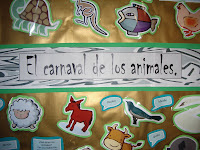
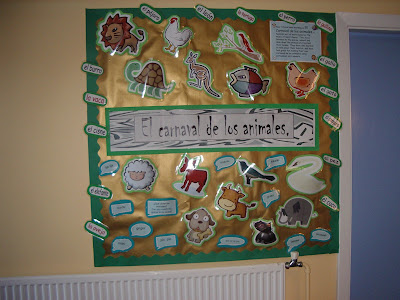
I made a display as part of the Unit too, well received by all of KS2 including the staff who liked its vibrant images and interactive quality – all the stuff to make it below! Just laminate! You can see more of the display here .


display

Since completing the Unit, I’ve discovered the following resources

Again, hope you found this useful.
Next I’ll report on Unit 14 Yo soy músico – that was a goody too :o)

Having missed a few tasks, I’m really pleased that the Whitehouse Common Primary have contributed to this month’s task for Voices of the World.

The May task is the last one for this academic year and is based around saying Goodbye.

Firstly, we recorded a goodbye greeting in Spanish using Voki– AC_Voki_Embed(300,400, ‘6378d6a5e17b42acb60fc7bd78074a50’, 471963, 1, ”, 0);

Get a Voki now!

Then we went around the school taking snapshots to show the other participants what our school is like. We uploaded them to Photostory3 to make a slideshow.

Finally, 4AT listened to and watched all the Voki produced by the other participants and, using the microphone on my laptop (still having issues with microphones at school), recorded the various greetings. And what a great job they did!

Once we’d added a funky soundtrack, the presentation was completed and uploaded to Teachertube for all to see!

Here it is – hope you enjoy it!

After I posted Joe’s quiz yesterday, I had an exchange of comments with Langwitch about how tricky it is was to name all the bloggers from their photos with so many people using avatars.

My obsession with widgets and avatars is well known (and well documented on this blog) but less is known about my love of quizzes and very competitive streak!

So, combining the two, here’s my version. Let’s see how ‘Joe’s best class‘ as José put it yesterday in a comment on Joe’s post, you get on with this.

(apologies to those who I’ve missed – any more avatars to declare?)

¡Vámonos! ©2026. All Rights Reserved.
Powered by WordPress. Theme by Phoenix Web Solutions